
Standing water right now? Mitigation is the clock, not the paperwork. Call (214) 286-6943 — 24/7 in Fort Lauderdale & Broward County.
Water Mitigation in Fort Lauderdale — Stop the Damage Before It Spreads
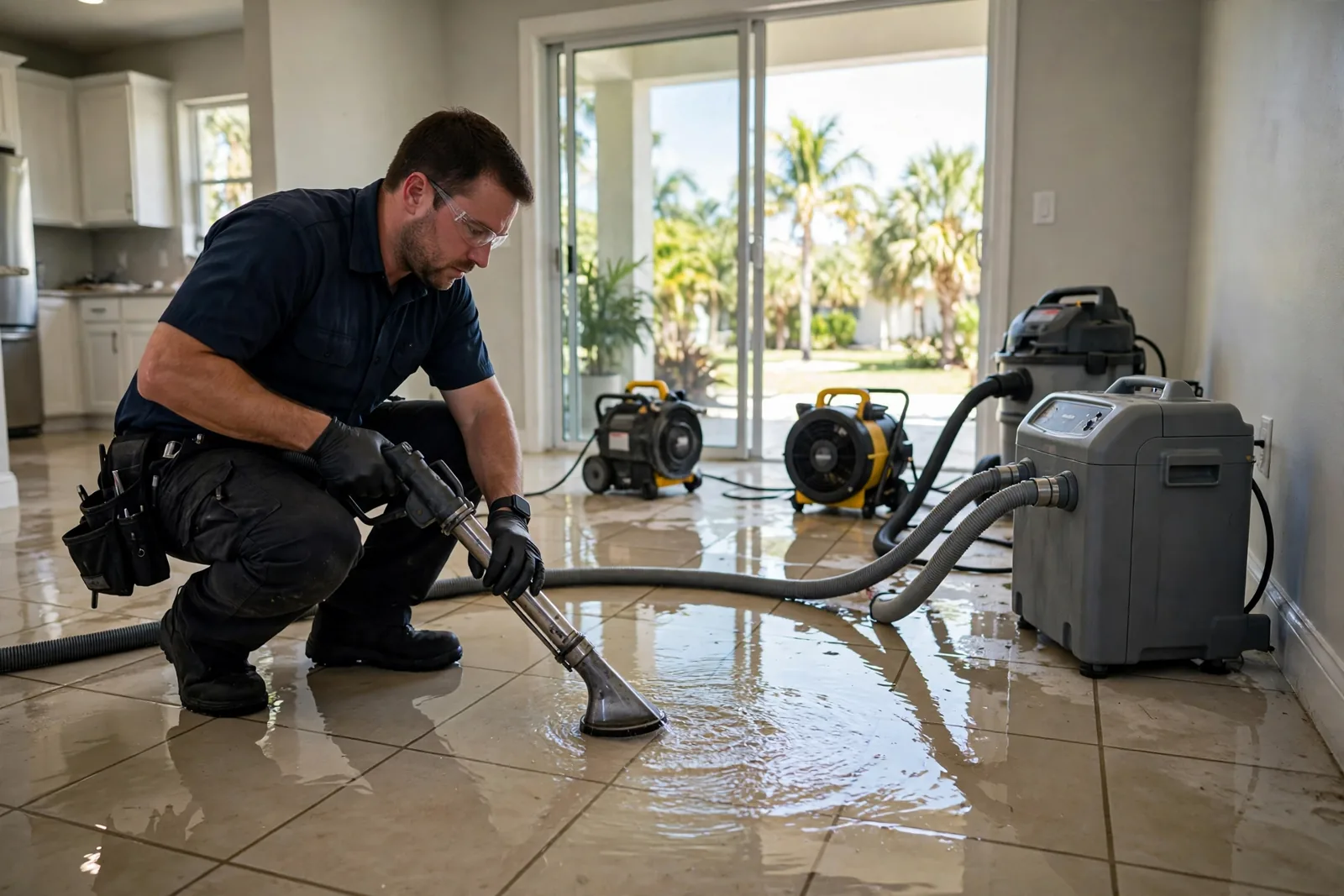
Water mitigation is the first, urgent work that stops water damage from getting worse: stopping the source, extracting standing water, removing materials that cannot be dried, and drying what remains to a measured target. In Fort Lauderdale that race is shorter than almost anywhere else in Florida. Our average elevation is about 9 feet, drainage is slow, humidity is high year-round, and mold can begin within 24 to 48 hours of water exposure. Mitigation done in the first day is usually a drying job. Mitigation delayed by a week is usually a mold remediation and reconstruction job — at several times the cost.
We are a Fort Lauderdale service-area team: IICRC-informed technicians, licensed & insured, 24/7 emergency response, and a written plan before we start. No walk-in office, no verbal estimate that changes later — we come to you, document everything with photos and moisture logs, and talk straight about what insurance usually covers and what it usually does not.
Water Mitigation in Fort Lauderdale at a Glance
- First goal: Stop the spread, not finish the repair — mitigation saves the structure, restoration and reconstruction rebuild it
- Clock: Mold risk starts in 24–48 hours; extraction should start the same day
- Measured, not guessed: Moisture meters + infrared imaging map how far water travelled
- Standard: Work follows the IICRC S500 approach — Category (how contaminated) + Class (how much, how hard to dry)
- Cost guide (site-published): Mitigation about $3–$4.25/sq ft (Category 1), $4–$6.50/sq ft (Category 2), $7–$12/sq ft (Category 3)
- Documentation: Photo + moisture log at every stage, formatted for your insurance adjuster
What Is Water Mitigation, and How Is It Different From Water Damage Restoration?
Water mitigation is the emergency phase: stop the source, extract the water, protect what can be saved, and dry the structure to a verified moisture target. Water damage restoration is the wider job that follows — cleaning, treatment, and returning the property to use. Reconstruction is the rebuild phase after that: drywall, flooring, cabinets and finishes.
Confusing the three is expensive. A company that jumps straight to repairs over wet materials is rebuilding over a mold problem. A company that only extracts and leaves — without measured drying and documentation — leaves you with hidden moisture and an insurance file with no evidence in it.
Mitigation vs Restoration vs Reconstruction — Comparison
| Phase | What it does | When it happens | Typical work |
|---|---|---|---|
| Mitigation | Stops damage spreading and stabilises the property | First hours to first days | Source stop, extraction, selective removal, structural drying, antimicrobial treatment, documentation |
| Restoration | Cleans, treats and returns affected areas to safe use | After drying targets are met | Cleaning, odor control, contents care, minor repairs |
| Reconstruction | Rebuilds what had to be removed | After restoration | Drywall, flooring, trim, cabinets, paint — typically $20–$37/sq ft on this site’s published guide |
Why Does Water Mitigation Have to Start So Fast in Fort Lauderdale?
Because three local facts stack against you:
- Elevation and drainage: At roughly 9 feet above sea level, stormwater and groundwater drain slowly. Water that enters a ground-floor home in Edgewood, River Oaks or Melrose Park sits longer than it would inland.
- Humidity: South Florida humidity slows natural drying to almost nothing. A wet wall cavity here does not “air out” — it stays wet.
- The housing stock: Many Fort Lauderdale homes were built decades ago, with older supply lines, cast iron sewer pipes, slab plumbing and AC condensate lines that fail quietly. Slow leaks are the most common mitigation call we describe — and the most underestimated.
The April 12–13, 2023 storm, which dropped more than 2 feet of rain in under 24 hours, is the extreme version of the same problem. The everyday version is a pinhole leak behind a wall in Victoria Park that runs for three weeks before the musty smell gives it away.
What Does a Water Mitigation Company Actually Do on the First Visit?
On the first visit we do five things, in this order:
- Safety and source: Confirm the water source is stopped and the area is electrically safe. If it is a burst supply line, the main shut-off comes before any equipment.
- Category and Class ID: Identify whether the water is Category 1 (clean), Category 2 (gray) or Category 3 (black — sewage, storm surge, floodwater), and the Class of loss under IICRC S500. Category decides what is dried and what is removed.
- Moisture mapping: Moisture meters and infrared imaging show exactly how far water travelled — including behind walls and under flooring where you cannot see it.
- Extraction: Standing water and saturated materials are removed first. Contaminated (Category 3) materials are removed, not dried.
- Written scope before full work starts: You get the plan, the drying targets and straight talk about likely insurance treatment — before we run the full job.
Not sure if this is a mitigation job or already a mold job? Call (214) 286-6943 and describe what happened, when, and where. We will tell you on the phone which one you are likely looking at.
What Is Our Water Mitigation Process, Step by Step?
- Phone assessment — What happened, when, and where, so we bring the right crew and equipment.
- On-site inspection — Moisture meters and infrared imaging map the full extent.
- Category & Class ID — Contamination level and drying difficulty, per IICRC S500.
- Extraction — Standing water and unsalvageable saturated materials removed first.
- Structural drying — Air movers and dehumidifiers set to specific, monitored moisture targets.
- Cleaning & treatment — Antimicrobial treatment and odor control where contamination is present.
- Documentation — A full photo and moisture-log report for your insurance adjuster.
- Final walkthrough — Confirmed by moisture readings, not just by how it looks.
How Much Does Water Mitigation Cost in Fort Lauderdale?
It depends mainly on the water category and the affected square footage. On the pricing this site already publishes: Category 1 (clean water) mitigation runs about $3–$4.25/sq ft, Category 2 (gray water) about $4–$6.50/sq ft, and Category 3 (black water, including sewage and storm surge) about $7–$12/sq ft for mitigation alone. Full reconstruction typically runs $20–$37/sq ft, and nationally the average insurance claim for water damage is around $12,500.
What changes your number most:
- How many hours the water ran before it was stopped
- Whether flooring and wall cavities are involved, or only surface water on tile
- Category — Category 3 removal and treatment costs more than Category 1 drying
- Access — a ground-floor single-family home dries differently from a high-rise condo unit on the Galt Ocean Mile
We give you a written scope with real numbers before any work starts. If a number has to change, you hear why before it changes, not after.
Will Homeowners Insurance Pay for Water Mitigation in Florida?
Often, yes — for sudden events. A burst pipe or a failed water heater is typically treated differently from a gradual leak that went unnoticed for months, which is frequently excluded. Storm surge and rising floodwater generally require separate flood insurance, often through the NFIP, and are not covered by a standard homeowners policy.
Two things protect you either way:
- Mitigate now anyway. Most policies expect you to prevent further damage. Waiting for an adjuster while a wall cavity stays wet can hurt a claim more than starting mitigation.
- Keep the evidence. Our photo documentation and moisture logs are formatted for adjusters, and we can speak directly with yours. We will also tell you upfront if we think part of the damage may not be covered.
What Happens If You Delay or Skip Water Mitigation?
- Mold growth can begin within 24–48 hours, turning a drying job into remediation
- Drywall softens and loses strength; flooring cups, buckles or delaminates
- Odors set into materials that could have been saved in the first two days
- The insurance argument gets harder — gradual, worsening damage is easier to dispute than a documented emergency response
- Total cost rises: mitigation is the cheapest phase of the entire job, by a wide margin
What Do Real Mitigation Jobs Look Like? 3 Representative Scenarios
These are representative scenarios of how typical jobs of each type unfold — not a specific past client’s file.
Scenario 1 — Category 1, burst supply line, single-family home. A supply line under a kitchen sink fails overnight. By morning, water has crossed the kitchen and entered the wall cavity. Extraction the same day, baseboards removed to vent the cavity, three days of monitored drying, moisture readings confirmed dry at the final walkthrough. No demolition beyond the baseboards — because mitigation started in hours, not days.
Scenario 2 — Category 2–3, storm flooding, low-lying neighbourhood. A ground-floor home takes on several inches of storm-driven water during extreme rain, the pattern Fort Lauderdale saw across Edgewood and Melrose Park in April 2023. Floodwater is treated as Category 3: saturated porous materials are removed rather than dried, the structure is cleaned and treated, and the full file is documented for what is usually a flood insurance claim, not a homeowners claim.
Scenario 3 — Category 1–2, slow leak caught late, older home. A musty smell and a soft patch of drywall, months after a slow leak started behind a wall — common in older homes with ageing plumbing and AC condensate lines. Moisture mapping finds an affected area far larger than the visible stain. Selective demolition, drying, and mold remediation follow. The lesson in almost every late-caught leak: the visible spot is rarely the whole job.
What Should Fort Lauderdale Homeowners Do in the First 24 Hours?
- Stop the source if it is safe — main shut-off for plumbing failures
- Keep clear of standing water if power may be involved; safety first
- Move what you can to a dry area; lift furniture off wet flooring if it is safe
- Photograph everything before you move or remove it — that is your insurance file starting
- Do not run household fans and call it drying — without moisture readings you cannot know what is still wet inside the wall
- Call a mitigation team the same day — (214) 286-6943
Frequently Asked Questions
How fast should water mitigation start after water damage?
The same day wherever possible. Mold risk begins within 24–48 hours in Fort Lauderdale’s humidity, and every day of delay moves work from drying into removal and remediation.
Is water mitigation the same as water extraction?
No. Extraction is one step inside mitigation — removing standing water. Mitigation also includes source control, moisture mapping, selective removal, structural drying to measured targets, treatment, and documentation.
How long does water mitigation take?
Extraction is usually same-day. Structural drying commonly takes several days of monitored equipment, depending on Class — how much material is wet and how hard it is to dry. The final walkthrough is confirmed by moisture readings.
Can I do water mitigation myself?
For a small, contained spill on a hard surface, yes. For anything soaked into drywall, flooring, insulation or cabinets, no — DIY drying leaves moisture where you cannot measure it, which is exactly how hidden mold starts.
Do you work with my insurance company?
Yes. Every job is documented with photos and moisture logs formatted for insurance claims, and we can speak directly with your adjuster. We will tell you upfront if we think part of a loss may not be covered.
Which areas do you cover for water mitigation?
Fort Lauderdale and surrounding Broward County, including Edgewood, River Oaks, Melrose Park, Oakland Park, Wilton Manors, Plantation, Hollywood, Pompano Beach, Davie, Sunrise and Coral Springs. We are a service-area business — call and we will confirm coverage for your address before dispatch.
Water does not wait, and in Fort Lauderdale neither does mold. Call (214) 286-6943 now for a free phone assessment and a written mitigation plan before we start.