
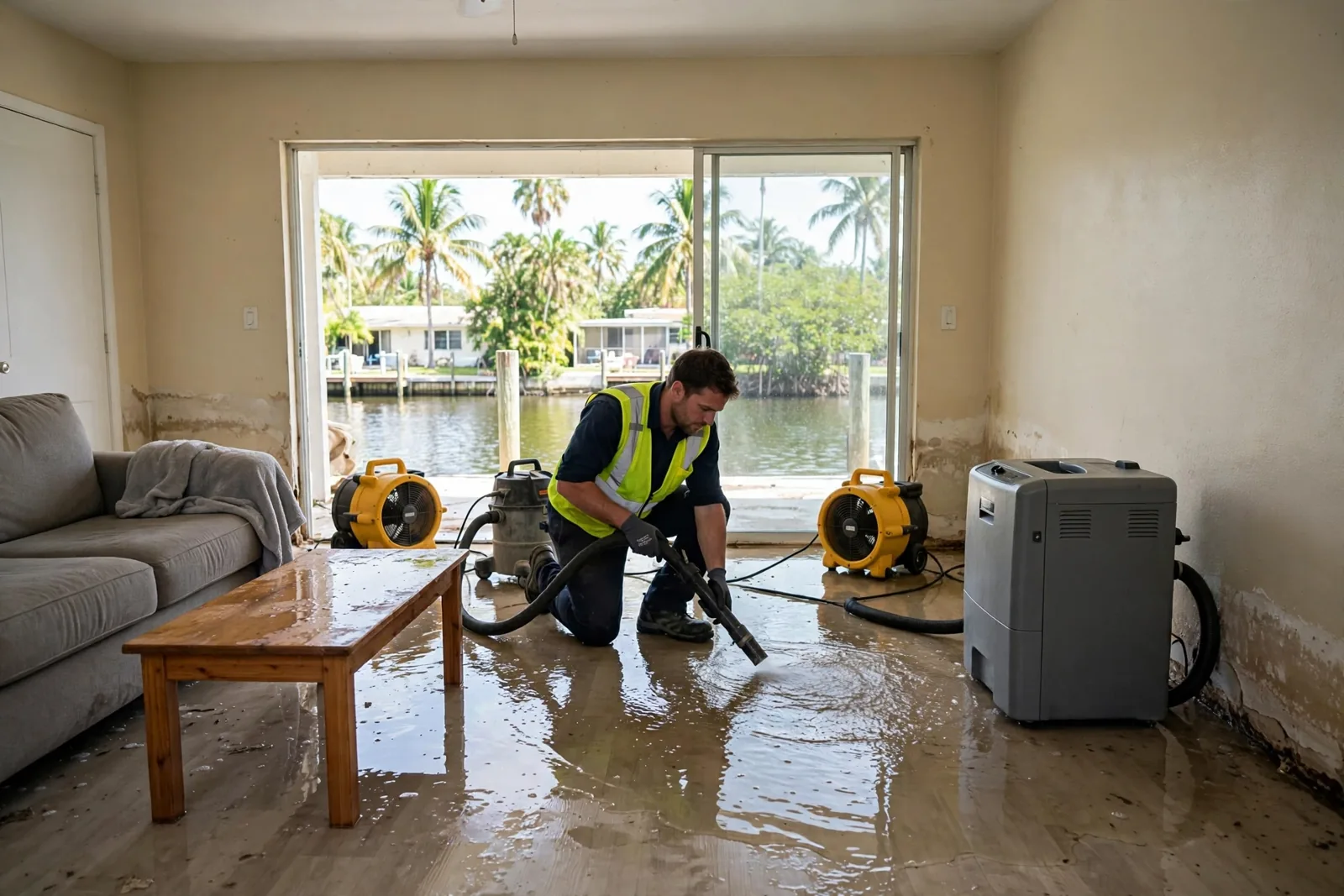
Water damage in Oakland Park right now? Call (214) 286-6943 — 24/7 dispatch from our Fort Lauderdale service area, with a written plan before we start.
Water Damage Restoration in Oakland Park, FL — Local Help, Fort Lauderdale Based
Oakland Park borders Fort Lauderdale directly to the north, and from a water point of view it behaves like an extension of the same city: low elevation, a canal system feeding the Middle River, and a housing stock with a lot of post-war single-storey homes that were never built for the rainfall South Florida now gets in a single afternoon. When a pipe fails in an Oakland Park ranch home or stormwater pushes up through a slab in a duplex, the problem is rarely just the room you can see. Water travels along slab edges, into wall bases and under flooring that looks dry on top.
That is why Oakland Park jobs are won or lost on moisture mapping, not on how fast someone can mop. We check the walls you cannot see into, we tell you which materials can genuinely be dried and which cannot, and we put the plan in writing before the equipment goes in.
We are Water Damage Restoration of Fort Lauderdale: IICRC-informed technicians, licensed & insured, a service-area business with no walk-in office — we come to you. Same discipline on every job: find the source, map the moisture, dry to a measured target, document everything for your insurer.
Water Damage Restoration in Oakland Park at a Glance
- Based: Fort Lauderdale service area — Oakland Park sits directly on Fort Lauderdale’s northern border, so it is one of the closest service areas we cover
- Available: 24 hours a day, 7 days a week, including holidays
- Clock: Mold risk begins within 24–48 hours in South Florida humidity — same-day mitigation matters
- Local watch-out: Low ground near the Middle River and the city’s canal network — outside water and slow drainage after heavy rain
- Standards & paperwork: IICRC-informed work per IICRC S500; photo documentation + moisture logs for your claim from day one
What Water Damage Services Do We Provide in Oakland Park?
The full restoration service, not just the first hour of it:
- Mitigation, extraction & structural drying — stop the spread, remove standing water, dry to measured targets
- Flood damage cleanup & sewage cleanup — contaminated Category 3 water removed and the area sanitised
- Mold remediation & mold inspection — when damage sat too long, or before you buy or sell
- Leak detection & moisture mapping — find the true source and the full extent before anyone opens a wall
- Repair & reconstruction — rooms put back together after drying is verified
How Fast Can You Get to Oakland Park?
Quickly — Oakland Park is immediately north of Fort Lauderdale, sharing a border along its northern edge, and our crews dispatch from the Fort Lauderdale service area. We do not publish a guaranteed minute count, because traffic and how many emergencies are already running change the honest answer. What we can promise is process: call (214) 286-6943 any hour, describe what happened, and we will confirm coverage for your exact Oakland Park address and give you a straight dispatch time on that call — before anyone sets off.
What Causes Most Water Damage in Oakland Park?
The Oakland Park pattern is consistent, and it is mostly age plus water geography:
- Ageing plumbing in post-war homes — older supply lines, galvanised and cast-iron pipework and original slab plumbing that fails quietly and runs for days before a stain appears
- Canal and river-adjacent ground — homes near the Middle River and the canal network sit on low ground where heavy rain raises the water table and pushes moisture through slabs and garage floors
- AC condensate failures — in a city where air conditioning runs most of the year, a blocked condensate line is one of the most common hidden ceiling and closet leaks we describe
- Storm and street flooding — intense short-burst rain overwhelms local drainage; ground-floor homes and converted garages take water first
- Appliance leaks — water heaters, washing machines and refrigerator lines in homes where the appliances are often as old as the plumbing
Why Does Oakland Park Get Hit by Water Problems So Often?
Oakland Park sits in the same low coastal plain as Fort Lauderdale — roughly the same ~9 ft elevation problem, with the same slow drainage. Rain that falls hard here does not run off quickly; it ponds in streets and yards, and the canal system and the Middle River, which form much of the city’s eastern and southern water geography, rise with it. When canals are already high from days of wet-season rain, a single intense storm can push water toward homes that have never flooded from a “named” event at all.
The second factor is the buildings themselves. A large share of Oakland Park housing dates from the post-war building decades — solid concrete-block construction, which is good news, wrapped around plumbing, roof systems and drainage details that are now 50-plus years old. Concrete block hides water well: a slow leak inside a block wall can saturate the cavity and the baseboard line long before paint bubbles give it away. Our inspection in Oakland Park therefore starts with meters on every wall base around the wet room — not just the wall with the stain.
Not sure how far the water has travelled? In Oakland Park the visible stain is rarely the whole job. Call (214) 286-6943 for a phone assessment first — we will tell you honestly whether you need a crew today or a plumber first.
How Much Does Water Damage Restoration Cost in Oakland Park?
It depends on the water category and the affected square footage — the same pricing this site publishes everywhere: Category 1 (clean water) mitigation runs about $3–$4.25/sq ft, Category 2 (gray water) about $4–$6.50/sq ft, and Category 3 (black water, including sewage and floodwater) about $7–$12/sq ft for mitigation alone. Full reconstruction typically runs $20–$37/sq ft. You get a written scope with real numbers before any work starts, so the figure you approve is the figure you are billed against.
Does Insurance Cover Water Damage in Oakland Park?
Usually, for sudden events — a burst pipe or a failed water heater is typically covered, while gradual damage from a leak that ran unnoticed for months is frequently excluded. Rising water from outside (street flooding, storm surge) generally needs a separate flood policy, often through the NFIP, rather than a standard homeowners policy. We document every job with photos and moisture logs an adjuster can actually use, we can speak directly with your adjuster, and we will tell you upfront if part of a loss looks like it may not be covered.
What Does the Restoration Process Look Like?
- Phone assessment — what happened, when, and where, so the right crew is dispatched.
- On-site inspection — source and full extent checked in person.
- Category & Class ID — contamination level and drying difficulty, per IICRC S500.
- Extraction — standing water and unsalvageable materials out first.
- Structural drying — equipment set to specific moisture targets, monitored daily.
- Cleaning & treatment — antimicrobial treatment and odour control where needed.
- Documentation — photos and moisture logs formatted for your adjuster.
- Final walkthrough — dryness confirmed by readings, not by touch.
What Do Jobs in Oakland Park Actually Look Like? Representative Scenarios
These are representative scenarios of how typical jobs of each type unfold in Oakland Park — not a specific past client’s file, and not testimonials.
Scenario 1 — Slow cast-iron failure, single-storey ranch home. A musty smell in a hallway turns out to be a failing cast-iron drain line under the slab-side wall. Moisture mapping finds three rooms affected, not one. Selective removal, drying to measured targets, and a full photo file for the insurer — with an honest conversation on day one that gradual damage is often disputed, which is exactly why the documentation was thorough.
Scenario 2 — Stormwater entry, ground-floor duplex near the canals. Heavy rain pushes inches of outside water through a rear door. Treated as Category 3: porous materials removed rather than dried, the structure cleaned and treated, then dried and documented.
Scenario 3 — AC condensate leak, caught by a water bill and a ceiling stain. Weeks of condensate overflow saturate a ceiling cavity. Source fixed, wet insulation removed, cavity dried and verified by readings before any cosmetic repair.
Frequently Asked Questions
Do you cover all of Oakland Park, including the neighbourhoods along the Middle River?
Yes — we serve the whole city as part of our Fort Lauderdale service area, canal-side streets included. Call (214) 286-6943 and we confirm your exact address on the call.
My Oakland Park home is older — does that change the job?
Usually, yes. Older plumbing, older roof details and concrete-block walls that hide moisture mean the inspection phase matters more. We map moisture beyond the visible damage before recommending any removal.
Can you dry a concrete-block wall?
Block can often be dried in place when the water is clean and caught early, but the cavity and baseboards need checking with meters — block hides water well. If the water was contaminated, or the cavity has been wet for weeks, selective opening is the honest answer.
Is Oakland Park in a flood-risk area?
Parts of it behave like one in practice: low ground near canals and the Middle River can pond and push water toward homes in extreme rain, whether or not a map labels a specific street high-risk. Separate flood insurance is the only reliable cover for rising outside water — a standard homeowners policy generally excludes it.
What should I do first if I find standing water in my Oakland Park home?
Stop the source if it is plumbing and it is safe, keep clear if power may be involved, photograph everything before moving it, and call (214) 286-6943 the same day — the 24–48 hour mold window does not wait for business hours.
Water in your Oakland Park home or business? Call (214) 286-6943 now — 24/7, a written plan before we start, and documentation your adjuster can use.