
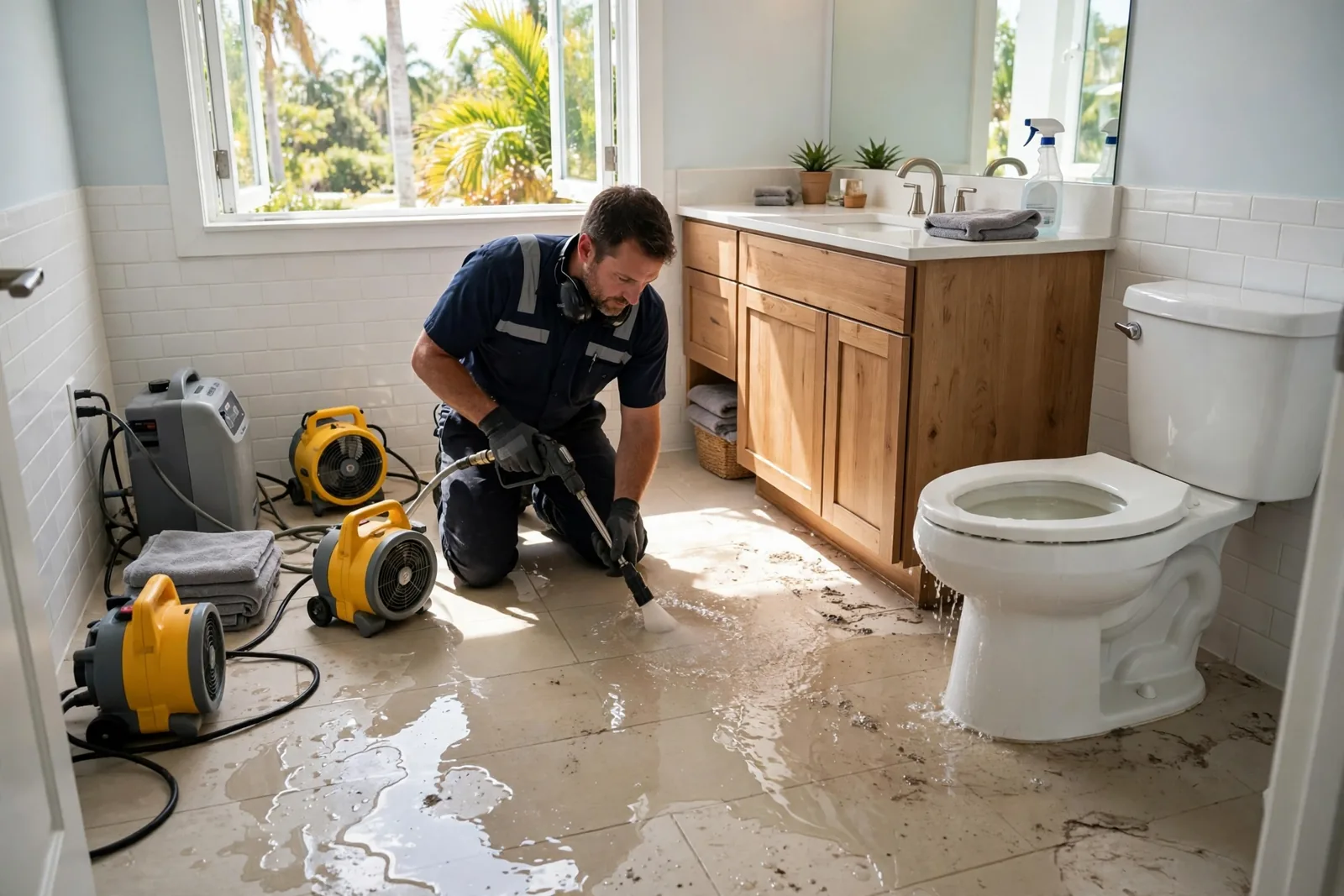
Toilet overflowed and the bathroom is flooded? Call (214) 286-6943 — 24/7 toilet overflow cleanup in Fort Lauderdale.
Toilet Overflow & Bathroom Flood Cleanup in Fort Lauderdale, FL
Toilet overflow cleanup means stopping the water, removing what it touched, cleaning and treating contaminated surfaces, and drying the bathroom to verified moisture readings — and the first question is always what kind of water it was. Clean water from a supply line that never reached the bowl is very different from water that passed through the bowl or backed up from the sewer, which is handled as Category 3. Guessing wrong is a health problem, not just a cleaning problem.
In Fort Lauderdale, that water does not stay in the bathroom. It runs under baseboards, into the vanity, and through the flooring — in a city about 9 ft above sea level with high humidity, where mold can begin in 24–48 hours. For many families this is also the only bathroom. We are a licensed & insured, IICRC-informed service-area business with no walk-in office — we come to you, 24/7, with a written plan before we start and photo and moisture documentation throughout.
Toilet Overflow Cleanup at a Glance
- First move: Stop the supply valve behind the toilet, then the main shut-off if it keeps running
- Category decides everything: Supply-line water, bowl water, and sewage backflow are handled differently
- Backflow is Category 3: Porous materials it touches are removed, not dried in place
- Hidden spread: Water travels under baseboards, vanities, and flooring within minutes
- Clock: Mold can begin in 24–48 hours in Fort Lauderdale humidity
- Cost guide: Mitigation $3–$4.25/sq ft (Category 1), $4–$6.50/sq ft (Category 2), $7–$12/sq ft (Category 3)
Was This a Clean Overflow or a Sewage Backflow?
That distinction decides the whole job. Water from a cracked supply line or failed fill valve, before it enters the bowl, starts as cleaner water. Water that overflowed from the bowl after use, or came back up from the sewer line, has passed through waste plumbing and is treated with Category 2 to Category 3 thinking — and true backflow is Category 3, full stop.
Do not judge it by how it looks — backflow water can look almost clear and still be contaminated. If unsure, treat it as the worse kind, keep children and pets out, and do not mop it into other rooms.
Clean Supply-Line Overflow vs Sewage Backflow Overflow — Comparison
| Type | Category | What is removed | Health handling |
|---|---|---|---|
| Clean supply-line overflow | Category 1, rising to 2 if it sat | Standing water; only materials that cannot be dried | Cleaning and drying, treatment where water sat |
| Sewage backflow overflow | Category 3 | Standing water plus saturated baseboards, drywall at floor level, vanity bases, affected flooring | Full cleaning and treatment, protective equipment, contaminated materials removed, not dried |
Where Does the Water Go After a Bathroom Flood?
Further than the puddle you can see:
- Under and behind baseboards, then wicking up the drywall behind them
- Inside the vanity, soaking its base and the floor underneath
- Under tile, vinyl, or laminate, and into the subfloor or slab edge
- Through the wall into the next room — often a bedroom or closet
- Around the toilet flange, which is why the toilet itself is checked
In older homes in Tarpon River and Sailboat Bend, cast-iron pipes can also mean an overflow is a symptom of a partial sewer blockage. If it has happened twice, say so on the phone.
Can the Vanity, Baseboards, and Flooring Be Saved?
Sometimes — the category decides. After a clean, quickly stopped overflow, baseboards and a vanity can often be dried in place once readings confirm what is wet. After Category 3 backflow, saturated porous materials are removed, because cleaning cannot make a soaked baseboard safe to keep. We tell you which list each item falls on before removal starts.
What Is Our Toilet Overflow Cleanup Process, Step by Step?
- Phone assessment — What overflowed, clean or backflow, how long, and whether the supply is off.
- On-site inspection — Meters check floor, baseboards, vanity, and rooms behind the bathroom.
- Category & Class ID (IICRC S500) — Category 3 changes removal, cleaning, and treatment.
- Extraction and removal — Standing water out; saturated porous materials removed where required.
- Structural drying — Air movers and dehumidifiers dry to set moisture targets.
- Cleaning & treatment — Hard surfaces cleaned and treated; contaminated items disposed of properly.
- Documentation — Photos and moisture logs, formatted for your insurance file.
- Final walkthrough confirmed by moisture readings — We show you the readings.
Not sure if this was clean water or backflow? Call (214) 286-6943 and describe what happened — we will tell you on the phone how it should be handled.
How Much Does Toilet Overflow Cleanup Cost in Fort Lauderdale?
Cost follows category and affected area, using the mitigation ranges published on this site: Category 1 at $3–$4.25/sq ft, Category 2 at $4–$6.50/sq ft, and Category 3 at $7–$12/sq ft. If removed drywall, flooring, or a vanity must be rebuilt, reconstruction typically runs $20–$37/sq ft. The average US water-damage insurance claim is around $12,500, though a contained bathroom job is often a very different number.
What changes the number:
- Clean overflow vs sewage backflow — Category 3 removal and treatment costs more
- How long the water ran and how far it spread beyond the bathroom
- Whether vanity, baseboards, and flooring can be dried or must be removed
You get a written scope with real numbers before work starts. If hidden damage changes it, you hear why before the number changes.
Will Insurance Cover a Toilet Overflow in Florida?
Often, yes for a sudden overflow — a burst supply line or failed valve. Sewage backflow is Category 3, and coverage often depends on specific backup coverage, so check your wording. A slow leak at the toilet base is more likely to be treated as gradual and disputed. Floodwater from outside generally needs separate flood insurance, often through the NFIP. Either way, stop the water and photograph everything before removed materials are thrown away.
What Do Real Toilet Overflow Jobs Look Like? 3 Representative Scenarios
These are representative scenarios of how typical jobs of each type unfold — not a specific past client’s file.
Scenario 1 — Clean supply-line failure, Victoria Park. A line splits at night and clean water floods bathroom and hall. Same-night extraction, baseboards vented, vanity dried in place. Clean water and a fast call keep removal minimal.
Scenario 2 — Sewage backflow, Edgewood. A toilet backs up from the sewer side. Handled as Category 3: saturated baseboards, lower drywall, and vanity base removed, hard surfaces cleaned and treated, structure dried and documented.
Scenario 3 — Repeat overflow, Coral Ridge. A second overflow in a month points to a partial blockage in ageing cast-iron pipe. Cleanup finds water in the adjoining bedroom wall — and the family is told plainly cleanup alone will not stop a third overflow until the pipe is fixed.
Frequently Asked Questions
Is toilet overflow water always sewage?
No. Supply-line water before the bowl is cleaner; water through the bowl or back from the sewer is Category 2 to 3, and backflow is Category 3.
Can I just mop it up and run a fan?
Only for a small clean spill caught in minutes on tile. Fans do not clean contamination or show what is still wet inside the wall.
Do baseboards always have to come off?
No — clean, fast-stopped overflows can often be dried in place. Saturated Category 3 baseboards are removed. Readings and category decide.
How long until the bathroom can be used again?
Once drying and, after backflow, cleaning and treatment are complete. We give an honest timeline at inspection.
What should I do before you arrive?
Turn off the supply valve if safe, keep people and pets out, do not mop contaminated water into other rooms, and photograph everything.
Bathroom flooded? Do not guess at the category. Call (214) 286-6943 now — 24/7, licensed & insured, written plan before we start.