
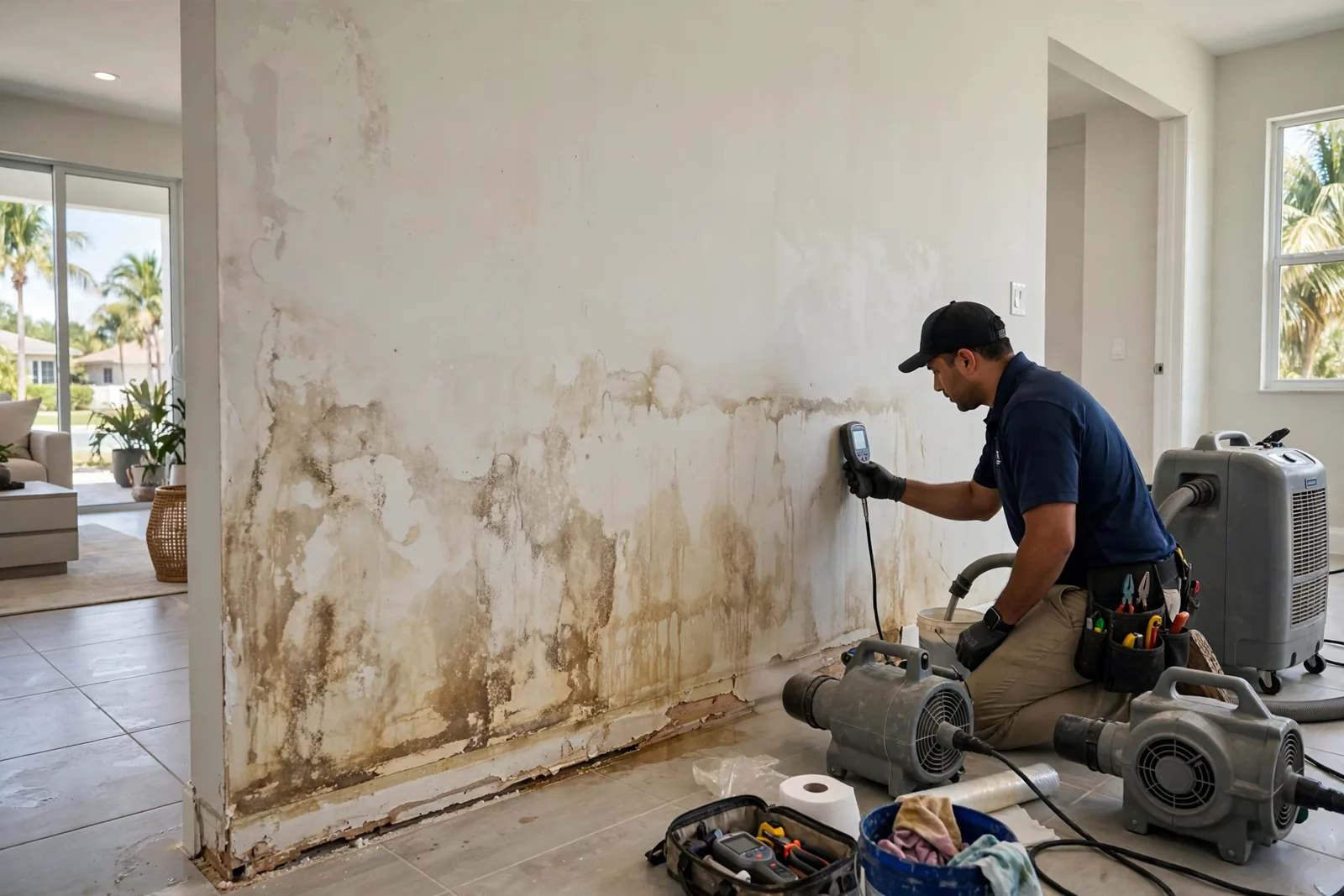
Drywall soft, stained, or bubbling after water damage? Call (214) 286-6943 — 24/7 in Fort Lauderdale. We measure what is wet inside the wall first.
Drywall Water Damage Repair in Fort Lauderdale, FL
Drywall water damage repair starts with a measurement decision, not a patch: is this wall dry enough, clean enough, and strong enough to dry in place, or does the wet section need to come out so the cavity behind it can be dried and treated? Wet drywall loses strength as it soaks, water wicks up inside a wall well above the visible stain, and painting over a wall still wet inside just seals the problem in. Moisture readings, the water category, and how long the wall has been wet make the call.
In Fort Lauderdale that call is urgent. The city sits about 9 ft above sea level with slow drainage and high year-round humidity, and mold can begin in 24–48 hours — including inside a closed wall cavity that feels dry to the touch. We are a licensed & insured, IICRC-informed service-area business with no walk-in office, available 24/7. You get a written plan before we start and photo and moisture documentation throughout.
Drywall Water Damage Repair at a Glance
- Wet drywall loses strength: Soaked board sags and crumbles — it cannot be painted back to sound
- Water wicks upward: The wet area inside a wall is usually taller than the visible stain
- Paint bubbling is a late sign: By the time paint blisters, the wall has usually been wet a while
- Key move: Baseboards come off to vent and dry the wall cavity
- Category decides removal: Category 3 water means affected drywall is removed, not dried
- Cost guide: Mitigation $3–$4.25/sq ft (Category 1), $4–$6.50/sq ft (Category 2), $7–$12/sq ft (Category 3); reconstruction $20–$37/sq ft
How Can You Tell If Wet Drywall Can Be Saved?
By three things: how wet it is, what kind of water wet it, and whether it is still sound. A wall that took clean water briefly and is still firm can often be dried in place once baseboards are removed to vent the cavity. A soft, sagging, or crumbling wall has lost strength — drying does not restore it. A wall soaked by Category 3 water is removed regardless, because the contamination is in the material. Readings first, then the decision, in writing.
Dry-It-In-Place vs Cut-and-Remove (Flood Cut) — Comparison
| Approach | When used | What decides | Finish result |
|---|---|---|---|
| Dry it in place | Clean water, caught fast, board still sound | Category 1, baseboards removed to vent cavity, readings falling on rechecks | Original wall kept; trim reinstated, cosmetic touch-up only |
| Cut and remove (flood cut) | Contaminated water, unsound board, or cavity that cannot dry closed | Category 3, soft or sagging board, high readings, wet insulation inside | Wet section removed at a clean cut line, cavity dried and treated, new drywall fitted and finished ready for paint |
Why Does Water Travel Higher Inside a Wall Than the Stain Shows?
Because drywall and insulation wick water upward, like a paper towel in a puddle. Water entering at floor level can be wet well above the line you can see, while the surface looks normal. It is the most common reason DIY repairs fail: the stain gets patched while the cavity stays wet.
Baseboard removal matters because the baseboard seals the bottom of the wall — taking it off opens the cavity so drying can reach the wet space. In older Fort Lauderdale homes, cast-iron pipes, slab plumbing, and AC condensate lines are common hidden sources, and walls shared with bathrooms and kitchens are the first to meter after any fixture leak.
Can You Just Paint Over Water-Damaged Drywall?
No — not if it is still wet inside. Paint bubbling or peeling tells you the wall was wet for a while, not that it has dried now. Paint over a wet wall traps moisture in, the finish fails again, and the cavity behind it is exactly the dark, humid space where mold grows here. If a wall meters dry, is sound, and the source is fixed, then cosmetic repair and paint are the whole job. The readings earn that answer.
What Is Our Drywall Water Damage Repair Process, Step by Step?
- Phone assessment — What wet the wall, when, and what you can see.
- On-site inspection — Readings up the wall, behind baseboards, and in adjoining rooms.
- Category & Class ID (IICRC S500) — Category decides whether drying in place is an option.
- Removal where required — Baseboards off to vent cavities; unsound or contaminated drywall cut out.
- Structural drying — Cavities and remaining materials dried to set targets.
- Cleaning & treatment — Cavities and surfaces cleaned and treated where needed.
- Documentation — Photos and moisture logs, formatted for your insurance file.
- Final walkthrough confirmed by moisture readings — No closing or refinishing until readings confirm dry.
Wall gone soft or paint bubbling after a leak? Call (214) 286-6943 before you patch or paint anything — a phone assessment will tell you if this sounds like drying or cut-out.
How Much Does Drywall Water Damage Repair Cost in Fort Lauderdale?
Mitigation uses the ranges published on this site: Category 1 at $3–$4.25/sq ft, Category 2 at $4–$6.50/sq ft, and Category 3 at $7–$12/sq ft. Where drywall must be cut out and replaced, the rebuild — new board, tape, finish, and trim — falls in the published reconstruction range, typically $20–$37/sq ft for the affected area. The average US water-damage insurance claim is around $12,500.
What changes the number:
- Dry-in-place vs flood cut — removal and rebuild cost more than drying alone
- How high the water wicked and how many walls are involved
- The category — Category 3 removal and treatment costs more than clean-water drying
- Whether insulation inside the wall is wet and must come out with the board
You get a written scope before work starts, stating which walls are dried and which are cut, and why.
Will Insurance Cover Drywall Water Damage in Florida?
Often, yes when the cause was sudden — a burst pipe in one event. Slow wetting is disputed: a leak that wet a wall over months is frequently treated as gradual and excluded. Floodwater is Category 3 and generally needs separate flood insurance, often through the NFIP. Early photos and moisture logs protect you, and most policies expect you to prevent further damage in the meantime.
What Do Real Drywall Jobs Look Like? 3 Representative Scenarios
These are representative scenarios of how typical jobs of each type unfold — not a specific past client’s file.
Scenario 1 — Clean water, dry in place, River Oaks. A supply-line leak wets one wall at floor level, caught the same day. Baseboards off, cavity vented and dried to target, board confirmed sound — only trim reinstated and cosmetic touch-up needed.
Scenario 2 — Flood cut after storm water, Melrose Park. Ground-floor drywall takes storm water of the kind seen in the April 12–13, 2023 storm, which dropped over 2 ft of rain in under 24 hours and hit Melrose Park among the worst. As Category 3, the wet lower section is cut out, the cavity cleaned, treated, and dried, and new drywall fitted under the published reconstruction range.
Scenario 3 — Bubbling paint, slow leak, Tarpon River. Blistering paint turns out to be the late sign of a slow slab-plumbing leak wetting the wall from behind, wicked above the visible damage. The unsound section is removed and the cavity dried — with a plain warning that the pipe repair must happen or the wall will be wet again within months.
Frequently Asked Questions
How high do you cut drywall on a flood cut?
As high as readings require and no higher — a clean line above the wet, unsound material, including wicking beyond the stain.
Can wet drywall dry out on its own in Florida?
A surface can feel dry while the cavity stays wet. If cavity and insulation are wet, monitored drying with baseboards off is what works — confirmed by readings.
Is wet insulation always removed?
In a contaminated or long-wet wall, generally yes — it holds moisture and dries poorly. Where it meters dry on a clean, fast-caught job, it can stay.
What if only one small area is stained?
Meter it first. A dry, sound wall may need only cosmetic repair; the same-looking stain can be the top of a larger wet area inside.
How long before a repaired wall can be painted?
Only after final readings confirm the wall and cavity are dry and any new drywall is finished. Painting sooner brings the bubbling back.
Wet wall? Get readings before you get a paint quote. Call (214) 286-6943 now — 24/7, licensed & insured, written plan before we start.