
Think water is hiding where you can’t see it? Call (214) 286-6943 — 24/7 in Fort Lauderdale.
Leak Detection & Moisture Mapping in Fort Lauderdale, FL
Leak detection and moisture mapping find where water is coming from and how far it has travelled — behind walls, under floors, and inside ceilings — without tearing the house apart first. If your water bill jumped, you smell something musty, or flooring feels soft, the leak is usually bigger than the visible sign. Fort Lauderdale sits about 9 feet above sea level, drainage is slow, humidity is high year-round, and mold can begin in 24–48 hours. Hidden water here does not dry out on its own.
We are Water Damage Restoration of Fort Lauderdale: licensed & insured, IICRC-informed, a service-area business with no walk-in office — we come to you, 24/7, with a written plan before we start and photo and moisture documentation.
Leak Detection & Moisture Mapping at a Glance
- Goal: Find the source and map hidden moisture before any demolition
- Tools: Pin meters, pinless meters, and infrared / thermal imaging together
- Approach: Non-invasive first — openings only where readings justify them
- Common sources: Slab plumbing, AC condensate lines, supply lines, cast-iron pipes
- Clock: Mold can begin in 24–48 hours in local humidity
- Proof: Photo and moisture documentation for repairs and insurance
What Are the Signs You Have a Hidden Leak?
A hidden leak usually shows up as a higher water bill, a musty smell cleaning does not remove, bubbling paint, warped flooring, or a growing stain. Any one of those is reason to measure rather than wait.
- Water bill rising with no change in use
- Musty odour in one room, closet, or cabinet
- Drywall softening or baseboards separating
- Flooring that feels spongy, warm, or uneven
- A ceiling stain below a bathroom or AC unit
How Do We Find a Leak Without Tearing Open Walls?
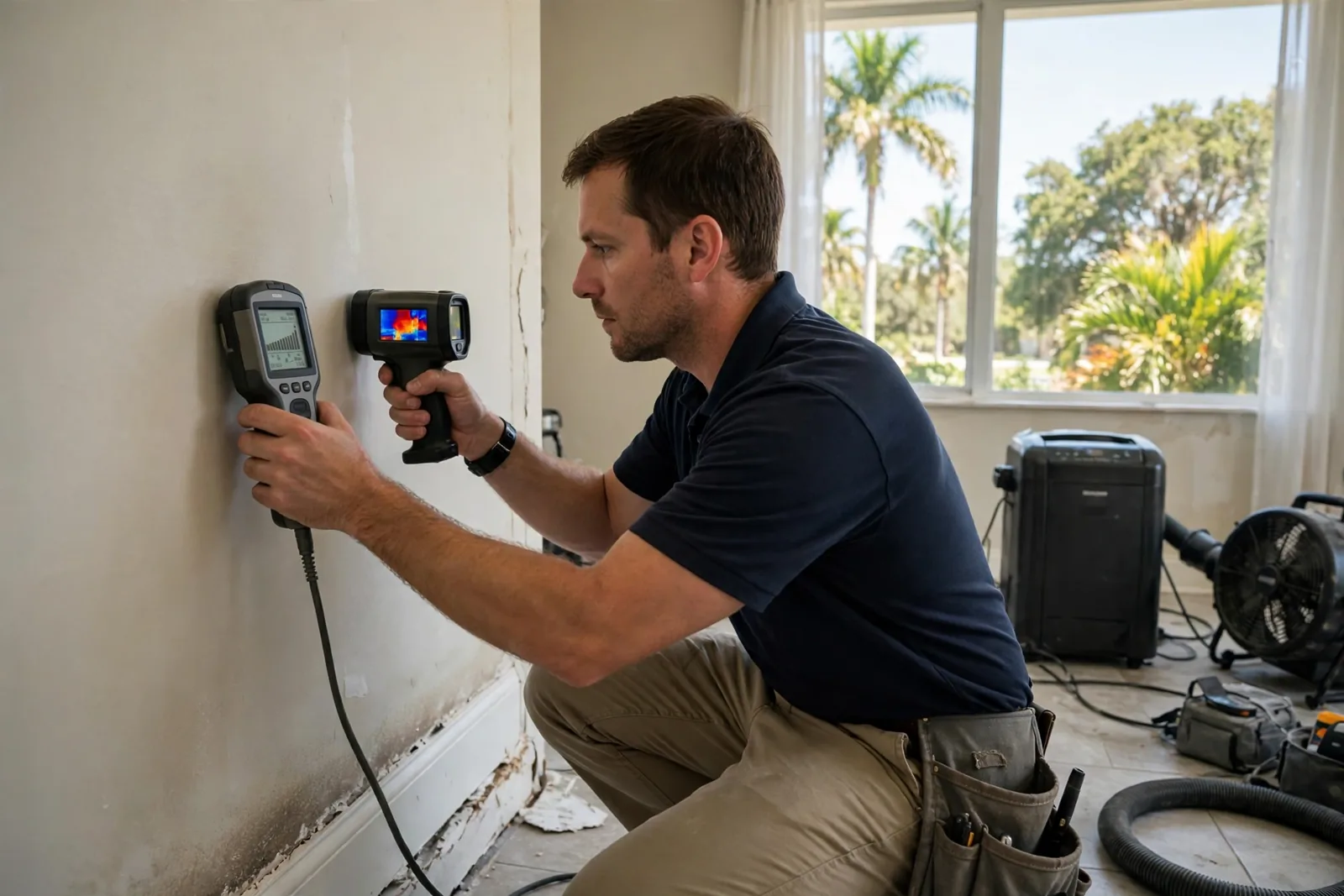
We start non-invasive: meters confirm which materials are actually wet, and infrared imaging shows temperature patterns that can point to moisture behind a surface. Readings are recorded in a grid, so the map — not a hunch — decides if a small opening is needed. A thermal image alone is not proof; a meter confirms or rules it out.
Moisture Detection Tools — Comparison
| Tool | What it finds | Limits |
|---|---|---|
| Pin meter | Moisture content at a specific depth in wood and drywall | Only reads where the pins go; tiny pin holes; slower over large areas |
| Pinless meter | Moisture presence over a wider area, scanned without pins | Limited depth; relative reading, confirmed with a pin meter |
| Infrared / thermal imaging | Temperature differences that can indicate moisture behind a surface | Does not measure moisture directly; must be verified with a meter |
Where Do Hidden Leaks Most Often Start in Fort Lauderdale Homes?
Most hidden leaks here start in slab plumbing, AC condensate lines, ageing supply lines, or cast-iron pipes in older homes. Pipes under a slab or inside a wall can leak for weeks before anything shows.
- Slab leaks: Water can travel along the slab and surface far from the break.
- AC condensate lines: AC runs most of the year; a clogged or cracked line can drip into a wall or ceiling.
- Older plumbing: Cast-iron pipes and older lines in Victoria Park, Rio Vista, and Sailboat Bend are a recurring source of slow losses.
What Happens After We Map the Moisture?
Once the source is confirmed, the next step is stopping the leak, then drying or removing materials based on how wet and contaminated they are. You see the readings and map first, so any repair or drying follows evidence. A dated log is also far stronger for insurance than a later photo of a stain.
A musty smell or rising water bill is a reason to measure, not wait. Call (214) 286-6943.
What Is Our Leak Detection & Moisture Mapping Process, Step by Step?
- Phone assessment — What you noticed, when, and where.
- On-site inspection — Visible signs, fixtures, AC system, and accessible plumbing.
- Category & Class ID (IICRC S500) — Contamination level and drying difficulty.
- Moisture mapping and source tracing — Meters and infrared imaging map the wet area and trace its source.
- Structural drying — Air movers and dehumidifiers set to monitored moisture targets.
- Cleaning & treatment — Areas cleaned and treated where moisture allowed growth.
- Documentation — Photos, readings, and findings for your records or adjuster.
- Final walkthrough confirmed by moisture readings — Mapped points re-read with you; dry versus needs-repair confirmed.
How Much Does Leak Detection & Moisture Mapping Cost in Fort Lauderdale?
We give a written scope for your home before follow-on work starts — we do not publish a one-size price for finding a leak we have not seen. The mitigation a leak often leads to is priced on this site as: Category 1 (clean water) $3–$4.25/sq ft, Category 2 $4–$6.50/sq ft, Category 3 $7–$12/sq ft. Rebuilding removed materials is typically $20–$37/sq ft for reconstruction.
What changes the number:
- Mapped wet area versus the size of the visible stain
- Water in a wall cavity, under flooring, or near the slab
- How long the leak ran — days is usually drying; months can mean removal
- Access — tight cavities, tile, and built-ins take longer
For context, the average US water-damage insurance claim is around $12,500.
Will Insurance Cover a Hidden Leak in Florida?
It depends on whether the leak was sudden or gradual. A sudden failure is typically treated differently from a slow leak that ran unnoticed for months, which is frequently excluded. Rising floodwater generally requires separate flood insurance, often through the NFIP.
What Do Real Leak Detection Jobs Look Like? 3 Representative Scenarios
These are representative scenarios of how typical jobs of each type unfold — not a specific past client’s file.
Scenario 1 — Slab leak, Coral Ridge. A water bill climbs for two months with no visible water. Imaging and scans map moisture in the hallway floor and trace it to a slab line, so the repair opening stays small and targeted.
Scenario 2 — AC condensate leak, Victoria Park. A musty odour will not go away, with no visible stain. Readings find the wall behind the AC closet saturated from a condensate leak. The cavity is dried and treated, and readings confirm damage stopped at one wall.
Scenario 3 — Slow wall leak, Tarpon River. Mold keeps returning on the same bathroom wall in an older home. Mapping shows moisture running down the cavity from a slow supply-line leak above. The source is repaired, wet material removed, and drying confirmed before the wall is closed.
Frequently Asked Questions
Can you find a leak without cutting into my walls?
Usually, yes — meters and imaging come first. If readings point to one spot, a small targeted opening may be needed to confirm the source, but we do not open walls on a guess.
Is a thermal image proof of a leak?
No. Infrared shows temperature differences that can indicate moisture. We confirm every pattern with a meter before recommending work.
Why is my water bill high but I see no water?
A leak under a slab, inside a wall, or at an AC condensate line can run continuously without surfacing.
Do I have to use you for drying or repair after detection?
No. You get the map, readings, and documentation either way. If you want us to continue, we provide a written scope first.
Can hidden moisture really cause mold that fast?
Yes. In Fort Lauderdale’s humidity, mold can begin in 24–48 hours — and a slow leak gives it far longer.
Stop guessing where the water is. Call (214) 286-6943 for measured, documented leak detection in Fort Lauderdale.