
Water in your home — kitchen, bathroom or a whole ground floor? Call (214) 286-6943. 24/7 residential response across Fort Lauderdale & Broward County, with a written plan before we start.
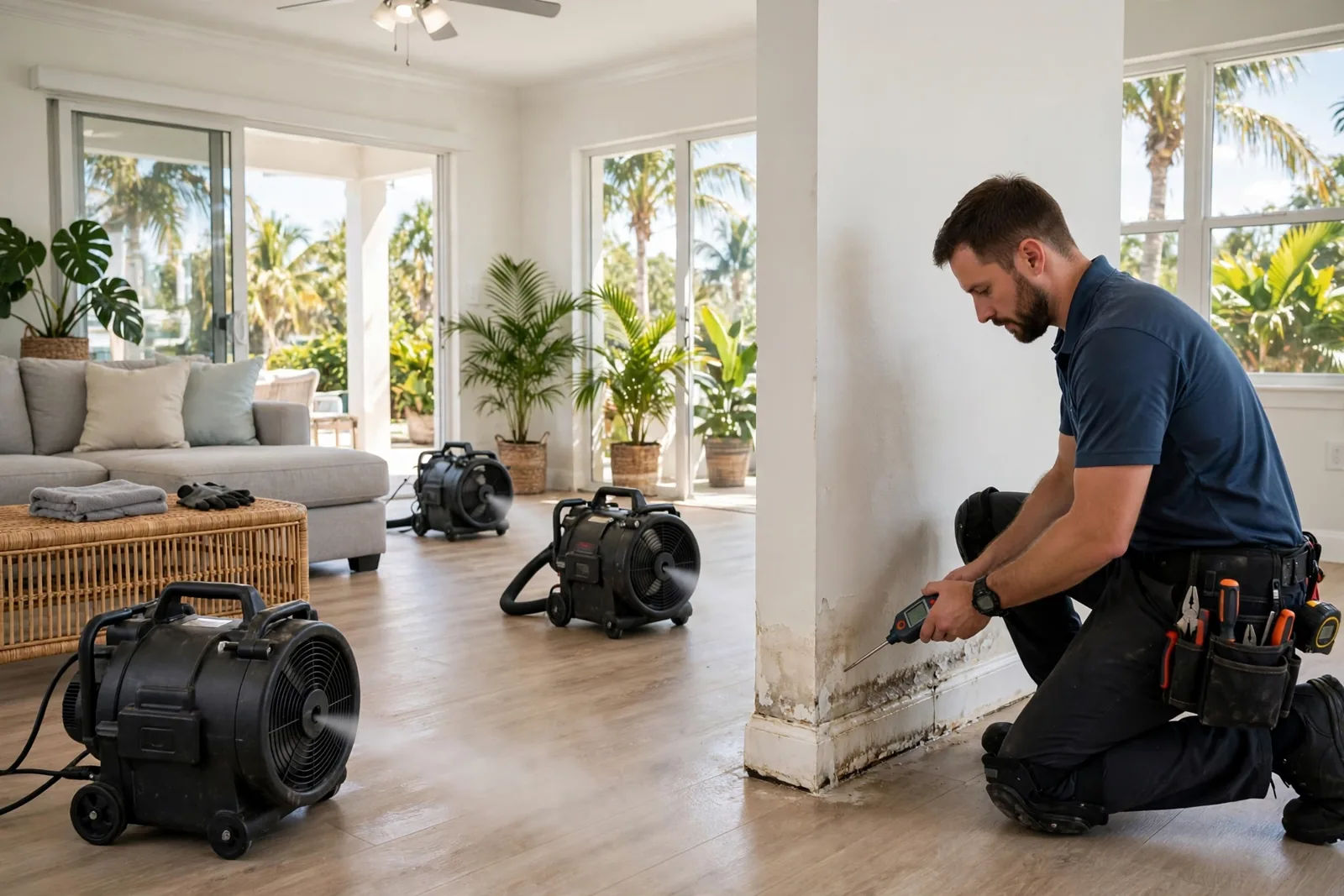
Residential Water Damage Restoration in Fort Lauderdale — For the Home You Actually Live In
Residential water damage restoration is the full job of returning a house, condo or townhome to a safe, dry, liveable condition after water damage: emergency mitigation, measured drying, cleaning and treatment, and the repairs that follow. It is different work from a commercial job. Your home is not an empty unit. It has your kitchen, your children’s bedrooms, your pets, your furniture, your photos — and usually, you are still trying to live in it while the work happens, or deciding whether you can.
In Fort Lauderdale, homes take water in very specific ways. Ground-floor homes in Edgewood, River Oaks and Melrose Park flood from extreme rain. Older homes in Victoria Park, Sailboat Bend and Tarpon River hide slow plumbing and cast iron pipe failures behind walls for months. Condos from downtown to the Galt Ocean Mile get water from the unit above — a neighbour’s water heater, a failed AC condensate line two floors up — and the damage in your ceiling has nothing to do with anything you did. Beach-area homes deal with wind-driven rain and salt air. One process does not fit all of those, and anyone who tells you it does has not worked many homes here.
We are a local, service-area team: IICRC-informed technicians, licensed & insured, 24/7. Straight talk, a written plan before work starts, photos and moisture logs for your insurer, and drying confirmed by readings — not by how dry a wall feels to the hand.
Residential Restoration in Fort Lauderdale at a Glance
- Home types: Single-family homes, condos & high-rises, townhomes, duplexes and multi-family homes
- Most common home causes here: Burst / leaking pipes, water heater failures, AC condensate leaks, appliance leaks, roof leaks, storm and flood entry
- Clock: Mold risk in 24–48 hours in Florida humidity — same-day response matters more in a home than anywhere
- Can you stay? Often yes for contained losses; usually no for Category 3 (sewage / floodwater) or whole-floor losses — we will tell you honestly on the first visit
- Cost guide (site-published): Mitigation $3–$12/sq ft depending on category; reconstruction $20–$37/sq ft
- Proof for insurance: Photos before anything moves, moisture logs every day, written scope before full work
What Does Residential Water Damage Restoration Include in a Home?
A complete residential job includes:
- Emergency mitigation — source stopped, standing water extracted, unsalvageable materials removed
- Moisture mapping — meters and infrared imaging to find every wet material, including inside walls and under floors
- Structural drying — air movers and dehumidifiers run to measured targets, checked and logged
- Cleaning & treatment — affected areas cleaned, with antimicrobial treatment and odor control where contamination is present
- Contents care — furniture and belongings moved, protected, or assessed honestly for what can and cannot be saved
- Restoration & repair coordination — the affected rooms returned to use, from drywall and flooring to trim and paint where reconstruction is needed
- Documentation — a photo and moisture-log file for your homeowners insurer, from day one
If a quote covers only extraction and fans, it is not a residential restoration quote — it is the first third of one.
How Is Restoring a Home Different From Restoring a Commercial Property?
| Question | Residential | Commercial |
|---|---|---|
| Who is affected | A family, often still living on site | Staff, customers, operations |
| Main priority | Safety, habitability, belongings, routine | Downtime, compliance, reopening |
| Typical hours | 24/7 emergency, work around occupants | Often scheduled around business hours |
| Contents | Personal, sentimental, hard to replace | Inventory and equipment, insured by value |
| Decision-maker | The homeowner (and their insurer / HOA) | Property or facilities management |
Why it matters to you: a residential crew plans around school runs, pets, a baby’s bedroom and a kitchen you still need to use. Drying equipment is loud and takes floor space — you should be told that upfront, room by room, before it arrives.
What Are the Most Common Causes of Water Damage in Fort Lauderdale Homes?
- Plumbing failures — burst supply lines, leaking angle stops, slab leaks, and ageing cast iron sewer pipes in older homes
- Water heaters — a tank that fails can release its full contents plus the supply feeding it, usually into a garage, closet or condo utility space
- AC condensate problems — in South Florida your AC runs most of the year; a blocked condensate line is one of the most common hidden causes of ceiling and wall damage here
- Appliances — dishwasher, washing machine and refrigerator lines failing quietly behind cabinets and under flooring
- Roof and window leaks — wind-driven rain during summer storms and hurricane season finds every weak flashing and seal
- Outside flooding — extreme rain, king tides and storm surge entering ground-floor homes in low-lying neighbourhoods
- The unit above (condos) — in condos and high-rises, your water damage often starts in someone else’s unit, which is why early documentation — for your insurer and your HOA — matters so much
Can My Family Stay in the Home During Restoration?
Often, yes — and sometimes, honestly, no.
- Usually stay: A contained Category 1 loss (clean water, one or two rooms), with a working bathroom and kitchen, and no one in the home with serious respiratory sensitivity to construction dust or drying conditions.
- Usually leave, at least for part of the job: Category 3 losses (sewage or floodwater), whole-ground-floor losses, losses involving a child’s bedroom or the only bathroom, or any job where demolition creates significant dust in living space.
- Pets count too: Drying equipment is loud and runs around the clock. Many families board a nervous dog for the drying days even when they stay themselves.
We will give you a straight answer at the first visit, based on category, rooms affected and who is living in the home — not based on what is easiest to schedule.
Wondering if your family can stay, or what your insurer will actually pay for? Call (214) 286-6943 — describe the rooms affected and we will walk you through both answers before anyone is dispatched.
What Is Our Process for Restoring a Home, Step by Step?
- Phone assessment — What happened, which rooms, and is anyone’s safety affected? We bring the right crew and equipment for a home, not a warehouse.
- On-site inspection — Moisture meters and infrared imaging map the damage room by room.
- Category & Class ID — Per IICRC S500, this decides what is dried, what is removed, and whether you can stay.
- Extraction — Standing water and unsalvageable saturated materials removed first.
- Structural drying — Equipment set to specific targets, monitored daily, and adjusted as readings change.
- Cleaning & treatment — Antimicrobial treatment and odor control where needed.
- Documentation — Full photo and moisture-log report for your insurer (and HOA, for condos).
- Final walkthrough — Every affected room confirmed dry by readings before equipment leaves.
How Much Does Residential Water Damage Restoration Cost in Fort Lauderdale?
On this site’s published guide: mitigation runs about $3–$4.25/sq ft for Category 1 (clean water), $4–$6.50/sq ft for Category 2 (gray water), and $7–$12/sq ft for Category 3 (black water). Full reconstruction typically runs $20–$37/sq ft. Nationally, the average insurance claim for water damage is around $12,500.
In a home, these factors move the number most:
- Number of rooms and whether kitchens / bathrooms (cabinets, tile, plumbing) are involved
- Flooring — tile on slab is forgiving; hardwood, laminate and carpet are not
- How long water ran or sat before the call — late-caught leaks add demolition and mold work
- Condo vs house — access, elevators, HOA rules and affected neighbouring units all change logistics
Written scope, real numbers, before full work starts. No surprise invoices.
Will My Homeowners Insurance Cover Residential Water Damage?
Sudden events — a burst pipe, a failed water heater — are typically covered. Gradual damage, like a slow leak that ran unnoticed for months, is frequently excluded. Rising floodwater from outside generally needs separate flood insurance, often through the NFIP. Condo owners: your unit policy, the HOA master policy and the unit-above owner’s policy can all be involved in one loss, which is exactly why dated photos from the first day matter.
We document every residential job for insurance, we can speak directly with your adjuster, and we will tell you upfront if we think part of your loss may not be covered.
What Do Real Residential Jobs Look Like? 3 Representative Scenarios
These are representative scenarios of how typical jobs of each type unfold — not a specific past client’s file.
Scenario 1 — Water heater failure, single-family home. A tank fails in a garage closet and water reaches the laundry room and hallway before it is found. Same-day extraction, baseboard and lower drywall assessment, four days of monitored drying, and a complete photo file for a homeowners claim. The family stayed in the home throughout — the loss was Category 1 and the bedrooms were untouched.
Scenario 2 — Condo ceiling loss from the unit above, high-rise. A condensate line fails two floors up; the first sign in the unit below is a ceiling stain and a musty smell. Moisture mapping shows the ceiling cavity and one wall are wet. Documentation goes to the owner’s insurer and the HOA on day one, drying runs with the least possible demolition, and the source-unit question is answered with readings, not opinions.
Scenario 3 — Ground-floor flood entry, low-lying neighbourhood. Extreme rain puts several inches of Category 3 water across a ground floor in the April 2023 pattern seen in Edgewood and River Oaks. Porous materials are removed, the structure is cleaned, treated and dried, and the family relocates for the removal and drying phase. The claim is documented as a flood loss, not presented as something it is not.
Frequently Asked Questions
How long does residential water damage restoration take?
Mitigation and extraction start same-day. Drying commonly runs several days with daily monitoring. Repairs after drying depend on scope — a room that only needed baseboards is days; a kitchen rebuild is weeks. You get the sequence in writing before full work starts.
Can you save my hardwood floors and furniture?
Sometimes — and we will tell you which pieces, based on readings, not hope. Tile on slab usually survives. Hardwood and laminate depend on how long they were wet and whether water got underneath. Upholstered furniture soaked by Category 3 water generally cannot be sanitised and should be let go.
What should I do before your crew arrives at my home?
Stop the source if it is safe, photograph everything, move small valuables to a dry room, and keep children and pets out of affected areas. Do not remove wet drywall or carpet before it is documented — that documentation is part of your claim.
Do you handle the insurance paperwork for a home claim?
We produce the documentation adjusters work from — photos, moisture logs and a written scope — and we can speak directly with your adjuster. The claim itself stays yours, and we will flag early anything we think an insurer may dispute.
Do you restore condos as well as houses?
Yes — single-family homes, condos, high-rises, townhomes and multi-family homes across Fort Lauderdale and Broward County, including Victoria Park, Rio Vista, Coral Ridge, Las Olas, Edgewood, Oakland Park, Wilton Manors, Hollywood, Pompano Beach, Plantation, Davie, Sunrise and Coral Springs.
Are you a local team or a national call centre?
A local, service-area team. There is no walk-in office — technicians come to your home, day or night. Call and we confirm coverage for your address before dispatch.
Your home, your family, one written plan. Call (214) 286-6943 now for a same-day residential assessment in Fort Lauderdale & Broward County.