
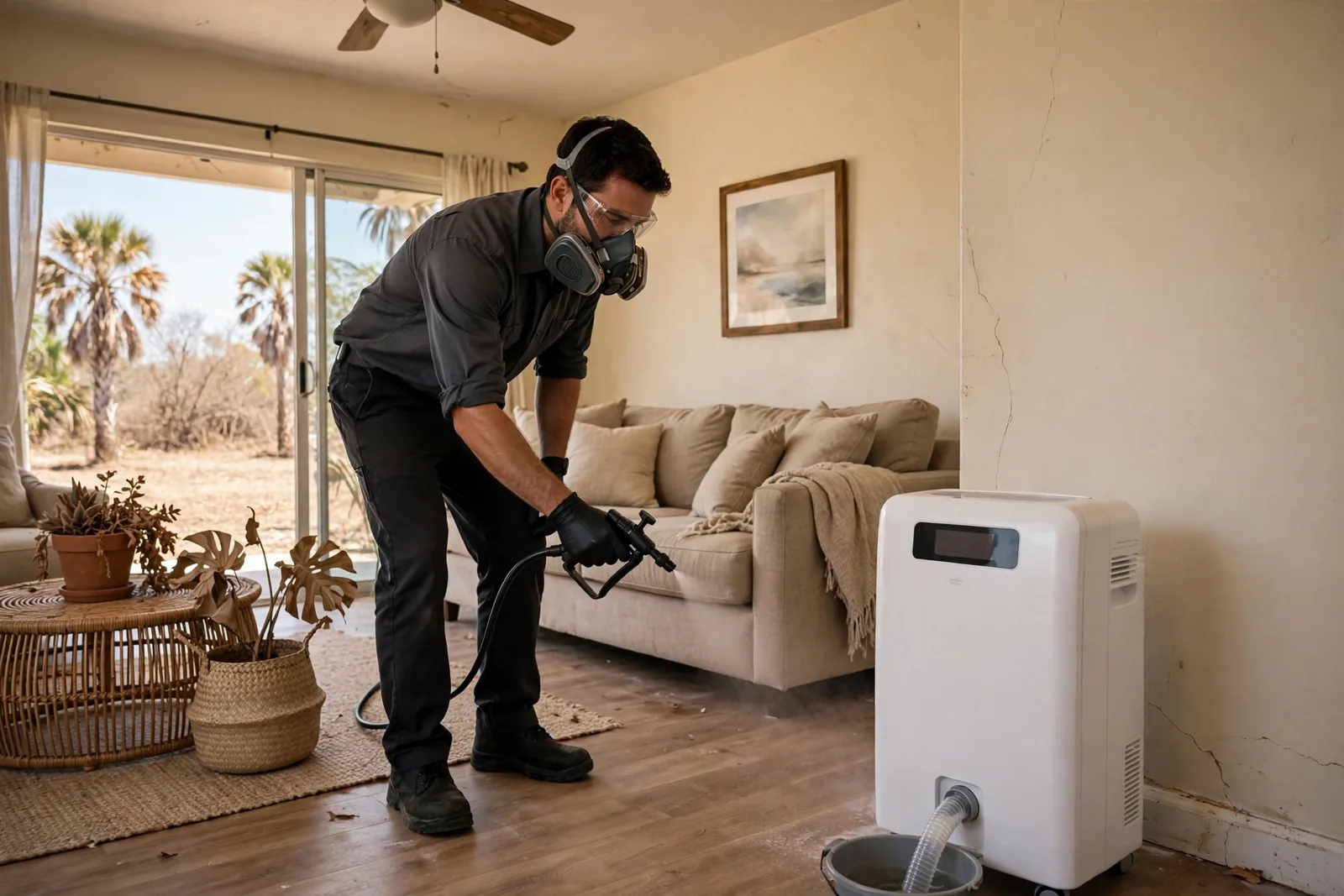
House dried out but the musty smell never left? Call (214) 286-6943 — 24/7 in Fort Lauderdale. That smell means something is still wet or contaminated, and we find it.
Odor Removal & Sanitization After Water Damage in Fort Lauderdale — Treat the Source, Not the Smell
Odor removal after water damage works only one way: find what is still wet or contaminated, remove or treat it, verify the structure is dry, then sanitise. A musty smell is a symptom, not the problem. If a room still smells weeks after a leak or flood, moisture or contamination is still present — in a wall cavity, under flooring, or in materials never properly treated. Covering it up just delays the day you deal with it.
We are a Fort Lauderdale service-area team: IICRC-informed, licensed & insured, 24/7, no walk-in office. You get a written plan before we start, plus photo and moisture documentation. Where mold can begin in 24–48 hours, odor work that skips moisture verification is money spent twice.
Odor Removal & Sanitization at a Glance
- Core rule: Odor means moisture or contamination remains — treat the source
- Order: Find it, remove or dry it, verify by readings, then sanitise
- Sanitization matters most: After Category 2 and 3 water
- What fails: Fresheners and sealing paint over a wet surface
- Local factor: Humidity keeps damp materials damp — odors do not air out here
- Proof: Moisture readings and a dry room — not a stronger fragrance
Why Does My House Still Smell Musty After Water Damage?
Because something is still feeding it:
- A wall cavity or floor layer that never reached dry — moisture left behind drywall, underlayment or cabinets
- Mold growth inside hidden spaces — growth you cannot see still produces the odor you can smell
- Contaminated materials kept in place — carpet, padding or porous items exposed to Category 2 or 3 water, surface-cleaned but never treated or removed
- A source that never stopped — a slow slab or pipe leak, or an AC condensate line still overflowing
Until the cause is fixed and verified dry, the smell returns — usually within days of any cover-up.
What Is the Difference Between Masking an Odor and Removing It?
Masking adds a stronger smell or seals the surface. Removal takes out the material or contamination producing the odor, dries what remains to a measured target, and sanitises it. It is a choice a lot of homeowners are sold backwards.
Masking vs Source Removal + Treatment — Comparison
| Approach | Why it fails / works | When used |
|---|---|---|
| Masking — air fresheners, scented cleaners, sealing paint | Fails if the source is still wet or contaminated: odor returns, the seal traps moisture in, hidden mold keeps growing | Only as a cosmetic step on a surface already verified dry and clean — never as the fix |
| Source removal + treatment | Works because the cause is gone: material removed, structure dried to verified readings, surfaces sanitised | After any loss with lingering odor, and always after Category 2–3 water |
When Is Sanitization Necessary After Water Damage?
Whenever water carried contamination — Category 2 (gray water, such as an appliance overflow that has sat) and always Category 3 (sewage, storm surge, floodwater) — and wherever mold was present. Cleaning and treatment come after removal and drying: sanitising a still-wet structure does not hold.
Tried air fresheners, cleaners, even paint — and the smell keeps coming back? Call (214) 286-6943. We check the moisture first and tell you straight what is causing it.
What Is Our Odor Removal & Sanitization Process, Step by Step?
- Phone assessment — When the damage happened, what was done, where the smell is strongest.
- On-site inspection — Meters and infrared imaging check the rooms — and the cavities and floors behind them.
- Category & source ID — Water category identified; odor traced to wet material, growth, contamination, or an active source.
- Source removal — Unsalvageable material removed; any active leak flagged for repair.
- Structural drying — Air movers and dehumidifiers dry to specific, monitored moisture targets.
- Cleaning & treatment — Surfaces cleaned and sanitised; antimicrobial treatment where Category 2–3 or mold was present.
- Documentation — Photos and logs record the cause, the work, and the dry readings reached.
- Final walkthrough — Confirmed by readings and by the room itself: dry, treated, odor gone.
How Much Does Odor Removal & Sanitization Cost in Fort Lauderdale?
Odor work is part of a wider loss, priced inside the written scope — no standalone odor price, because the cost is really the cost of fixing the cause. Framing ranges published on this site: mitigation about $3–$4.25/sq ft (Category 1), $4–$6.50/sq ft (Category 2), $7–$12/sq ft (Category 3); reconstruction typically $20–$37/sq ft if materials came out. The average US water-damage claim is around $12,500.
What changes the number: the cause, the water category, removal versus in-place treatment, and any active leak still needing repair.
Will Insurance Pay for Odor Removal After Water Damage?
Usually as part of a covered loss, not standalone. If the original event — a burst pipe, for example — was covered, the drying and sanitization needed to return the property to use are normally part of that file. Odor from a long-ignored leak or floodwater is harder: gradual damage is frequently excluded; floodwater generally needs separate flood insurance.
What Do Real Odor Removal Jobs Look Like? 3 Representative Scenarios
These are representative scenarios of how typical jobs of each type unfold — not a specific past client’s file.
Scenario 1 — Musty bedroom, Sailboat Bend. The smell persisted months after a roof leak was “fixed”: the wall cavity was still wet, with growth inside. Opening, drying, removal and treatment ended it.
Scenario 2 — Sewage backup, River Oaks. After a Category 3 backup, flooring and lower walls were removed, the structure dried to verified readings, and remaining surfaces sanitised before reconstruction.
Scenario 3 — Storm odor, Galt Ocean Mile condo. Extracted and repainted by others, the condo still smelled. Readings found moisture under the flooring; once dried and treated, the odor went. The paint had sealed it in.
Frequently Asked Questions
Can I just use air fresheners or an odor-sealing paint?
Paint is a finish, not a fix. Over a wet or contaminated surface it fails — odor returns and hidden moisture keeps damaging behind the seal.
How do you know the odor is really gone?
The cause is gone and the structure verified dry by readings before treatment. A smell removed at its source stays removed; a covered-up one does not.
Is a musty smell always mold?
Not always — it can be wet materials or contaminated items. But treat a persistent musty smell as moisture still present until readings prove otherwise.
Do you sanitise after every water job?
Where contamination is present, yes — always after Category 2 and 3 water, and where mold was found.
Can odor come from my AC system?
Yes — a leaking AC condensate line is a common local source, wetting walls, closets or flooring near the unit.
Stop covering the smell and fix what is causing it. Call (214) 286-6943 for odor removal and sanitization backed by moisture readings, 24/7 in Fort Lauderdale.