
Water coming through your ceiling, or a leak flooding units below you? Call (214) 286-6943 — 24/7 in Fort Lauderdale. In a stacked building, one leak is never just one unit’s problem.
Apartment & Multi-Family Water Damage Restoration in Fort Lauderdale — One Leak, Many Units
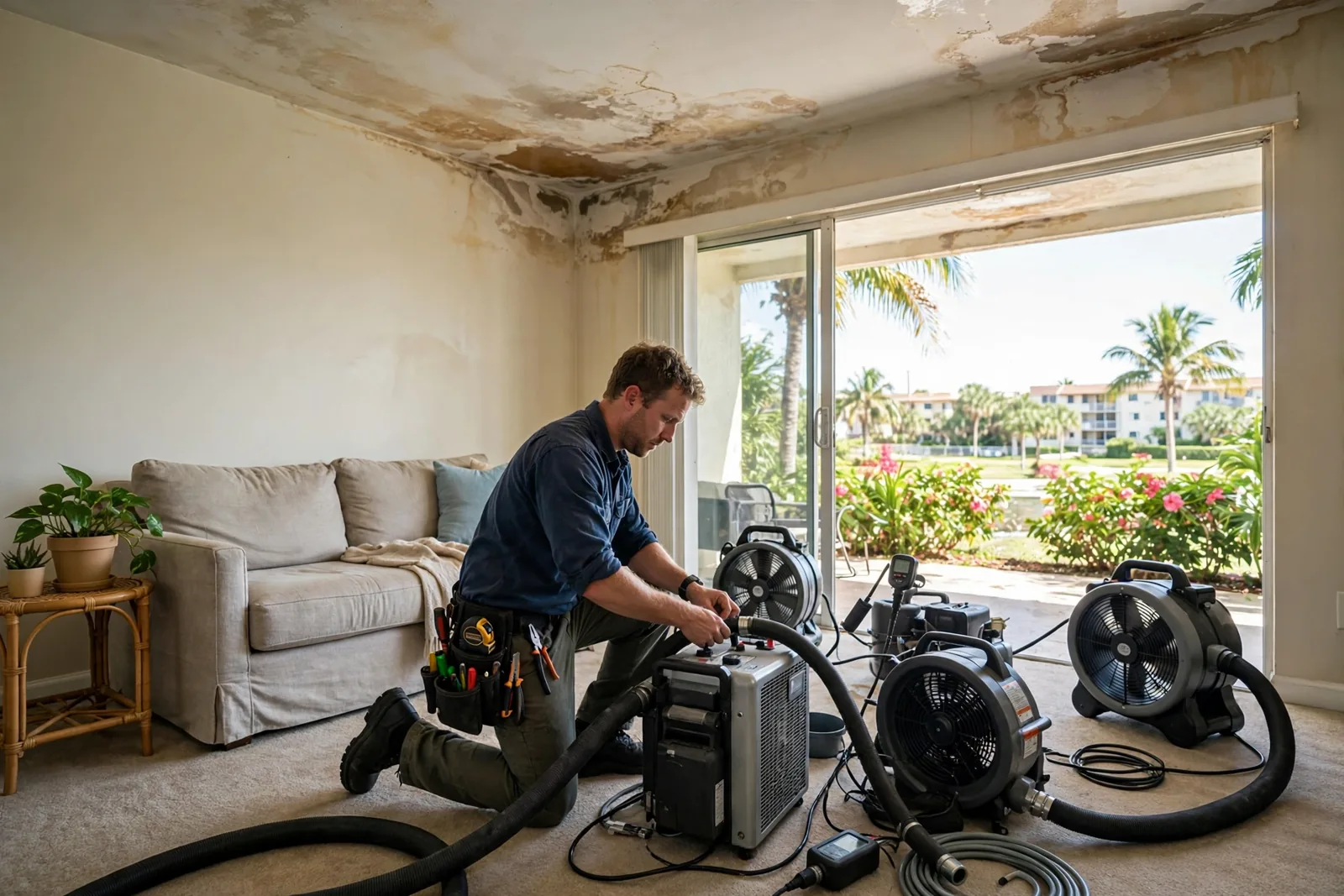
Apartment water damage restoration deals with stacked living: water travels down through ceilings, walls and shafts, so one failed supply line or AC condensate leak can affect the units below and beside it. The work is the same discipline as in a house — stop the source, extract, dry to measured targets — but coordination is harder: tenants, landlords, property managers and the owner of the unit above all need the same documented facts, fast.
We are a Fort Lauderdale service-area team: IICRC-informed, licensed & insured, 24/7 — including after-hours emergencies, when apartment leaks usually announce themselves — with no walk-in office. You get a written plan before we start, and per-unit photo and moisture documentation. Policies and leases vary, so we give no legal answers; we produce the documentation that protects everyone.
Apartment & Multi-Family Restoration at a Glance
- Defining feature: Stacked units — one leak can wet several homes
- Clock: Mold can begin in 24–48 hours; no waiting for office hours
- First move: Stop the source; identify every affected unit
- Documentation: Per-unit photos and moisture logs
- Coordination: Tenants, landlords, managers, source unit — one shared file
- Standard: IICRC-informed Category and Class approach
Why Does One Apartment Leak Affect So Many Units?
Because buildings share plumbing, walls and gravity. Supply and AC condensate lines run vertically; a failure upstairs drains through ceiling cavities and shafts, sometimes appearing two floors below before the source unit shows any sign. Water also spreads sideways along slabs and shared walls — so our first inspection checks the units below, beside and above. The caller is frequently not the source.
Locally: king tides and sunny-day flooding push water into ground-floor units, canals, the New River and the Intracoastal keep the water table high, and hurricane season (June 1–November 30) can wet whole buildings at once.
Who Is Responsible for What After an Apartment Water Loss?
It depends on the source, the lease and building policies, and whose insurance applies — all of which vary, so treat this table as a documentation guide, not a legal ruling. What does not vary: fast mitigation and a proper paper trail protect every party.
Tenant vs Landlord/Property Manager vs the Unit Above — Comparison
| Party | Responsibility | Documentation | Who calls |
|---|---|---|---|
| Tenant | Report it immediately, protect belongings, allow access | Their own photos, plus our per-unit report | Usually raises the alarm — landlord or manager first, and us any time |
| Landlord / property manager | The structure: mitigation, drying, repair, coordinating units | Our written scope, photos and moisture logs per unit | Typically authorises the restoration work |
| The unit above (source unit) | The source: their failed line or AC unit, and access to repair it | Source photos, our findings, the repair record | Whoever discovers it — source stopped first; fault later |
What Should Tenants and Managers Do in the First Hours?
Stop the source if safe (unit or building shut-off), call it in immediately — never wait until morning on an active leak — and photograph everything before items are moved. Keep clear of sagging ceilings and water near electrics. Do not let wet units wait for a coverage decision: insurers expect prompt mitigation. Call (214) 286-6943.
Managing a building with water in multiple units right now? Call (214) 286-6943. We assess every affected unit, document each one separately, and give you one clear written plan.
What Is Our Apartment & Multi-Family Restoration Process, Step by Step?
- Phone assessment — Which units are affected, the likely source, and whether it is stopped.
- On-site inspection — Moisture mapping in the reporting unit, units below and beside it, and the source unit.
- Category & Class ID — Contamination and drying difficulty per unit, IICRC-informed.
- Extraction and source control — Standing water removed; failed line, appliance or AC source isolated.
- Structural drying — Equipment set per unit, monitored to specific targets in ceilings, walls and floors.
- Cleaning & treatment — Antimicrobial treatment and sanitization where the category requires it.
- Documentation — A per-unit photo and moisture-log file for manager, owners and insurers.
- Final walkthrough — Each unit confirmed dry by readings, manager or tenant present where possible.
How Much Does Apartment Water Damage Restoration Cost in Fort Lauderdale?
Apartment work is priced in a written scope per loss, using this site’s published ranges: mitigation about $3–$4.25/sq ft (Category 1), $4–$6.50/sq ft (Category 2), $7–$12/sq ft (Category 3); reconstruction typically $20–$37/sq ft where ceilings or flooring came out. The average US water-damage claim is around $12,500 — multi-unit losses can involve several claims.
What changes the number: units affected (the biggest factor), water category and duration, ceiling and cavity involvement, and after-hours working. Who pays is decided by leases, policies and insurers, not by us.
How Does Insurance Work for Apartment Water Damage?
Usually more than one policy is in the picture — tenant’s contents, landlord’s property, sometimes the source unit’s liability — and each adjuster asks: what happened, where, and what was done, with evidence. Sudden failures are treated differently from gradual leaks; rising floodwater generally needs separate flood insurance. We cannot say how your lease allocates cost — only that every party should work from the same documented facts.
What Do Real Apartment Restoration Jobs Look Like? 3 Representative Scenarios
These are representative scenarios of how typical jobs of each type unfold — not a specific past client’s file.
Scenario 1 — Supply line failure, near Las Olas. A line failed upstairs overnight; by morning, ceilings in two units below were wet. Source stopped, all three units mapped and dried, a separate file per unit to the manager.
Scenario 2 — AC condensate leak, Coral Ridge area. A musty smell and bubbling paint traced to a neighbour’s overflowing condensate line wetting the shared wall. Opening, drying and treatment fixed it; documentation to the manager the same week.
Scenario 3 — Storm entry, Edgewood. In April 2023-pattern rain, several ground-floor units took on Category 3 water. Porous materials were removed, and units were cleaned, treated and dried in sequence.
Frequently Asked Questions
I am a tenant. Should I call you or my landlord first?
Your landlord or manager first — and if water is actively spreading, call us at (214) 286-6943 as well. Delay is how one unit’s leak becomes three units’ loss.
The water is coming from the empty unit above. What happens?
The manager normally arranges access and shut-off. We document your unit from the first visit, so the file exists regardless.
Will I have to move out during drying?
Often not — many units stay occupied with equipment running. With Category 3 water or major ceiling work, relocation may be safer; that decision sits with landlord and insurer.
Can you provide separate reports per unit?
Yes — standard on multi-family work, and can be summarised into one building-level file for the manager.
Who pays — me, my landlord, or the unit above?
It depends on the source, your lease and the policies. We guarantee a clear, documented scope so those parties and insurers can decide quickly.
One leak, several units, no time to waste. Call (214) 286-6943 for apartment and multi-family water damage restoration in Fort Lauderdale — documented per unit, 24/7.