
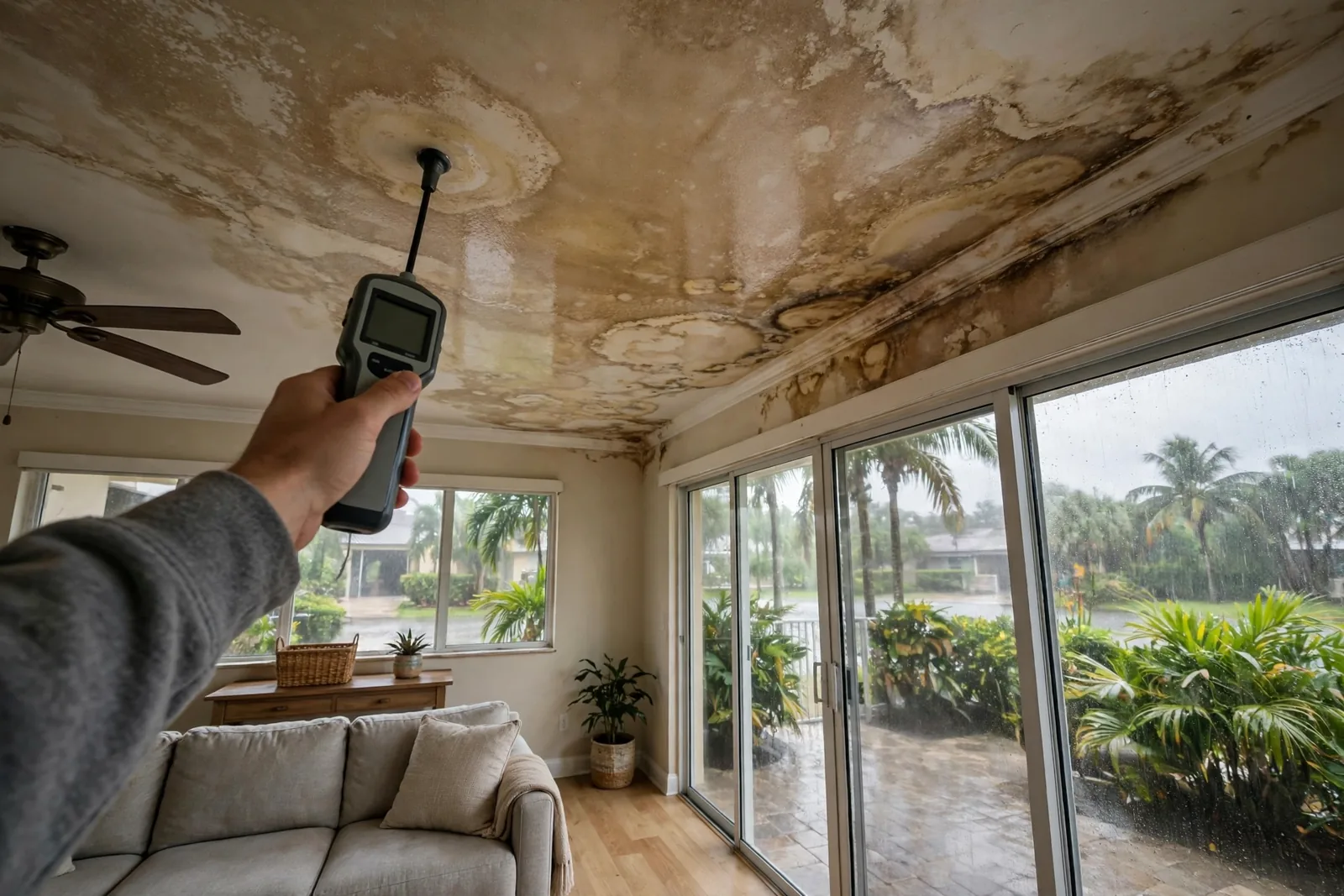
Ceiling stain growing when it rains? Call (214) 286-6943 — 24/7 in Fort Lauderdale.
Roof Leak Water Damage in Fort Lauderdale — Stop the Interior Damage
Roof leak water damage is water entering through the roof and soaking ceilings, insulation, walls, and attic materials below. It needs drying fast: in Fort Lauderdale’s humidity, mold can begin in 24–48 hours. By the time a stain shows through paint, water has usually soaked a much wider area above it. Wind-driven rain in hurricane season, June 1–November 30, also pushes water under shingles and flashing that holds fine in a normal shower — a storm-only leak is still a real leak.
We are Water Damage Restoration of Fort Lauderdale: IICRC-informed, licensed & insured, 24/7, a service-area business with no walk-in office. We restore the interior damage, map moisture, dry the structure, and document everything — written plan before we start, photo and moisture documentation throughout. Honest scope: we do not claim a roofing licence and we do not repair roofs. The roof itself needs a roofer; our job is stopping the interior damage becoming a mold and reconstruction job.
Roof Leak Water Damage at a Glance
- First sign: Ceiling stain, bubbling paint, or a drip during rain
- Hidden part: Wet attic insulation above the visible stain
- Clock: Mold can begin in 24–48 hours
- Our scope: Interior drying and documentation — roof repair is a roofer’s job
- Standard: Category and Class per IICRC S500
- Call: (214) 286-6943, 24/7
How Can You Tell a Roof Leak From a Plumbing Leak?
Roof leak stains worsen with rain, especially wind-driven rain. Plumbing leaks from above worsen with water use and can happen on a dry day. Roof leaks show near rooflines, exterior walls, and vents; plumbing leaks cluster under bathrooms or lines above. Do not paint over a stain and guess — moisture mapping shows exactly what is wet and decides what is dried or removed.
Roof Leak vs Plumbing Leak From Above — Comparison
| Factor | Active roof leak | Plumbing leak from above |
|---|---|---|
| Where stains appear | Near rooflines, walls, vents | Below bathrooms, pipes, AC units |
| When it worsens | During/after rain, worst in storms | When water is used above, any time |
| First check | Attic insulation above the stain | Shut-off and fittings above |
Why Do Roof Leaks Cause So Much Hidden Damage Here?
Water at the roofline runs along decking and rafters and pools in insulation, so the wet area is usually far wider than the stain in a Victoria Park or Coral Ridge home. Fort Lauderdale sits about 9 feet above sea level with slow drainage, and the April 12–13, 2023 storm dropped over 2 feet of rain in under 24 hours, with Edgewood, River Oaks, and Melrose Park hit worst. A wet attic here does not air out — it stays wet until dried on purpose.
What Should You Do While a Leak Is Active?
Put a container under any drip, move belongings from below if safe, and photograph everything before you move it — that starts your insurance file. Do not climb on a wet roof, and keep clear if a ceiling bulges or water is near wiring. Call (214) 286-6943 and tell us where the stain is and when it grows.
Will a Small Roof Leak Dry Out on Its Own?
No, not reliably. Once water reaches insulation and the back of drywall, humidity keeps it wet past the 24–48-hour mold window. We measure instead of guessing: readings show whether you need drying, selective removal, or nothing. If it is already dry, we tell you so.
Rain coming again and that stain is still wet? Call (214) 286-6943 — we map it, dry it, and document it for your adjuster.
What Is Our Roof Leak Water Damage Process, Step by Step?
- Phone assessment — Location, timing, and whether water is active now.
- On-site inspection — Ceiling, walls, and attic mapped with meters and imaging.
- Category & Class ID (IICRC S500) — Contamination and drying difficulty assessed.
- Extraction and selective removal — Water removed; unsalvageable wet material taken out.
- Structural drying — Air movers and dehumidifiers set to measured targets.
- Cleaning & treatment — Affected areas cleaned and treated where moisture sat.
- Documentation — Photos and moisture logs formatted for your adjuster.
- Final walkthrough confirmed by moisture readings — Not by appearance.
How Much Does Roof Leak Water Damage Cost in Fort Lauderdale?
Cost depends on category and affected square footage. Published pricing on this site: Category 1 mitigation about $3–$4.25/sq ft, Category 2 about $4–$6.50/sq ft, Category 3 about $7–$12/sq ft. Reconstruction, if drywall or flooring must be rebuilt, typically runs $20–$37/sq ft. The average US water-damage insurance claim is around $12,500.
What changes the number:
- How long the leak ran — one storm versus a season
- How much insulation and drywall is wet, not just stained
- Whether water reached walls or flooring below
You get a written scope before work starts. Roof repair is your roofer’s separate price.
Will Homeowners Insurance Pay for Roof Leak Water Damage?
Often for sudden storm damage; much less reliably for a worn roof or slow leak unnoticed for months, which insurers frequently treat as gradual damage and may exclude. Mitigate the interior anyway — policies expect you to prevent further damage — and keep our photos and logs for your adjuster. We will say upfront if part of a loss may not be covered. Rising floodwater generally needs separate flood insurance, often through the NFIP.
What Do Real Roof Leak Jobs Look Like? 3 Representative Scenarios
These are representative scenarios of how typical jobs of each type unfold — not a specific past client’s file.
Scenario 1 — Wind-driven rain, Coral Ridge. A ceiling stain appears only in hard storms. Mapping finds wet insulation far wider than the stain. It is removed, the cavity dried to target, and a roofer fixes the flashing — two honest scopes.
Scenario 2 — Leak caught late, Tarpon River. A painted-over stain returns larger by fall, with odor. Readings confirm the ceiling stayed wet between storms. Selective removal, treatment, and monitored drying follow.
Scenario 3 — Condo near Las Olas, source unclear. Water below an upper unit worsens with rain, not water use — the roof, not plumbing. Documentation goes to owner and association; drying proceeds once the building’s roofer is engaged.
Frequently Asked Questions
Do you repair the roof itself?
No. We restore interior water damage. The roof needs a licensed roofer.
How fast does mold start after a roof leak?
Mold can begin in 24–48 hours on wet drywall and insulation in this humidity. Measure a wet stain the same day.
Can a wet ceiling be dried without tearing it out?
Sometimes, if drywall is sound and insulation is not saturated. Readings decide — soaked or soft material comes out.
Should I wait for my roofer first?
No. Roofer and drying can run in parallel. Waiting is how drying becomes remediation.
What if it only leaks during storms?
That is classic wind-driven rain under roofing or flashing. It is still an active leak — photograph it and get it mapped.
Wet ceiling or a stain that grows with every storm? Call (214) 286-6943 now — 24/7, licensed & insured, written plan before we start.