
Water damage in Lauderhill right now? Call (214) 286-6943 — 24/7 dispatch from our Fort Lauderdale service area, with a written plan before we start.
Water Damage Restoration in Lauderhill, FL — Local Help, Fort Lauderdale Based
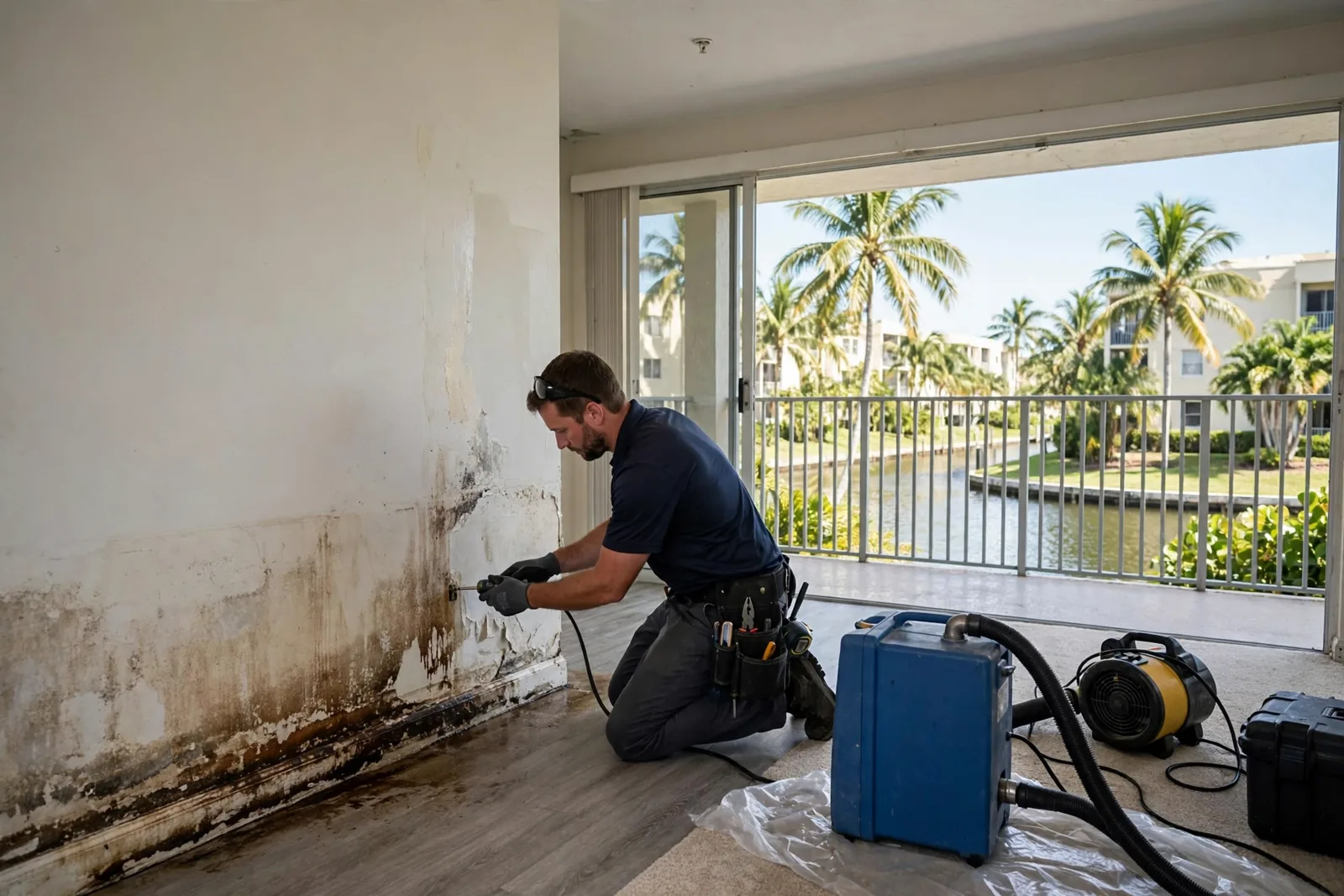
Lauderhill, northwest of Fort Lauderdale in central Broward, is a city of canals and condominium communities. Large, established condo developments make up a major share of its housing, alongside single-family neighbourhoods of the same 1970s–80s building era — and the water-damage work here follows that stock. Ageing shared plumbing, original condo water heaters and AC systems, and canal-side ground floors are the recurring themes, with the added complication that in a condo community, a single pipe failure can involve the owner, the association and two neighbouring units before lunch.
We handle Lauderhill the way multi-family work has to be handled: find the true source, dry each affected unit to measured targets, and keep documentation so clean that insurers and associations are arguing from facts. And for the city’s single-family homes, the same discipline applies — map the moisture, tell you what can be saved, and put the scope in writing first.
We are Water Damage Restoration of Fort Lauderdale: IICRC-informed technicians, licensed & insured, a service-area business with no walk-in office — we come to you. Same discipline on every job: find the source, map the moisture, dry to a measured target, document everything for your insurer.
Water Damage Restoration in Lauderhill at a Glance
- Based: Fort Lauderdale service area — Lauderhill lies northwest of Fort Lauderdale, inland in central Broward — firmly inside our Fort Lauderdale service area
- Available: 24 hours a day, 7 days a week, including holidays
- Clock: Mold risk begins within 24–48 hours in South Florida humidity — same-day mitigation matters
- Local watch-out: Canals run through the whole city, and a large share of housing is 1970s–80s condominiums — shared plumbing and ageing lines are the recurring story
- Standards & paperwork: IICRC-informed work per IICRC S500; photo documentation + moisture logs for your claim from day one
What Water Damage Services Do We Provide in Lauderhill?
The full restoration service, not just the first hour of it:
- Mitigation, extraction & structural drying — stop the spread, remove standing water, dry to measured targets
- Flood damage cleanup & sewage cleanup — contaminated Category 3 water removed and the area sanitised
- Mold remediation & mold inspection — when damage sat too long, or before you buy or sell
- Leak detection & moisture mapping — find the true source and the full extent before anyone opens a wall
- Repair & reconstruction — rooms put back together after drying is verified
How Fast Can You Get to Lauderhill?
Lauderhill is inland just northwest of Fort Lauderdale, an easy dispatch from our Fort Lauderdale service area. We do not publish guaranteed arrival times — in condo communities, gate access and building procedures affect the real timeline as much as the drive does. Call (214) 286-6943 at any hour; we will confirm coverage for your Lauderhill address, ask the building-access questions upfront, and give you a straight dispatch estimate on the call.
What Causes Most Water Damage in Lauderhill?
Lauderhill’s most common causes, as we see them described across the city:
- Condo plumbing at scale — large 1970s–80s communities where stacks, risers, water heaters and unit supply lines are all of the same age and begin failing in clusters
- Unit-to-unit spread — upstairs bathrooms, kitchens and AC units leaking into the units below, often discovered from the ceiling down
- Canal-adjacent ground floors — the canal network crossing the city keeps nearby ground low and wet-season ground moisture high, complicating ground-floor drying
- Original single-family systems — homes of the same era carry original slab plumbing, cast-iron drains and ageing roof details
- AC condensate overflows — the year-round South Florida cause, especially damaging in units that sit closed between seasonal stays
Why Does Lauderhill’s Condo Stock Shapes Its Water Damage?
Lauderhill’s defining water feature is not a river — it is repetition. When a community of hundreds of units was built in a few years with the same plumbing materials, those materials reach end-of-life together. One building’s cast-iron stack failure is a warning for the whole street. For owners, the practical consequence is that a “small leak” in a Lauderhill condo deserves a wider inspection than the same leak in a newer building: the line that failed in your kitchen wall has identical siblings behind your bathroom wall.
The canals are the second factor. They cross the city and connect into the wider Broward canal system, keeping the water table close to the surface for nearby ground floors through the wet season. After the kind of extreme rain events South Florida now sees regularly — Fort Lauderdale’s April 2023 storm dropped over two feet of rain in under a day just a few miles east — canal-side ground drains slowly, and ground-floor units can take moisture through slabs and door thresholds even without any plumbing failure at all. Sorting plumbing water from ground water, with meters, is where a Lauderhill job starts.
Not sure how far the water has travelled? In Lauderhill the visible stain is rarely the whole job. Call (214) 286-6943 for a phone assessment first — we will tell you honestly whether you need a crew today or a plumber first.
How Much Does Water Damage Restoration Cost in Lauderhill?
Start with the category and the square footage — that is what actually drives the number. On the pricing published across this site, mitigation runs about $3–$4.25/sq ft for Category 1 clean water, $4–$6.50/sq ft for Category 2, and $7–$12/sq ft for Category 3 (sewage and floodwater), with reconstruction typically $20–$37/sq ft after that. What pushes a job up or down locally is how far water travelled — into wall cavities, under flooring, into a second room.
Does Insurance Cover Water Damage in Lauderhill?
Usually, for sudden events — a burst pipe or a failed water heater is typically covered, while gradual damage from a leak that ran unnoticed for months is frequently excluded. Rising water from outside (street flooding, storm surge) generally needs a separate flood policy, often through the NFIP, rather than a standard homeowners policy. We document every job with photos and moisture logs an adjuster can actually use, we can speak directly with your adjuster, and we will tell you upfront if part of a loss looks like it may not be covered.
What Does the Restoration Process Look Like?
- Phone assessment — what happened, when, and where, so the right crew is dispatched.
- On-site inspection — source and full extent checked in person.
- Category & Class ID — contamination level and drying difficulty, per IICRC S500.
- Extraction — standing water and unsalvageable materials out first.
- Structural drying — equipment set to specific moisture targets, monitored daily.
- Cleaning & treatment — antimicrobial treatment and odour control where needed.
- Documentation — photos and moisture logs formatted for your adjuster.
- Final walkthrough — dryness confirmed by readings, not by touch.
What Do Jobs in Lauderhill Actually Look Like? Representative Scenarios
These are representative scenarios of how typical jobs of each type unfold in Lauderhill — not a specific past client’s file, and not testimonials.
Scenario 1 — Stack failure affecting three condo units. A drain stack leak wets a vertical line of units. Each unit is inspected, dried and documented separately; the source evidence supports the association’s involvement, and no unit’s claim depends on another’s paperwork.
Scenario 2 — Seasonal condo, condensate leak found on return. Owners return to a musty unit and a collapsed ceiling patch — a condensate overflow ran for weeks in a closed unit. Remediation joins drying at that point, and the conversation turns to prevention: condensate servicing and a shut-off routine before the next trip.
Scenario 3 — Canal-side single-family home, ground moisture plus roof leak after storms. Two separate problems after a storm spell: wind-driven roof entry upstairs, slab moisture downstairs. Mapped and treated as the two different jobs they are — roof-side drying in the attic and bedrooms, ground-floor monitoring rather than demolition.
Frequently Asked Questions
My Lauderhill condo community has had several leaks this year. Is that a coincidence?
Probably not. Communities built in one era with one set of plumbing materials tend to see failures cluster as those materials age out. It is worth having your own unit’s lines and water heater assessed even if your leak has not happened yet.
Who is responsible when a condo pipe fails — me or the association?
It depends on whether the failed line serves only your unit or is a common element, and on the association’s documents and master policy. We document the source precisely and can speak with adjusters — that evidence is what the responsibility question is actually decided on.
Do you work in gated condo communities in Lauderhill?
Yes. Tell us the gate and access procedure on the first call ((214) 286-6943) and we coordinate arrival, parking and building rules with you and, where needed, the association.
Can ground-floor dampness near the canals be fixed by drying alone?
If it is ground moisture rather than a leak, equipment drying alone is not the whole answer — the moisture source is the saturated ground itself in wet season. Mapping tells us which problem you have; a leak gets repaired and dried, ground moisture gets managed and monitored honestly.
How are seasonal owners supposed to catch leaks early?
Shut off the unit’s water when leaving for long periods, keep the AC serviced so condensate drains properly, and have someone walk the unit after big storms. If you return to damage, photograph before touching anything and call the same day.
Water in your Lauderhill home or business? Call (214) 286-6943 now — 24/7, a written plan before we start, and documentation your adjuster can use.