
Water in guest rooms, a dining room, or an office floor? Call (214) 286-6943 — 24/7 in Fort Lauderdale. Every hour of downtime costs more than the drying does.
Hotel, Restaurant & Office Water Damage in Fort Lauderdale — Downtime Is the Real Cost
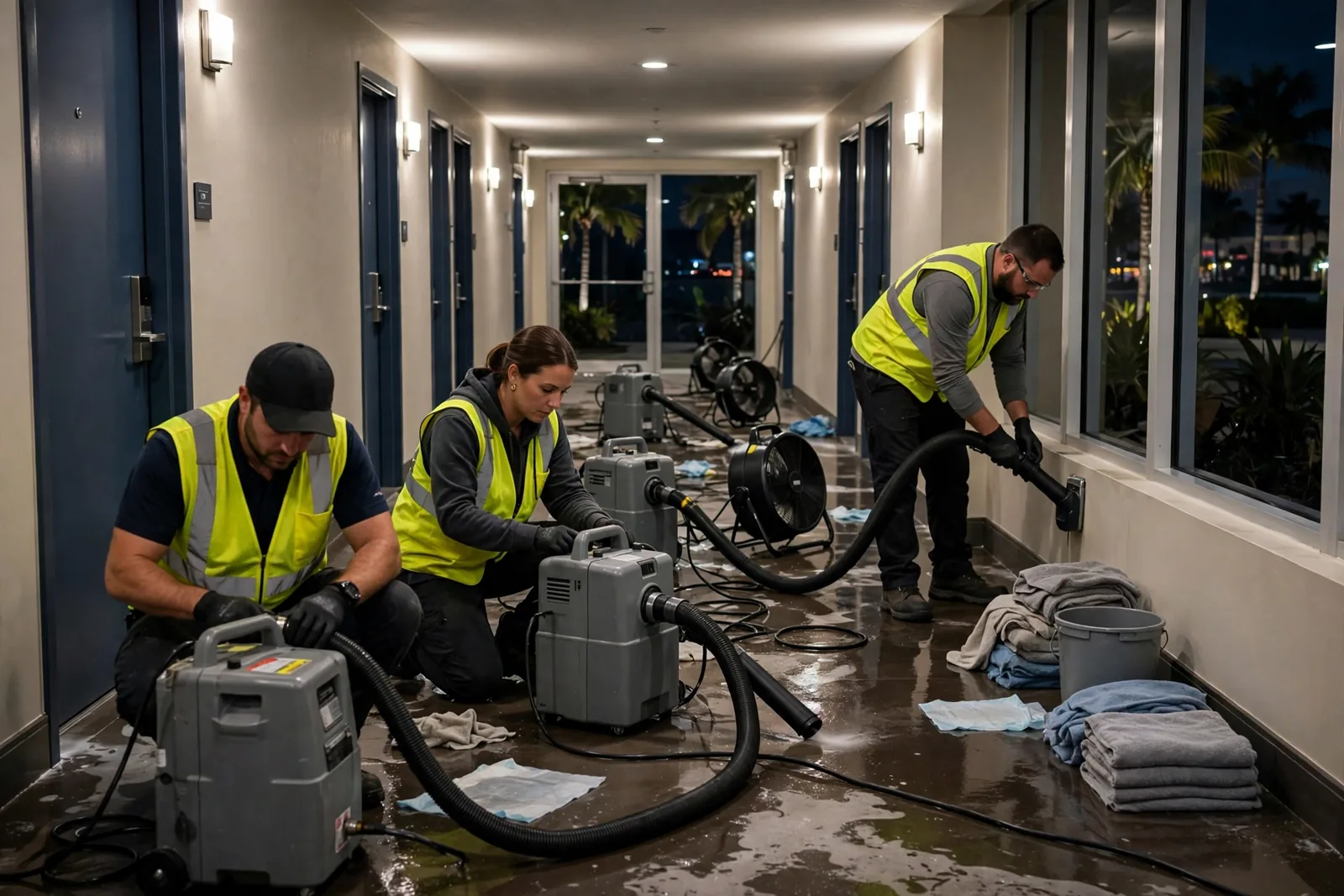
For a hotel, restaurant or office, water damage is two losses at once: the physical damage, and the downtime while rooms, tables or desks cannot be used. Commercial restoration in Fort Lauderdale has to solve both — stop and dry the loss to measured targets, and phase the work, including off-hours, so the business keeps operating wherever it safely can. A burst line over a dining room is a revenue problem with water in it.
We are a Fort Lauderdale service-area team: IICRC-informed, licensed & insured, 24/7, no walk-in office. You get a written plan before we start, phased around your operating hours, and photo and moisture documentation for your insurer and ownership or management group. From the beach and hospitality corridor to downtown offices, we talk straight about what can stay open, and for how long.
Hotel, Restaurant & Office Water Damage at a Glance
- Real cost: Downtime — unusable rooms, covers and desks — plus the repair
- Working pattern: Phased and off-hours, where safety and category allow
- Clock: Mold can begin in 24–48 hours; weekends left wet mean bigger closures
- Scope discipline: Only affected areas close — mapping defines them
- Documentation: Photo and moisture-log file per area
- Standard: IICRC-informed Category and Class approach
How Is Commercial Water Damage Different From a House?
The restoration physics is the same; the pressures are not:
- Displacement: Guests move rooms, diners cannot be seated, staff cannot work at wet desks — lost use, described without invented figures
- Scale and systems: Larger floor plates, shared risers and AC systems, and materials that hide moisture
- More decision-makers: Managers, ownership groups, tenants and insurers may all need the same file
- Timing: Work bends around check-ins, service and office hours — planned phases, night work
Hotel vs Restaurant vs Office Losses — Comparison
| Setting | Main pressure | Typical causes | Working pattern |
|---|---|---|---|
| Hotel | Guest displacement, rooms out of service | Guest-room plumbing, AC condensate overflows, storm entry | Room-by-room phases; night work in corridors and back-of-house |
| Restaurant | Lost service and hygiene — a wet kitchen cannot trade | Kitchen and bar plumbing, appliance failures, storm entry | Off-hours work; Category 3 areas closed until cleaned, treated, verified |
| Office | Staff displacement, interrupted operations | Risers, bathroom stacks, AC systems, roof leaks | Zoned drying around working areas; weekends for intrusive phases |
What Happens in the First Hours of a Commercial Loss?
The same discipline as any loss, run faster and documented wider. Source stopped, safety confirmed, and moisture mapping defines the true affected area — which decides how much of the business closes. Over-closing wastes revenue; under-closing leaves wet material to become a mold problem that closes you for longer. Extraction, targeted removal and monitored drying follow; the phased plan is agreed in writing.
Hurricane season (June 1–November 30) and events like the April 12–13, 2023 storm — over 2 feet of rain in under 24 hours — are the extreme case: ground-floor space near the coast, canals and the Intracoastal can take on Category 3 water, treated as contamination, not damp.
Deciding how much of your property to close tonight? Call (214) 286-6943. We moisture-map first, so the closure is exactly as big as the damage — no bigger, no smaller.
What Is Our Commercial Restoration Process, Step by Step?
- Phone assessment — What happened, which areas, what is closed, your operating constraints.
- On-site inspection — Moisture mapping across affected and adjoining areas, cavities and shared risers.
- Category & Class ID — Contamination and drying difficulty, IICRC-informed — sets what is dried, removed, and closed.
- Extraction and area control — Water removed; affected zones isolated so trading areas stay safe.
- Structural drying — Equipment set per zone, monitored to specific targets, phased around operating hours.
- Cleaning & treatment — Cleaning, sanitization and antimicrobial treatment by water category, before reopening.
- Documentation — A per-area photo and moisture-log file for insurer and ownership.
- Final walkthrough — Each area confirmed dry by readings and reopened in the agreed sequence.
How Much Does Commercial Water Damage Restoration Cost in Fort Lauderdale?
Commercial losses are priced in a written scope per loss, using this site’s published ranges: mitigation about $3–$4.25/sq ft (Category 1), $4–$6.50/sq ft (Category 2), $7–$12/sq ft (Category 3); reconstruction typically $20–$37/sq ft where finishes or flooring came out. The average US water-damage claim is around $12,500 — commercial files are scoped on their own facts, and the downtime figure is for you and your insurer, not one we invent.
What changes the number: square footage and number of areas, water category, phased or off-hours working, and reconstruction scope.
How Does Insurance Handle a Commercial Water Loss?
Commercial policies generally treat sudden events — a burst riser, a failed appliance line — differently from gradual leaks, and rising floodwater generally requires separate flood coverage. Interruption questions sit with your policy and broker; what we control is the evidence: a dated, per-area photo and moisture record showing what was damaged, what was done, and when each area was verified dry and reopened — often the backbone of an interruption claim, built from hour one.
What Do Real Commercial Jobs Look Like? 3 Representative Scenarios
These are representative scenarios of how typical jobs of each type unfold — not a specific past client’s file.
Scenario 1 — Hotel, Galt Ocean Mile. An AC condensate overflow wet a corridor and two guest rooms; only those rooms closed. Corridor work ran overnight, rooms verified dry before returning to service, one documented file to the insurer.
Scenario 2 — Restaurant, downtown. A kitchen line failed before service; the kitchen and one dining section closed, the rest traded. Cleaning and sanitization were verified before reopening — no shortcuts on a food premises.
Scenario 3 — Office, downtown. A stack leak wet ceiling tiles and carpet on part of a floor plate. Drying was zoned so the unaffected half kept working; ceiling work ran over a weekend.
Frequently Asked Questions
Can we stay open during restoration?
Often, in part. Mapping defines the affected area; work is phased or off-hours so the rest keeps trading, if category and safety allow. Category 3 areas stay closed until cleaned, treated and verified.
How fast can you be on site for a commercial loss?
We respond 24/7. Call (214) 286-6943 with the areas affected and what is closed; we confirm dispatch and first-visit scope.
Do you work nights and weekends?
Yes, where the plan calls for it — standard for hospitality and office work here, not a special favour.
Will you document the loss for our ownership group?
Yes. The per-area file is formatted for insurers, owners and management groups, including the reopening timeline.
Is this different from your general commercial service?
It is the hospitality-and-office specialisation of it — same team and standards, phasing built around trading hours.
Every closed room, table and desk is a cost. Call (214) 286-6943 now for a written, phased restoration plan for your Fort Lauderdale property — 24/7.