
Floodwater inside your home right now? Do not wade in until you read the safety answer below — then call (214) 286-6943, 24/7 in Fort Lauderdale & Broward County.
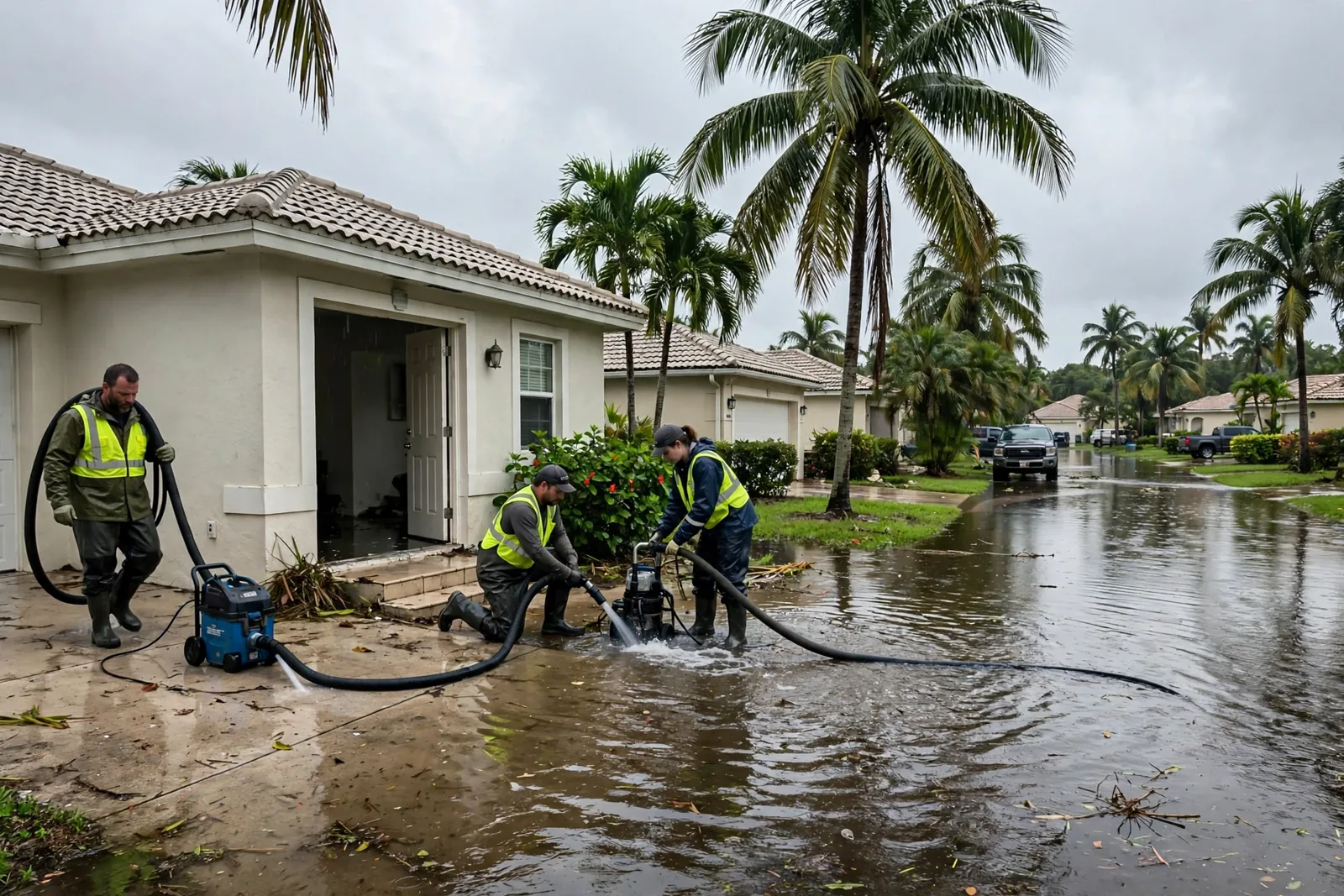
Flood Damage Cleanup in Fort Lauderdale — After the Water, the Clock Starts
Flood damage cleanup is the removal of floodwater and contaminated materials, followed by cleaning, sanitising and measured structural drying, after water enters a home from outside — heavy rain, storm surge, king tides, or overflowing canals and storm drains. Fort Lauderdale knows this better than almost any city in America. We sit at about 9 feet above sea level on a network of canals, the New River and the Intracoastal. On April 12–13, 2023, more than 2 feet of rain fell here in under 24 hours — the rainiest day in the city’s recorded history — and neighbourhoods including Edgewood, River Oaks and Melrose Park took on some of the worst interior flooding, in places over 18 inches.
Here is the part most homeowners learn too late: floodwater is not clean water. Outside water that has crossed streets, yards, sewers and garages is treated as Category 3 — the most contaminated category in the IICRC S500 standard. That changes everything about the cleanup. Flood-damaged porous materials are removed, not dried and kept. If a crew treats a flood like a plumbing leak, they are leaving contamination inside your walls.
We are IICRC-informed, licensed & insured, and on call 24/7. Written plan before we start, photo and moisture documentation at every stage, and straight talk about flood insurance — because flood losses are claimed differently from almost every other kind of water damage.
Flood Damage Cleanup in Fort Lauderdale at a Glance
- Water type: Floodwater = Category 3 (contaminated) — porous materials are removed, not saved
- Local triggers: Extreme short-burst rain, hurricane storm surge, king tides / sunny-day flooding, canal and storm-drain overflow
- Highest-risk pattern: Ground-floor homes in low-lying areas — Edgewood, River Oaks, Melrose Park and streets near canals and the New River
- Clock: Mold risk begins in 24–48 hours; contaminated drying takes longer than clean-water drying
- Insurance: Rising floodwater is generally NOT in a standard homeowners policy — it usually needs separate flood insurance, often through the NFIP
- Proof: Photos before anything is moved, moisture logs throughout — your flood claim depends on both
Is Floodwater Really That Different From a Burst Pipe in My Home?
Yes — in category, in method, and in insurance.
- Burst pipe: Usually Category 1 clean water from a supply line. Much of what got wet can be dried and saved.
- Floodwater: Category 3. It has travelled across roads, soil, fertiliser, fuel, and, when systems are overwhelmed, sewage. Drywall, insulation, carpet and padding that floodwater has soaked are removed, the structure behind them is cleaned and treated, and only then does drying start.
That is not upselling. It is the S500 approach, and it is why a real flood estimate looks different from a leak estimate for the same square footage.
Flood Cleanup vs Clean-Water Cleanup — Comparison
| Question | Clean-water loss (burst pipe) | Flood loss (rain, surge, tide) |
|---|---|---|
| Water category | Usually Category 1 | Category 3 — contaminated |
| Porous materials | Often dried and saved | Removed, not dried |
| Cleaning | Standard cleaning | Sanitising + antimicrobial treatment required |
| Typical insurance route | Homeowners policy, if sudden | Separate flood insurance / NFIP in most cases |
| Main hidden risk | Trapped moisture in walls | Contamination + trapped moisture |
Which Parts of Fort Lauderdale Flood First, and Why?
The pattern repeats because the geography does not change:
- Low elevation + slow drainage: At roughly 9 feet above sea level, with some neighbourhoods lower, stormwater has very little fall to drain away. Intense rain arrives faster than the system can move it.
- Canals, river and tide: High tides and storm surge push water back through drainage. During king tides in the autumn, streets near the Intracoastal and the Las Olas Isles can flood on a sunny day, with no rain at all.
- Ageing infrastructure: Parts of the stormwater and sewer system date back decades. Extreme short-burst rainfall — the April 2023 pattern — overwhelms capacity even when the system is working as designed.
- Ground-floor living: Single-storey and ground-floor homes, garages and converted ground-floor spaces take the water first. A few inches outside can become interior flooding once door thresholds are passed.
If you live in Edgewood, River Oaks, Melrose Park, along a canal in Coral Ridge or Wilton Manors, or near the New River in Tarpon River or Sailboat Bend, your flood plan should be written before hurricane season — June 1 to November 30 — not during a storm.
What Should I Do in the First 24 Hours After a Flood?
- Safety before property: Do not enter standing floodwater if power could be live, and treat all floodwater as contaminated — boots and gloves, no bare skin contact, keep children and pets out.
- Do not start the car in a flooded garage, and do not move a vehicle through deep water to “save” it at the risk of entering a flooded space.
- Photograph and video everything before anything is moved — water lines on walls, every room, serial plates on appliances. This is the backbone of a flood claim.
- Stop further entry if you safely can — sandbags and door seals only help before or during minor entry, never at the risk of wading in contaminated water.
- Call a flood cleanup team the same day — (214) 286-6943. Extraction, removal decisions and documentation need to start inside the 24–48 hour mold window.
- Call your insurer / flood insurer early and keep every receipt. Do not throw damaged items away before they are documented.
What Does Flood Damage Cleanup Actually Include, Step by Step?
- Phone assessment — What entered, how deep, and is the water still rising? Safety guidance comes first.
- On-site inspection — Water depth, category confirmation, and moisture mapping of how far water travelled up walls and under floors.
- Extraction — Standing floodwater removed with truck-mounted and portable equipment.
- Removal — Flood-soaked porous materials removed: typically carpet and padding, affected drywall and insulation, swollen baseboards and damaged contents that cannot be sanitised.
- Cleaning & treatment — The exposed structure is cleaned, sanitised and treated with antimicrobial products where contamination is present.
- Structural drying — Air movers and dehumidifiers run to specific moisture targets, monitored and logged daily.
- Documentation — Photo record and moisture logs formatted for a flood insurance adjuster.
- Final walkthrough — Confirmed by moisture readings, not by appearance.
Inches of water or a full ground floor — the first decisions decide the whole claim. Call (214) 286-6943 for a written flood cleanup plan before we start.
How Much Does Flood Damage Cleanup Cost in Fort Lauderdale?
Category 3 mitigation — the category floodwater falls into — runs about $7–$12/sq ft for mitigation alone on this site’s published guide. Full reconstruction after removal typically runs $20–$37/sq ft. Nationally, the average insurance claim for water damage is around $12,500, and larger flood losses go well above that average because removal and reconstruction replace the materials that clean-water jobs can save.
Your cost is driven by:
- Depth and spread — a 2-inch entry and an 18-inch entry are different jobs entirely
- How much porous material floodwater reached (flooring type matters most)
- Whether electrical, appliances or HVAC were affected — those need their own specialists
- How fast cleanup starts — delay adds mold remediation on top of flood cleanup
You get a written scope with real numbers before full work starts.
Does Insurance Cover Flood Damage in Fort Lauderdale?
Usually not under a standard homeowners policy. This is the hardest conversation in Florida water damage, so here it is plainly:
- Homeowners policies typically cover sudden internal events like a burst pipe. Rising water from outside — rain flooding, storm surge, tide — is generally excluded.
- Flood insurance is a separate policy, often through the NFIP, and it is the route most true flood losses are claimed under.
- Documentation decides outcomes. Photos before removal, moisture logs, and a written scope are what an adjuster works from. We produce all three, we can speak directly with your adjuster, and we will tell you upfront if we think part of a loss may not be covered.
If April 2023 taught Fort Lauderdale one thing, it is that a home does not have to sit in a high-risk flood zone on a map to take on a foot of rain floodwater in a single day.
What Do Real Flood Cleanups Look Like? 3 Representative Scenarios
These are representative scenarios of how typical jobs of each type unfold — not a specific past client’s file.
Scenario 1 — Extreme rain, ground-floor home, low-lying neighbourhood. Several inches of rain floodwater enter during a short-burst storm, the April 2023 pattern in Edgewood and Melrose Park. Flood-soaked carpet, padding and lower drywall are removed, the slab and framing are cleaned, treated and dried to measured targets, and the file is documented for a flood claim.
Scenario 2 — King tide / sunny-day flooding, canal-front home. Seawater pushes in at ground level during an autumn king tide near the Intracoastal. Volumes are smaller, but salt water changes the job: materials are assessed for salt contamination, cleaning is thorough before drying, and the homeowner gets a prevention conversation — thresholds, backflow and storage — not just a cleanup.
Scenario 3 — Storm surge after a hurricane, coastal property. Six to ten inches of surge water cross a ground floor near the coast. The response waits for safe access, then runs the full Category 3 sequence — extraction, removal, sanitising, Class 3 drying and a moisture map — with documentation prepared for what is typically a separate flood insurance claim alongside any wind claim.
Frequently Asked Questions
Can flood-damaged drywall and carpet be dried and saved?
Generally, no. Floodwater is Category 3, so porous materials it has soaked — carpet, padding, drywall, insulation — are removed. The structure behind them is cleaned, treated and dried. Hard, non-porous surfaces can usually be cleaned and sanitised.
How long does flood damage cleanup take?
Extraction and removal usually start the same day we can safely access the property. Drying to verified targets commonly takes several days or longer after a flood, because volumes and wall saturation are greater than a typical leak. Mold remediation, if delay allowed growth to start, adds time.
Is floodwater in my home a health risk?
Treat it as one. Category 3 water can carry bacteria and chemicals picked up outside, and sewage contamination is possible when systems are overwhelmed. Keep skin contact to a minimum, keep children and pets out of affected areas, and let the cleanup include sanitising.
What is the difference between flood cleanup and water mitigation?
Flood cleanup is mitigation for an outside-water, Category 3 loss — with removal and sanitising at its centre. Water mitigation is the wider emergency phase for all water types. Every flood job is a mitigation job; not every mitigation job is a flood job.
Will you help with my flood insurance claim?
Yes. You receive a full photo and moisture-log report formatted for insurance, and we can speak directly with your adjuster. We will also tell you plainly if part of a loss looks like it falls outside your policy.
Which areas do you cover for flood cleanup?
Fort Lauderdale and Broward County, including Edgewood, River Oaks, Melrose Park, Coral Ridge, Oakland Park, Wilton Manors, Hollywood, Pompano Beach, Plantation, Davie, Sunrise and Coral Springs. As a service-area business we come to you — call to confirm coverage for your address before dispatch.
Floodwater leaves contamination behind even after it recedes. Call (214) 286-6943 now — same-day flood assessment, a written plan, and documentation your adjuster can actually use.