
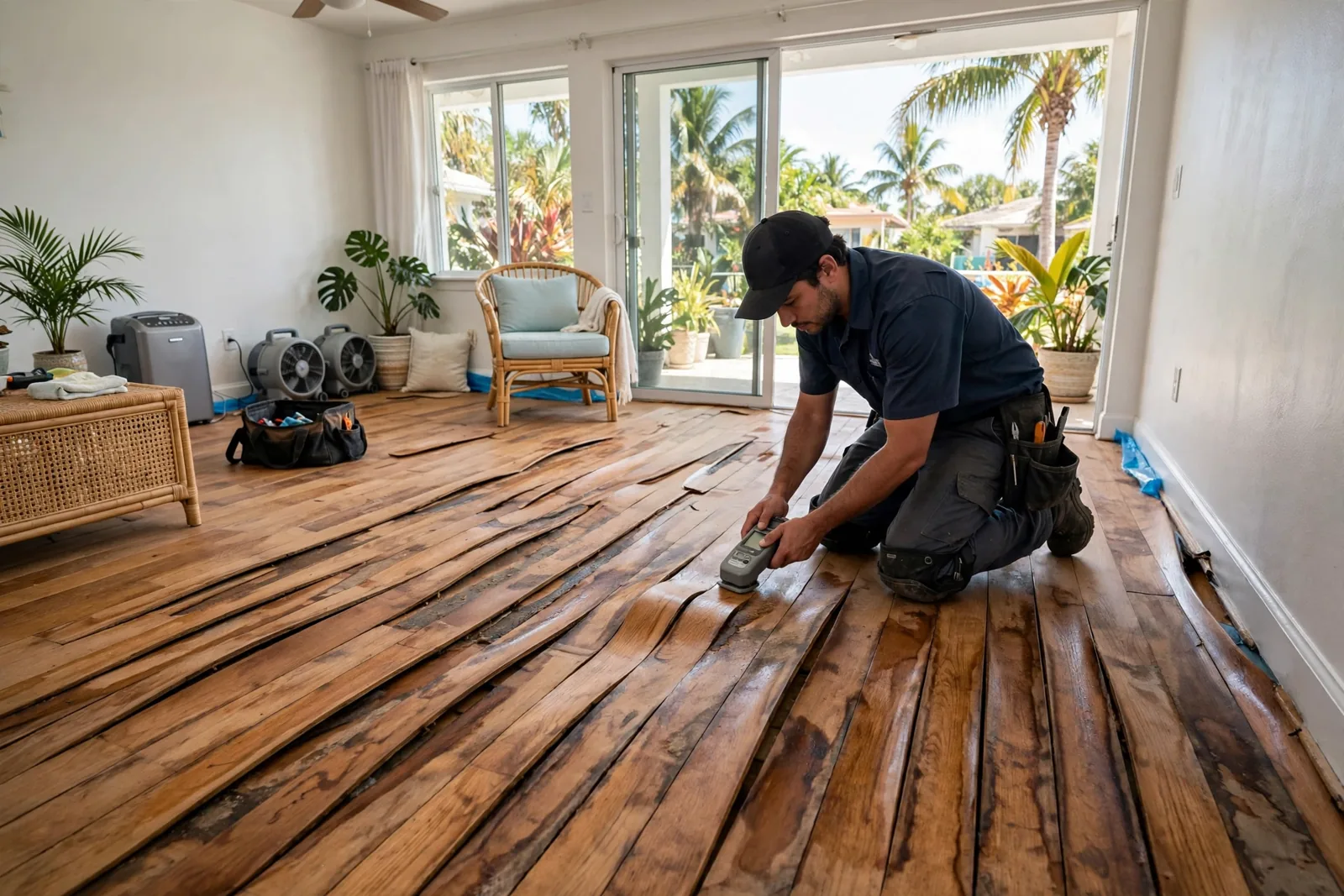
Hardwood cupping, buckling, or gone dark after a leak? Call (214) 286-6943 — 24/7 in Fort Lauderdale. Moisture readings decide whether your floor can be saved.
Hardwood Floor Water Damage in Fort Lauderdale, FL
Hardwood floor water damage is handled by extracting the water fast, measuring how much moisture the boards and the structure under them have taken on, and drying with floor-focused equipment while readings are tracked — because whether a wood floor can be saved is a measurement question, not an opinion. Cupped boards sometimes flatten again as they dry properly. Buckled, delaminated, or long-soaked floors often do not, and anyone who promises a result before taking readings is guessing with your money.
Fort Lauderdale stacks the odds. The city sits about 9 ft above sea level, humidity is high year-round and slows every drying job, and mold can begin in 24–48 hours — including under a floor that looks dry on top. Many homes sit on slab, so water also travels between slab and flooring where you cannot see it. We are a licensed & insured, IICRC-informed service-area business with no walk-in office, available 24/7, with a written plan before we start and photo and moisture documentation throughout.
Hardwood Floor Water Damage at a Glance
- Decided by readings: Moisture content of boards and subfloor or slab, measured and logged
- Early signs: Cupping, darkening, edges feeling raised
- Late signs: Crowning after bad drying, buckling, boards lifting
- Clock: Same-day extraction and drying give a floor its best chance
- Technique: Floor drying systems draw moisture out of boards in place, monitored daily
- Cost guide: Mitigation $3–$4.25/sq ft (Category 1), $4–$6.50/sq ft (Category 2), $7–$12/sq ft (Category 3); reconstruction $20–$37/sq ft
What Do Cupping, Crowning, and Buckling Actually Mean?
They are three different reactions to moisture, at different stages. Cupping means the edges of a board rise higher than its centre, because the underside took on more moisture than the top — the most common early sign, and it can improve as the floor dries correctly. Crowning is the opposite, the centre rising, and it often appears when a cupped floor was sanded flat too soon, before it had actually dried. Buckling means boards have pulled away and lifted — a late stage that usually means at least that section cannot be dried back into place. If you see any of the three, do not sand, and do not wait to see if it settles.
Can a Wet Hardwood Floor Actually Be Saved?
Sometimes — that is the honest answer, and here is what it depends on:
- How long it was wet: Hours is a drying job; weeks is often a removal job
- What the floor is: Solid hardwood tolerates in-place drying best; engineered depends on construction; laminate rarely survives soaking
- How much water, and what category: Clean supply water differs from Category 3 floodwater, which means removal for health reasons regardless of the wood
- What is underneath: Water trapped between flooring and slab decides the plan as much as the boards do
Floor drying systems — mats and directed airflow pulling moisture from the boards — paired with dehumidification are the standard approach, run monitored to target readings, not a guessed number of days.
Solid Hardwood vs Engineered Wood vs Laminate vs Tile on Slab — Comparison
| Flooring | Can it be dried? | Signs | Salvage outlook |
|---|---|---|---|
| Solid hardwood | Often, if drying starts fast | Cupping, darkening, raised edges | Best of the wood floors — sometimes flattens as it dries to target |
| Engineered wood | Sometimes — depends on construction and time wet | Cupping, veneer lifting or splitting | Mixed; delaminated sections removed, sound sections may dry |
| Laminate | Rarely after real soaking | Swollen, bubbling seams, spongy feel | Poor — swollen laminate does not return to shape; removal is usual |
| Tile on slab | Tile usually survives; moisture beneath is the issue | Loose or hollow tiles, wet grout, moisture at walls | Good for tile itself; drying focuses on slab, edges, adjoining materials |
Why Does Fort Lauderdale Humidity Change the Answer?
Because a floor dries into the air around it, and South Florida air is already moisture-heavy most of the year. A floor that might air-dry in a dry climate sits wet here — monitored dehumidification is not optional, and “it feels dry” is not a measurement. During hurricane season, June 1–November 30, and around king tides near the canals, the New River, and the Intracoastal, floors in Las Olas, Rio Vista, and Galt Ocean Mile need readings, not assumptions.
What Is Our Hardwood Floor Water Damage Process, Step by Step?
- Phone assessment — What leaked, how long wet, and what the boards are doing.
- On-site inspection — Readings across the floor, at walls, and in adjoining rooms.
- Category & Class ID (IICRC S500) — Category decides whether drying in place is an option.
- Extraction — Standing water out; unsalvageable sections identified honestly now.
- Structural drying — Floor drying and dehumidifiers run to target readings, logged as they fall.
- Cleaning & treatment — Surfaces cleaned and treated where water sat.
- Documentation — Photos and moisture log, formatted for your insurance file.
- Final walkthrough confirmed by moisture readings — Decisions based on numbers, shown to you.
Floor changing shape after a leak? Every day wet closes off the save option. Call (214) 286-6943 now and tell us how long it has been wet.
How Much Does Hardwood Floor Water Damage Cost in Fort Lauderdale?
Drying and mitigation use the ranges published on this site: Category 1 at $3–$4.25/sq ft, Category 2 at $4–$6.50/sq ft, and Category 3 at $7–$12/sq ft. Where sections cannot be saved and must be replaced, reconstruction typically runs $20–$37/sq ft. The average US water-damage insurance claim is around $12,500.
What changes the number:
- How much of the floor is wet — water travels further under boards than the stain shows
- Solid, engineered, or laminate — and how much readings say can be saved
- How long it sat wet before drying started
- Whether walls, subfloor, or slab moisture are part of the job
You get a written scope before work starts. If readings during drying change the save-or-remove picture, you hear it with the numbers in front of you.
Will Insurance Cover Hardwood Floor Water Damage in Florida?
Often, yes when the cause was sudden — a burst pipe or failed appliance line that soaked the floor in one event. Gradual cases are disputed: a slow leak that cupped a floor over months is frequently treated as gradual damage. Flood and storm-surge water are Category 3 in handling and generally covered only under separate flood insurance, often through the NFIP. Either way, fast measured drying protects both the floor and the claim — a moisture log showing a same-day response is a much stronger file.
What Do Real Hardwood Floor Jobs Look Like? 3 Representative Scenarios
These are representative scenarios of how typical jobs of each type unfold — not a specific past client’s file.
Scenario 1 — Supply-line leak on solid hardwood, Victoria Park. A clean-water leak found the day it starts, with early cupping near one wall. Same-day extraction and floor drying, readings falling steadily, boards flattening as they reach target. No sections removed — because the call came in hours, not weeks.
Scenario 2 — Engineered wood soaked by a slow leak, Coral Ridge. The veneer lifts in the worst area. Readings split the floor into two answers: the delaminated section is removed, the sound section dried in place, and that split is given in writing before removal starts.
Scenario 3 — Storm water across mixed flooring, Las Olas. Heavy rain — the pattern of the April 12–13, 2023 storm that dropped over 2 ft of rain in under 24 hours — pushes water into a ground-floor home. As Category 3 floodwater, soaked laminate and affected wood are removed, the slab is cleaned, treated, and dried, and the rebuild is scoped at the published reconstruction range.
Frequently Asked Questions
Will cupped hardwood flatten again on its own?
Do not count on it in this humidity. Some cupped floors flatten with measured drying to target; sanding before they are dry causes crowning.
How long does floor drying take?
It depends on readings, not a fixed number of days — monitored until boards and subfloor reach target, commonly several days.
Can laminate flooring be dried and kept?
Rarely after real soaking. It swells at the seams and does not return to shape; removal is the usual honest answer.
Should I run fans and a home dehumidifier instead?
No — household equipment cannot pull moisture from under boards fast enough, and without meters you cannot know if it is dry underneath.
What if only part of the floor is damaged?
Readings define the area: unsalvageable sections are removed selectively, sound sections dried in place where category and condition allow.
Do not let a saveable floor become a replacement. Call (214) 286-6943 now — 24/7, licensed & insured, readings first and a written plan before we start.