
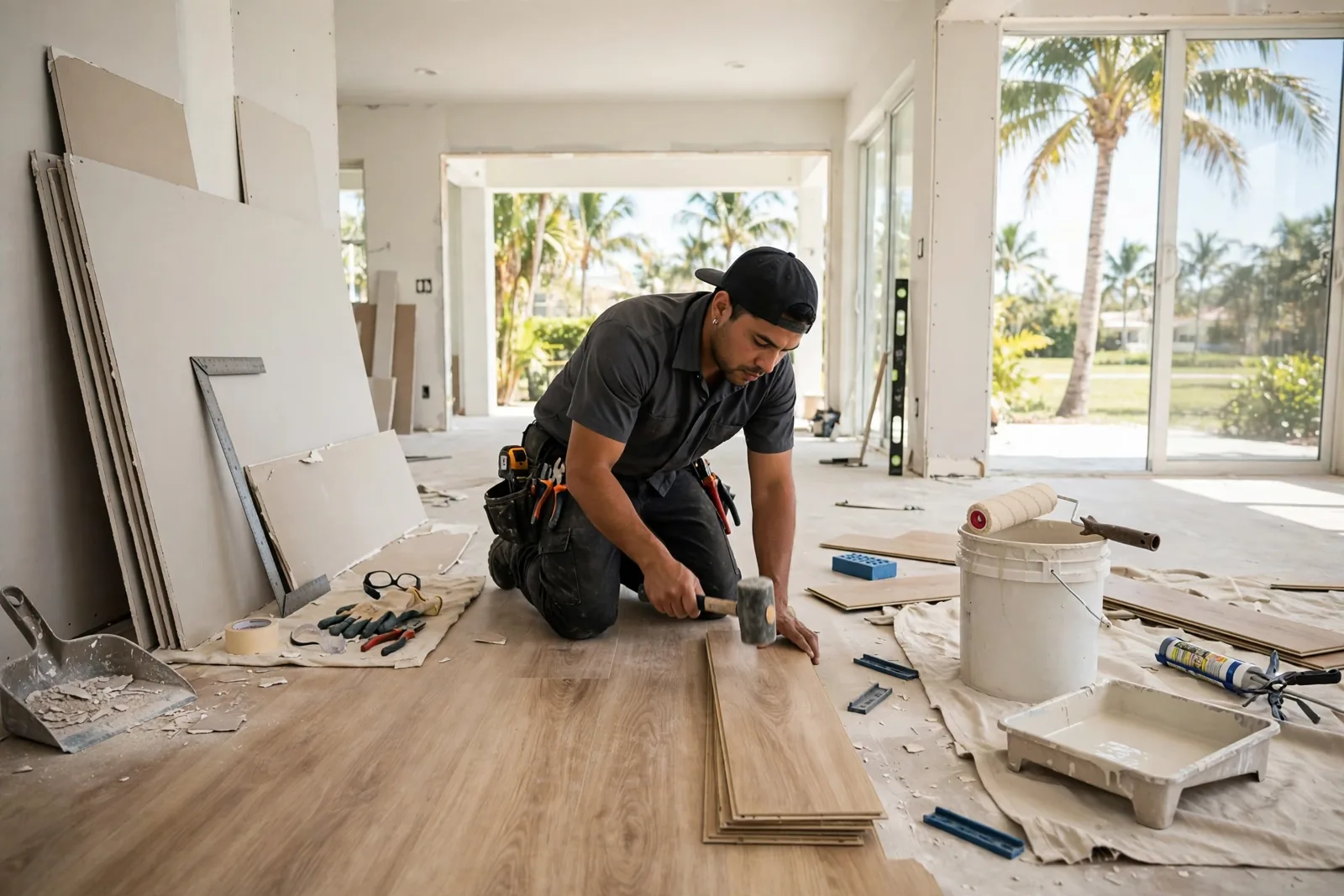
Dry is verified and now it needs rebuilding? Call (214) 286-6943 — repair and reconstruction in Fort Lauderdale.
Water Damage Repair & Reconstruction in Fort Lauderdale, FL
Water damage repair and reconstruction rebuild what water — and the removal work needed to dry properly — took out: drywall, flooring, cabinets, trim, and paint. It comes last, not first. Nothing should be rebuilt until moisture readings confirm the structure underneath is dry, or the new materials will trap moisture and mold can begin again within 24–48 hours in Fort Lauderdale’s humidity. Done in the right order, reconstruction returns the room to normal use, not just to looking finished.
We are Water Damage Restoration of Fort Lauderdale: licensed & insured, IICRC-informed, 24/7, and a service-area business with no walk-in office. Where we handled the mitigation, the same crew carries the job through to rebuild. You get a written plan before we start, with photo and moisture documentation throughout.
Water Damage Repair & Reconstruction at a Glance
- When it starts: Only after drying is verified by moisture readings
- Covers: Drywall, flooring, cabinets, trim, and paint
- Continuity: One crew from mitigation to rebuild, where we did the mitigation
- Cost guide: Reconstruction typically $20–$37/sq ft on this site’s published guide
- Local factor: High humidity means wet materials do not “air out” before rebuilding
- Proof: Photo and moisture documentation from removal through final walkthrough
What Does Water Damage Reconstruction Actually Cover?
Reconstruction covers putting back what was removed or ruined: drywall and insulation, flooring, baseboards and trim, cabinets and vanities, and paint. It does not include stopping the water, extraction, or drying — those are mitigation, and they must be finished and verified first.
Typical rebuild work:
- Drywall replacement and finishing where wet sections were cut out
- Flooring — replacing sections or rooms that cupped, buckled, or were removed
- Cabinets and vanities damaged at the base, where water wicks up first
- Trim, baseboards, and doors removed to vent and dry wall cavities
- Priming and painting to match the surrounding finish as closely as materials allow
Why Must Everything Be Verified Dry Before We Rebuild?
Because closing a wall or laying floor over wet material traps that moisture inside. In Fort Lauderdale — about 9 feet above sea level, slow drainage, high humidity year-round — trapped moisture feeds mold, warps new flooring, and rots the repair from behind. Readings, not touch or appearance, decide when rebuilding starts.
Repair vs Reconstruction vs Mitigation — Comparison
| Phase | What it covers | When |
|---|---|---|
| Mitigation | Stopping the source, extraction, selective removal, structural drying, treatment, documentation | First hours to first days, as an emergency |
| Repair | Smaller fixes to damaged finishes and materials that were not fully removed | After verified drying, for limited damage |
| Reconstruction | Rebuilding removed areas — drywall, flooring, cabinets, trim, paint | After verified drying, when materials were removed or ruined |
Should the Same Crew Handle Mitigation and the Rebuild?
Yes, where possible — continuity prevents the most common rebuild problems. The crew that removed materials knows what was cut, what was dried, and what the readings were. A new company starting cold has to re-inspect, re-measure, and guess at what happened before they arrived.
Continuity also keeps one documentation file for you and, where relevant, your adjuster. If another company handled your mitigation, we can still rebuild — we verify dryness ourselves before closing anything.
What About Permits and HOA Requirements?
Some rebuild work can involve permits, and condos and HOA communities often have their own approval and access requirements. Requirements vary by property and scope, so we flag what may apply in the written plan before we start, and the schedule accounts for it upfront.
Not sure if you need repair, reconstruction, or both? Call (214) 286-6943 and describe what was damaged.
What Is Our Water Damage Repair & Reconstruction Process, Step by Step?
- Phone assessment — What happened, what was removed or damaged, and what stage the job is at.
- On-site inspection — Damage, materials, and measurements checked against the mitigation documentation.
- Category & Class ID (IICRC S500) — Confirmed from the loss record, so rebuild scope matches how the water behaved.
- Removal of unsalvageable material — Any remaining ruined drywall, flooring, or cabinets taken out cleanly.
- Structural drying — Verified complete by readings before any new material goes in.
- Cleaning & treatment — Surfaces cleaned and treated so new materials go onto a clean structure.
- Documentation — Photos and readings before, during, and after the rebuild.
- Final walkthrough confirmed by moisture readings — Finished work checked with you, with dryness readings on record.
How Much Does Water Damage Repair & Reconstruction Cost in Fort Lauderdale?
Reconstruction typically runs $20–$37/sq ft on this site’s published guide. That is the rebuild phase only. If mitigation is still needed first, it is priced by water category: Category 1 (clean water) $3–$4.25/sq ft, Category 2 $4–$6.50/sq ft, Category 3 $7–$12/sq ft.
What changes the number:
- How much was removed — a cut-out section of drywall versus a full kitchen
- Materials — cabinets, tile, and hardwood cost more than paint and trim
- Whether flooring is a section repair or a whole room
- Access and approvals — high-rise or HOA requirements can add time
For context, the average US water-damage insurance claim is around $12,500. We give a written scope with real numbers before work starts; if a number has to change, you hear why first.
Will Insurance Pay for Reconstruction After Water Damage in Florida?
Often, for sudden events — a covered loss is typically handled differently from damage caused by a gradual leak, which is frequently excluded. Rising floodwater generally requires separate flood insurance, often through the NFIP. One documentation file helps either way.
What Do Real Reconstruction Jobs Look Like? 3 Representative Scenarios
These are representative scenarios of how typical jobs of each type unfold — not a specific past client’s file.
Scenario 1 — Kitchen rebuild, Rio Vista. A supply-line failure floods a kitchen; cabinets at floor level and a section of drywall are removed to dry. After readings confirm dry, cabinets, drywall, trim, and paint are rebuilt by the same crew that dried it — no second company re-measuring the room.
Scenario 2 — Flooring and walls, Edgewood. Storm water from the kind of extreme rain Fort Lauderdale saw on April 12–13, 2023 enters a ground-floor home. Saturated flooring and lower drywall are removed, the structure is dried and treated, then new flooring and walls go in only after verified readings.
Scenario 3 — Bathroom rebuild, Coral Ridge. A slow AC condensate leak ruins a vanity and the wall behind it. The damaged sections are removed, the cavity dried, and the vanity, drywall, and paint rebuilt — scoped to the mapped damage, not the whole bathroom.
Frequently Asked Questions
Can you start rebuilding right after the water is extracted?
No. Extraction is not dryness. Rebuilding starts only after structural drying is verified by moisture readings.
Do you rebuild if another company did the mitigation?
Yes. We inspect and verify dryness ourselves first, then provide a written reconstruction scope.
Will the new paint and flooring match exactly?
We match as closely as available materials allow and tell you upfront where an exact match may not be possible, for example with older flooring.
How long does reconstruction take?
It depends on scope — a single wall is days; a kitchen is longer — and on any permit or HOA steps. Your written plan includes the expected sequence before work starts.
Is reconstruction covered separately from mitigation?
They are different phases with different pricing — mitigation by water category, reconstruction typically $20–$37/sq ft — and both are documented in your file.
Ready to put the room back together — properly dry first? Call (214) 286-6943 for a written reconstruction scope.