
Water coming through your condo ceiling right now? Call (214) 286-6943 — 24/7 in Fort Lauderdale.
Condo & High-Rise Water Damage Restoration in Fort Lauderdale, FL
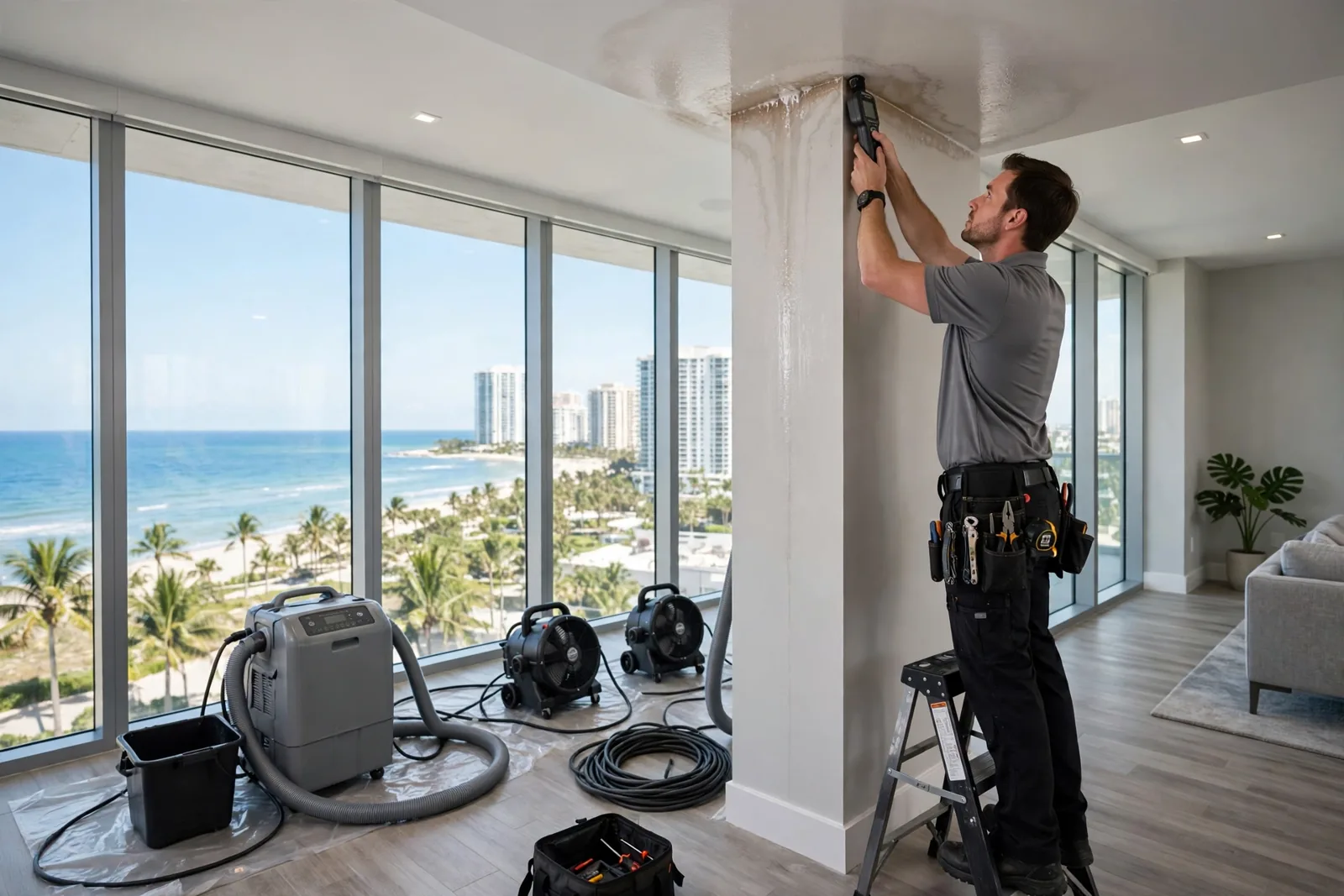
Condo water damage restoration dries, cleans, and documents water damage in a unit — and the hard part is rarely just the water. In a high-rise, the source is often another unit: a failed water heater, a leaking AC condensate line, or a supply line in the unit above. That means neighbours, an HOA, building access rules, and two insurance policies can all be involved before the drying is even finished. Acting fast still matters most: mold can begin in 24–48 hours in Fort Lauderdale’s humidity, whichever unit the water started in.
We are Water Damage Restoration of Fort Lauderdale: licensed & insured, IICRC-informed, 24/7, and a service-area business with no walk-in office. We document source and affected units with photos and moisture readings, and you get a written plan before we start — a file an HOA, a neighbour, and an adjuster can all work from.
Condo & High-Rise Water Damage at a Glance
- Common sources: The unit above — water heaters, AC condensate lines, supply lines
- Who is involved: You, the source unit, the HOA / building management, and insurers
- Logistics: Elevator booking, access hours, and building rules planned upfront
- Documentation: Source unit identified with readings, not just opinion
- Clock: Mold can begin in 24–48 hours, regardless of whose unit leaked
- Areas: Galt Ocean Mile, downtown, and Las Olas high-rises, plus condos across Fort Lauderdale
Where Does Condo Water Damage Usually Come From?
It usually comes from above. In stacked units, water heaters, AC condensate lines, bathrooms, and kitchens sit in roughly the same place on every floor, so a failure on one floor shows up as a ceiling stain, wet wall, or warped floor on the floor below.
- Water heater failure in the unit above
- AC condensate line clog or leak — AC runs most of the year in South Florida
- Bathroom and kitchen supply or drain leaks in stacked units
- Storm and king-tide water affecting ground-floor and parking-level units, with canals, the New River, and the Intracoastal nearby
How Is a Condo Loss Different From a House Loss?
A condo loss affects more people, is paid for under more than one policy, and needs building access a house does not. A single-family loss is usually one owner, one policy, and a crew that can start at the front door.
Condo Loss vs Single-Family Loss — Comparison
| Factor | Condo / high-rise loss | Single-family loss |
|---|---|---|
| Who is affected | Source unit, units below and beside it, common areas | Usually one household |
| Who pays | HOA master policy and unit owner policy may each cover different parts; source unit can be involved | Usually the homeowner’s policy |
| Access | Building management, elevator booking, work hours, parking and loading rules | Direct access at the owner’s decision |
| Documentation | Readings and photos identifying the source unit, shared with HOA and adjusters | Documentation for the owner’s own claim |
Who Pays — the HOA Master Policy or My Unit Policy?
It depends on where the water started and what was damaged, and the two policies typically cover different parts of the same loss. The HOA master policy and your unit owner policy divide responsibility differently from building to building, which is exactly why the documentation has to show the source, the path, and the readings clearly.
We do not decide coverage — insurers do. We give every party the same evidence: photos, moisture mapping, and a written scope. Floodwater is separate: rising water generally requires separate flood insurance, often through the NFIP.
How Do Building Access and Elevators Affect the Job?
Access can add time if it is not planned, so we plan it first. Equipment and removed materials move through service elevators and loading areas, often within building work hours. On the Galt Ocean Mile, downtown, and around Las Olas, we coordinate with building management before dispatch.
Dealing with a leak from the unit above? Call (214) 286-6943 — we document the source unit with readings.
What Is Our Condo Water Damage Restoration Process, Step by Step?
- Phone assessment — What happened, which unit, and building access details.
- On-site inspection — Your unit and, with permission, the suspected source unit above.
- Category & Class ID (IICRC S500) — Contamination level and drying difficulty.
- Extraction and source documentation — Standing water removed; source unit documented with photos and readings.
- Structural drying — Equipment set within building rules, to monitored moisture targets.
- Cleaning & treatment — Affected areas cleaned and treated where contamination is present.
- Documentation — Photo and moisture file formatted for HOA, neighbours, and adjusters.
- Final walkthrough confirmed by moisture readings — Dryness verified, not assumed, before sign-off.
How Much Does Condo Water Damage Restoration Cost in Fort Lauderdale?
Mitigation is priced by water category on this site: Category 1 (clean water) $3–$4.25/sq ft, Category 2 $4–$6.50/sq ft, Category 3 $7–$12/sq ft. If removed materials need rebuilding, reconstruction typically runs $20–$37/sq ft. For context, the average US water-damage insurance claim is around $12,500.
What changes the number:
- How many units are affected, and how far water travelled down or sideways
- Whether ceilings, walls, and flooring in more than one unit need drying or removal
- Building access — elevator scheduling and work hours affect crew time
- How fast the source was shut off in the unit above
You get a written scope before work starts, with documentation that separates your unit’s damage from the source.
What Do Real Condo Jobs Look Like? 3 Representative Scenarios
These are representative scenarios of how typical jobs of each type unfold — not a specific past client’s file.
Scenario 1 — Water heater failure, Galt Ocean Mile. A water heater fails in an upper unit and water comes through the ceiling below. The source unit is documented with readings, both units are extracted and dried, and one file goes to the HOA and both owners’ insurers.
Scenario 2 — AC condensate leak, downtown high-rise. A clogged condensate line drips into a wall shared by two stacked units, found only when paint bubbles below. Moisture mapping shows which sections are wet, the line is cleared, and only the mapped sections are opened and dried.
Scenario 3 — Ground-floor unit, Las Olas area. Heavy rain and king-tide conditions push water into a ground-floor unit. Floodwater is treated as the most contaminated category: porous materials are removed rather than dried, and the file is documented as a flood loss, not a plumbing loss.
Frequently Asked Questions
The leak is in the unit above, not mine. What should I do?
Document your damage with photos, notify building management and the unit above promptly, and call for mitigation — your unit still needs drying within the 24–48 hour mold window, whoever pays later.
Will you inspect the unit above as well?
With that owner’s and the building’s permission, yes. Identifying and documenting the source unit with readings is a core part of a condo job.
Who pays for my unit’s drying — me, the HOA, or the neighbour?
It depends on the source, the building’s documents, and the policies involved. We provide the evidence all parties need; insurers make the coverage decision.
Can you work within my building’s elevator and work-hour rules?
Yes. We coordinate access, elevator booking, and work hours with building management before dispatch.
Does my unit policy cover water from another unit?
Policies differ. Sudden events are typically treated differently from gradual leaks, and floodwater generally needs separate flood insurance. Your documentation file supports whichever claim applies.
One call, one documented file for you, your HOA, and your insurer. Call (214) 286-6943.