
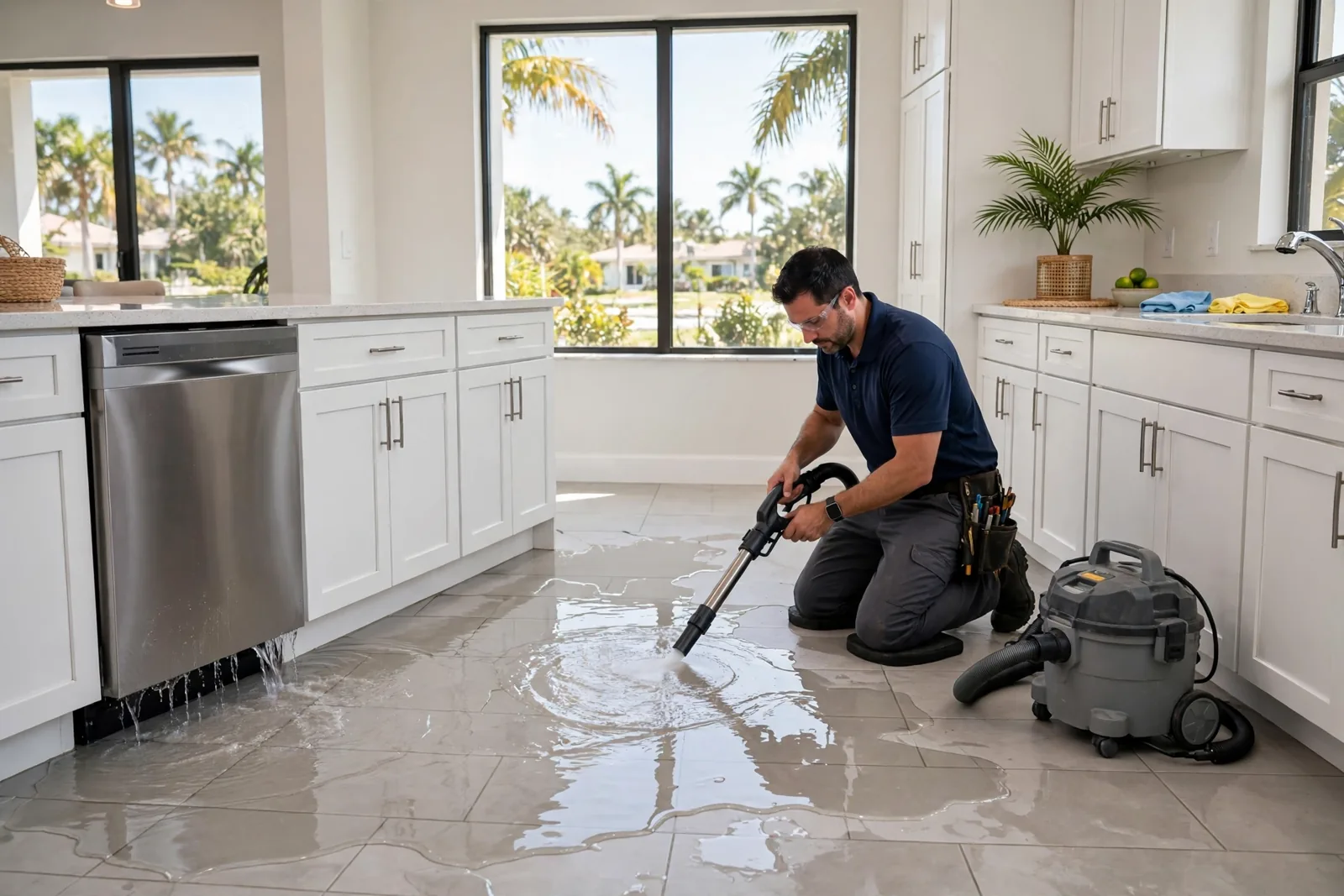
Water under the fridge, dishwasher, or washer? Call (214) 286-6943 — 24/7 in Fort Lauderdale.
Appliance Leak Water Damage in Fort Lauderdale — The Slow Leak Is the Problem
Appliance leak water damage is water escaping from a dishwasher, washing machine, refrigerator ice-maker line, or supply hose, soaking flooring, cabinets, and wall bases — often slowly and out of sight for weeks. That hidden moisture is the danger here: with high year-round humidity, mold can begin in 24–48 hours, and a pinhole drip under a Rio Vista kitchen floor or in a Galt Ocean Mile condo laundry closet can ruin materials long before a puddle shows. Found warped flooring or a musty cabinet? Shut the appliance supply off if safe, then call us.
We are Water Damage Restoration of Fort Lauderdale: IICRC-informed, licensed & insured, 24/7, a service-area business with no walk-in office. Straight talk only — a written plan before we start, photo and moisture documentation throughout, and no hype about damage readings do not support. If it is dry, we say so. If it is wet behind the cabinets, we show you the readings.
Appliance Leak Water Damage at a Glance
- Top sources: Dishwasher lines, washer hoses, fridge ice-maker lines
- Worst feature: Slow leaks hide under flooring and cabinet bases
- Clock: Mold can begin in 24–48 hours
- Method: Moisture mapping before any flooring comes up
- Standard: Category and Class per IICRC S500
- Call: (214) 286-6943, 24/7
Which Appliances Cause the Most Water Damage?
Dishwashers, washing machines, and fridges with ice-maker lines — all combine a pressurised supply, a hidden connection, and flooring that hides the evidence. Dishwashers leak at supply, seal, or drain hose and run under the unit into cabinets. Washer hoses fail suddenly or seep; in condo laundry closets, one leak can reach the unit below. Ice-maker lines drip slowly behind the fridge for months.
Dishwasher vs Washing Machine vs Fridge Ice-Maker Line — Comparison
| Factor | Dishwasher | Washing machine | Fridge ice-maker line |
|---|---|---|---|
| Where water goes | Under unit, into cabinets and flooring | Across laundry floor, to unit below in condos | Behind fridge, into flooring and wall base |
| Warning signs | Musty cabinet, soft floor at unit | Puddle after cycles, damp wall, hose bulge | Warped floor beside fridge, musty smell |
| Materials at risk | Cabinets, flooring, drywall base | Drywall, flooring, ceiling below | Flooring, drywall base, nearby cabinets |
Why Are Slow Appliance Leaks Worse Than Big Ones?
A big leak gets a same-day response. A slow leak gets months — an ice-maker line dripping behind a fridge in Sailboat Bend keeps flooring and drywall permanently damp, leading to mold, odor, and material that must be removed instead of dried. Slow leaks also hurt insurance claims, as gradual damage is treated differently from a sudden failure. Found and documented early, the job stays small.
How Do You Know If a Leak Spread Under the Floor?
From the surface, usually you cannot — which is why we map first. Warning signs: flooring soft, lifted, or warped near the appliance; musty cabinets cleaning cannot fix; baseboards pulling away or paint bubbling low on the wall. Meters and imaging show how far water travelled under tile, wood, or laminate, and that map decides what dries in place and what comes up.
Wet patch, musty cabinet, or a hose you do not trust? Call (214) 286-6943 — we measure what is actually wet.
What Is Our Appliance Leak Water Damage Process, Step by Step?
- Phone assessment — Which appliance, when found, and whether supply is off.
- On-site inspection — Flooring, cabinets, and wall bases mapped with meters and imaging.
- Category & Class ID (IICRC S500) — Supply versus drain water changes the work.
- Extraction and selective removal — Water removed; unsalvageable material taken out.
- Structural drying — Floors, wall bases, and cabinets dried to measured targets.
- Cleaning & treatment — Affected areas cleaned and treated where water sat.
- Documentation — Photos and moisture logs formatted for your adjuster.
- Final walkthrough confirmed by moisture readings — Not by appearance.
How Much Does Appliance Leak Water Damage Cost in Fort Lauderdale?
Cost follows category and affected square footage. Published pricing on this site: Category 1 mitigation about $3–$4.25/sq ft, Category 2 about $4–$6.50/sq ft, Category 3 about $7–$12/sq ft. Dishwasher and washer drain water is often Category 2. Reconstruction of cabinets, flooring, or drywall typically runs $20–$37/sq ft. The average US water-damage insurance claim is around $12,500.
What changes the number:
- How long the leak ran — hours versus weeks
- Whether water got under flooring and into cabinets
- Slab home versus upper-floor condo with a unit below
You get a written scope with real numbers before work starts.
Will Homeowners Insurance Pay for Appliance Leak Damage?
Often for a sudden failure, like a burst hose. Slow leaks are the hard cases: insurers frequently call months of dripping gradual damage or a maintenance issue and may exclude it. Stop the source and mitigate anyway — policies expect you to prevent further damage — and keep our dated photos and logs as evidence. We will say upfront if part of a loss may not be covered. Floodwater from outside generally needs separate flood insurance, often through the NFIP.
What Do Real Appliance Leak Jobs Look Like? 3 Representative Scenarios
These are representative scenarios of how typical jobs of each type unfold — not a specific past client’s file.
Scenario 1 — Dishwasher slow leak, Victoria Park. A musty sink cabinet leads to mapping that finds the supply seeping into the cabinet base and flooring beyond. Supply off, failed base removed, floor and wall dried to target — a month later this is a cabinet replacement.
Scenario 2 — Washer hose failure, Galt Ocean Mile condo. A hose lets go mid-cycle; water reaches the hallway and the unit below. Same-day extraction and drying in both units, documented for owners and association, keeps it a drying job, not a rebuild.
Scenario 3 — Ice-maker line, Coral Ridge. Flooring beside the fridge warps over a season before anyone blames the small line behind it. Readings confirm damp under floor and wall base. Line off, affected flooring selectively lifted, drying follows. The line repair is a plumber’s job; the damage is ours.
Frequently Asked Questions
What do I do first when an appliance leaks?
Shut its supply valve if safe, or the main shut-off. Keep clear of water near power, photograph everything, and call (214) 286-6943 the same day.
Can flooring be saved after a dishwasher leak?
Often after a short leak, if readings show the material is not saturated underneath. Long slow leaks usually need selective lifting. Readings decide.
Is dishwasher or washer water dangerous?
Drain water is typically Category 2 — detergents and contaminants — so porous materials are handled more conservatively than with clean supply water, per IICRC S500.
How long does drying take?
Extraction is usually same-day; structural drying commonly runs several days of monitored equipment. The final walkthrough is confirmed by moisture readings.
Do you repair the appliance?
No. We restore the water damage. Repair or replacement is your appliance technician’s or plumber’s job.
Appliance leaking or flooring warping for no clear reason? Call (214) 286-6943 now — 24/7, licensed & insured, written plan before we start.