
Slow drains, sewer smell, or a backup in an older home? Call (214) 286-6943 — 24/7 in Fort Lauderdale. It can be Category 3 water — do not wait.
Cast Iron Pipe Water Damage in Fort Lauderdale — Old Drains Fail Slowly, Then Suddenly
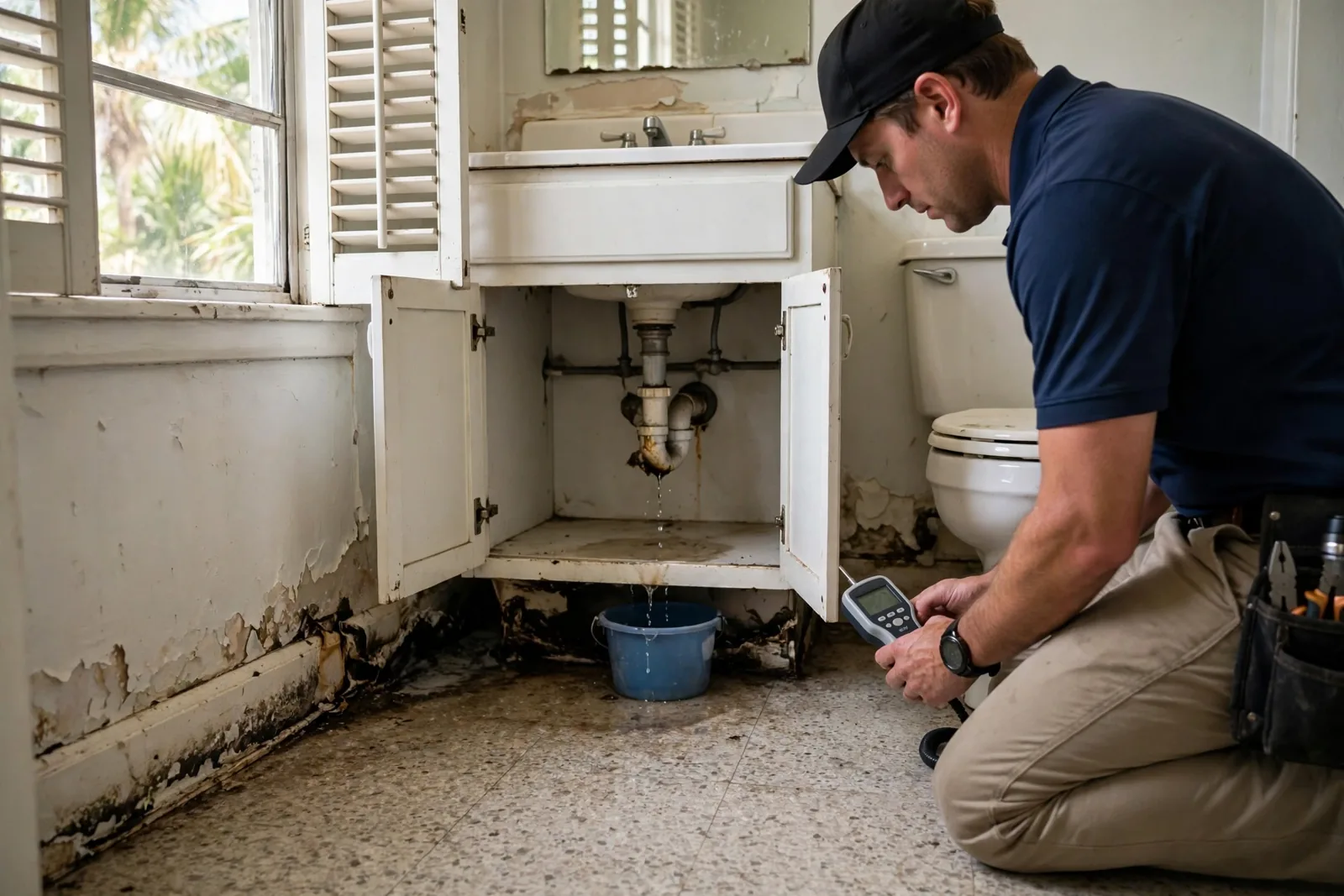
Cast iron pipe water damage comes from deteriorating cast iron drain pipes, common in older Fort Lauderdale homes, that corrode, crack, and leak drain or sewer water into walls, floors, and slab areas — slowly for years, or suddenly as a backup. It concentrates in older neighbourhoods like Victoria Park, Sailboat Bend, and Tarpon River. Signs get written off too long: slow drains, gurgling, sewer odor, recurring damp at a bathroom wall. A backup into the home is Category 3, the most serious category.
We are Water Damage Restoration of Fort Lauderdale: IICRC-informed, licensed & insured, 24/7, service-area, no walk-in office. Our scope: extraction, removal, cleaning, treatment, drying, documentation — written plan before we start. Pipe replacement is a plumber’s job; drying while the drain keeps failing is money spent twice.
Cast Iron Pipe Water Damage at a Glance
- Where: Older homes — Victoria Park, Sailboat Bend, Tarpon River
- Pattern: Slow internal corrosion, then leaks or a sudden backup
- Serious point: Sewer backup is Category 3 — soaked porous material is removed
- Signs: Slow drains, gurgling, sewer smell, recurring bathroom damp
- Standard: Category and Class per IICRC S500
- Call: (214) 286-6943, 24/7
How Do Cast Iron Pipes Fail, and Why So Slowly?
They deteriorate from the inside out: decades of drain water thin and crack the pipe, and leaks begin long before a drain stops working. Drain pipes are not pressurised, so a failing line seeps rather than sprays, into walls, floors, or the slab area. By the time clues show — slow drains, intermittent sewer smell, bathroom flooring that never seems dry — surrounding material may have been damp for months, and long-damp drywall rarely dries back to sound in this humidity, where mold can begin in 24–48 hours.
How Is a Cast Iron Drain Failure Different From a Supply-Line Leak?
A supply leak releases clean water under pressure: fast, visible, Category 1 at first. A cast iron failure releases used drain water slowly and hidden, and a sewer backup is Category 3. Water type changes what can be dried, what must be removed, and how it is cleaned.
Cast Iron Drain Failure vs Supply-Line Leak — Comparison
| Factor | Cast iron drain failure | Supply-line leak |
|---|---|---|
| Water type / category | Drain water; sewer backup is Category 3 | Clean supply water, Category 1 at first |
| Smell | Sewer or musty odor, often the first clue | No odor until materials stay wet |
| Pattern | Slow, recurring, hidden seepage | Sudden, visible puddle or spray |
Sewer smell plus moisture in an older home is not a cleaning problem. It is a pipe problem with water damage attached.
What Happens When Sewer Water Backs Up?
It is a Category 3 cleanup from step one. Porous materials soaked with sewer water — drywall, insulation, carpet, swollen flooring — are removed, not dried. Hard surfaces are cleaned and treated, and remaining structure dried to measured targets. Keep people and pets out, avoid contact, and do not run fans that spread contamination. Call (214) 286-6943 and say it is a backup.
Sewer smell and damp that keeps coming back? Call (214) 286-6943 — we measure what is wet, handle Category 3 properly, and document it all.
What Is Our Cast Iron Pipe Water Damage Process, Step by Step?
- Phone assessment — Home’s age, drain symptoms, any backup, where odor or moisture shows.
- On-site inspection — Bathrooms, wall bases, floors, adjoining rooms mapped with meters and imaging.
- Category & Class ID (IICRC S500) — Drain versus sewer water confirmed first.
- Extraction and contaminated removal — Water extracted safely; Category 3-soaked porous material removed.
- Structural drying — Remaining structure dried to measured targets.
- Cleaning & treatment — Areas cleaned and treated, including odor control.
- Documentation — Photos and moisture logs formatted for your adjuster.
- Final walkthrough confirmed by moisture readings — Verified, not assumed.
How Much Does Cast Iron Pipe Water Damage Cost in Fort Lauderdale?
Cost follows category and square footage. Published pricing: Category 1 mitigation about $3–$4.25/sq ft, Category 2 about $4–$6.50/sq ft, Category 3 about $7–$12/sq ft. Cast iron jobs are often Category 3 with a backup. Reconstruction typically runs $20–$37/sq ft; the average US water-damage claim is around $12,500. Plumber costs are separate.
What changes the number:
- Seepage versus backup — category is the biggest driver
- How long the pipe leaked before it was found
- Rooms and wall cavities affected around drain runs
You get a written scope with real numbers before work starts.
Will Homeowners Insurance Pay for Cast Iron Pipe Damage?
Honestly, this is a harder category. Damage from a sudden backup may be treated differently from the pipe itself, and slow deterioration damage is frequently argued to be gradual — often excluded or limited. The longer a leak ran, the harder the claim. Dated photos, maps, and logs protect you, and we will say upfront if part of a loss may not be covered. Floodwater generally needs separate flood insurance, often through the NFIP.
What Do Real Cast Iron Pipe Jobs Look Like? 3 Representative Scenarios
These are representative scenarios of how typical jobs of each type unfold — not a specific past client’s file.
Scenario 1 — Slow seepage, Victoria Park. Slow drains and musty smell at a bathroom wall; mapping shows long-term damp. Failed material removed, structure dried, plumber scopes the drain line.
Scenario 2 — Sewer backup, Sailboat Bend. Category 3 water enters a bathroom and hallway. Soaked material is removed, hard surfaces cleaned and treated, drying confirmed by readings, photo file to the adjuster the same week.
Scenario 3 — Recurring damp, Tarpon River. Flooring near a bathroom feels damp months apart, blamed on humidity. Readings centre the moisture on the drain run; targeted removal and drying follow, documented for the plumber’s repair.
Frequently Asked Questions
Is cast iron damage the same as a sewage backup?
Not always. A drain can seep with no backup; a sewer backup into living space is Category 3. Assessment decides which you have.
Can drywall soaked with sewer water be saved?
No — porous material soaked with Category 3 water, including drywall and insulation, is removed. Hard surfaces can be cleaned and treated.
Do you replace cast iron pipes?
No — a plumber’s job. We handle the damage and will tell you when the pipe must be fixed for the work to last.
Why does damage recur in the same place?
The source was never fixed — the next seep wets the same wall and floor again.
How fast must I act on a backup?
Immediately. Keep clear, keep people and pets out, do not mop or fan it around, and call (214) 286-6943 the same hour if you can.
Does every older home have this problem?
Many older homes have cast iron drains; age alone does not mean failure. Slow drains, odor, gurgling, and recurring damp are the signs to act on.
Older home, slow drains, sewer smell, or a backup today? Call (214) 286-6943 now — 24/7, licensed & insured, written plan before we start.