
Musty smell, a stain, or a leak never checked properly? Call (214) 286-6943 — 24/7 in Fort Lauderdale. We find the moisture source first.
Mold Inspection in Fort Lauderdale — Find the Moisture, Not Just the Mold
A mold inspection should answer two questions: where is the moisture coming from, and how far has it travelled? Visible mold is the symptom; the source — a slow pipe leak, a failed AC condensate line, water left in a wall after a flood — is the problem. In a city about 9 feet above sea level, with slow drainage, high humidity, and mold able to begin in 24–48 hours, guessing is not a plan.
We are a Fort Lauderdale service-area team: IICRC-informed, licensed & insured, 24/7, no walk-in office. You get a written plan before we start, plus photo and moisture documentation. Straight talk on scope: our inspection is a visual and moisture-based assessment by the restoration team. Where a formal lab report is needed, that testing is done by a licensed mold assessor in Florida — we do not claim to be one.
Mold Inspection at a Glance
- Goal: Find the moisture source and full extent, not just the visible patch
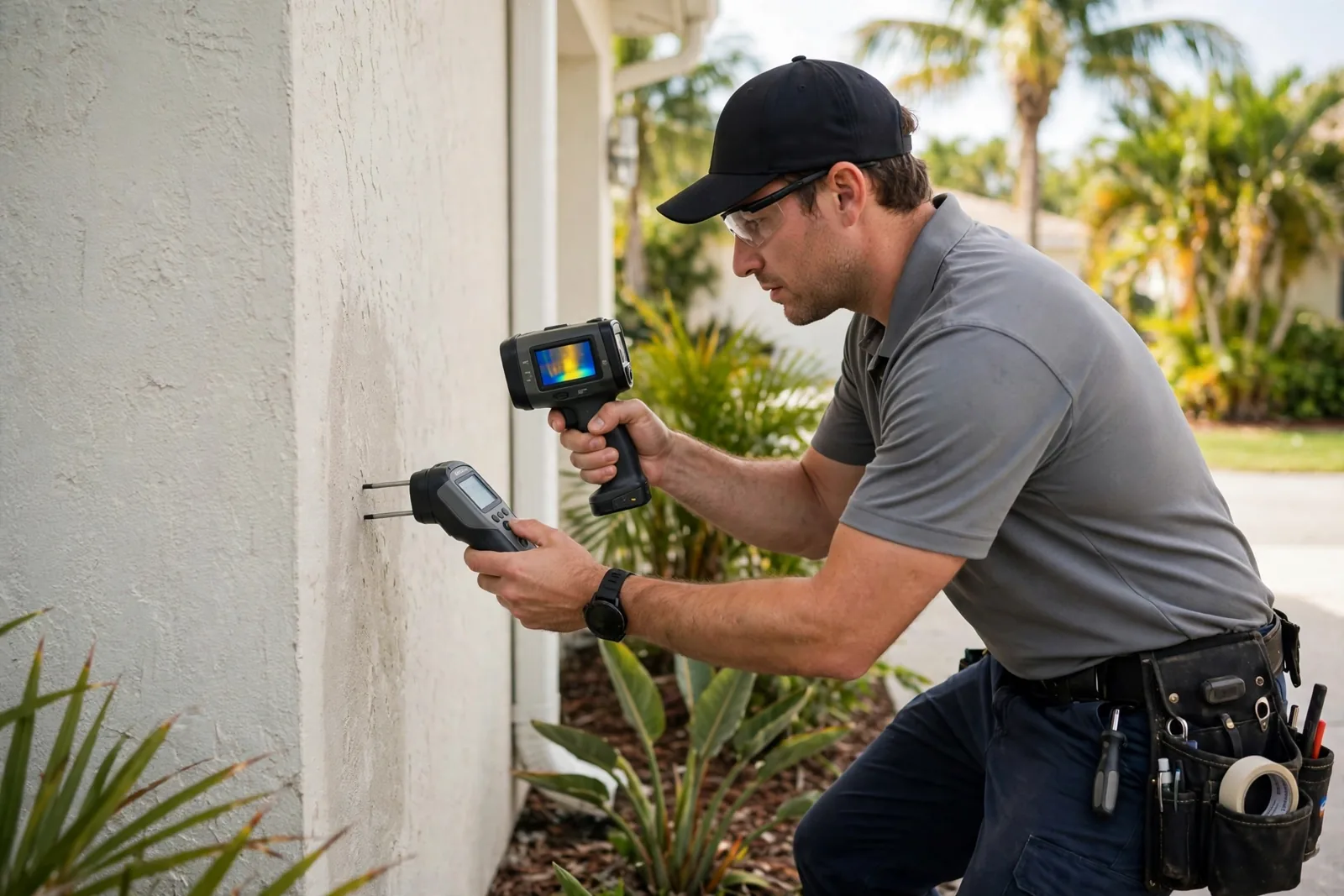
- Method: Visual check plus moisture meters and infrared imaging
- Clock: Mold can begin in 24–48 hours locally
- Honest scope: Lab testing is by a licensed mold assessor, not us
- Next step: Remediation scoped in writing before work starts
- Documentation: Photos and moisture readings for insurance or an assessor
What Does a Mold Inspection Actually Check?
It checks the building, not just the spot you can see. We look for visible growth, stains and soft materials, then use meters and infrared imaging inside wall cavities, under flooring, and around plumbing, windows and AC systems — a dry-looking wall can still hold wet insulation. Sources are traced too: cast-iron pipes, slab plumbing, AC condensate lines. You finish with a clear finding: what is wet, what should be removed or dried, what can be left alone.
When Should You Get a Mold Inspection in Fort Lauderdale?
Book one when any of these apply:
- A musty smell with no visible source — often the first and only early sign
- After any leak, flood or storm entry dried without moisture readings
- Visible spots on drywall, ceilings, baseboards or around AC vents
- Before buying, selling or reoccupying a property after known water damage
After the April 12–13, 2023 storm dropped over 2 feet of rain in under 24 hours, many Edgewood, River Oaks and Melrose Park homes were dried on the surface only — later inspections found damage still inside the walls. Note: an air sample alone is no substitute; it can miss growth sealed in a cavity and cannot identify the water source.
Visual/Moisture Inspection vs Lab Testing — Comparison
| Method | What it tells you | When you need it | Who does it |
|---|---|---|---|
| Visual + moisture inspection | Where it is wet, where growth is visible or likely, and what remediation is needed | After a leak or flood, for a musty smell, or before remediation is scoped | Our restoration team, using meters and infrared imaging |
| Lab testing | Mold types and levels in samples, in a formal written report | When a report is required — dispute, transaction, clearance, insurer | A licensed mold assessor in Florida, independent of the remediation |
Not sure whether you need an inspection, an assessor, or remediation? Call (214) 286-6943 and describe what you are seeing and smelling. We will tell you which step fits.
What Is Our Mold Inspection Process, Step by Step?
- Phone assessment — What you have seen or smelled; any leak or flood history.
- On-site inspection — Room-by-room visual check of affected and adjoining areas.
- Moisture assessment — Meters and infrared imaging map wet materials, behind walls and under floors.
- Source tracing — The moisture pattern followed back to plumbing, AC, roof, window or storm entry.
- Extent and scope — The core work: what can be dried, what should be removed and remediated.
- Cleaning & treatment recommendations — What fits once the source is fixed and drying verified.
- Documentation — Photos and readings in a file for your insurer or a licensed mold assessor.
- Final walkthrough — Findings walked through with you; next step agreed in writing.
How Much Does Mold Inspection Cost in Fort Lauderdale?
We do not publish a standalone inspection price: the honest cost depends on what the inspection finds, and following work is priced in the written scope before it starts. Where inspection leads into a wider loss, the ranges published on this site frame it: mitigation about $3–$4.25/sq ft (Category 1), $4–$6.50/sq ft (Category 2), and $7–$12/sq ft (Category 3), with reconstruction typically $20–$37/sq ft. The average US water-damage claim is around $12,500.
What changes the number: the size of the affected area, whether the source is still active, whether lab testing by a licensed mold assessor is required, and how much material must be removed versus dried in place.
Will Insurance Pay for Mold Inspection or Remediation in Florida?
Sometimes — it turns on the cause. Mold following a sudden, covered event, such as a burst pipe, is treated differently from mold caused by a slow leak left for months, or by rising floodwater, which generally needs separate flood insurance. Keep the evidence: dated photos, our readings, any assessor report.
What Do Real Mold Inspection Jobs Look Like? 3 Representative Scenarios
These are representative scenarios of how typical jobs of each type unfold — not a specific past client’s file.
Scenario 1 — Musty smell, Victoria Park. Readings found a wet cavity behind a bedroom closet, traced to a slow AC condensate overflow. Source repair, selective opening, drying and targeted remediation followed.
Scenario 2 — Post-leak check, Rio Vista. A kitchen leak was mopped up and fanned, no readings taken. Two weeks later, cabinets and the wall behind them were still wet, with early growth. Drying and remediation followed, documented for insurance.
Scenario 3 — After storm entry, Edgewood. Months after heavy rain, staining showed moisture and growth inside a wall cavity from water never fully extracted. Scope: removal, treatment, verified drying, and a recommended assessor’s clearance report.
Frequently Asked Questions
Is your inspection the same as mold testing?
No. Ours is visual and moisture-based — it finds the source and extent. Lab testing, where a report is needed, is done by a licensed mold assessor in Florida. We are not one.
I can smell mold but cannot see it. Is an inspection still useful?
Yes — a common reason to book one. Meters and infrared imaging locate wet cavities and hidden growth a visual check misses.
Should the leak be fixed before or after the inspection?
Stop active water as soon as safely possible. Inspection then confirms how far moisture travelled and whether the repair solved the whole problem.
What happens if the inspection finds mold?
You get a written remediation scope first — what will be removed, contained, cleaned and dried, and to what readings.
Do you offer remediation as well as inspection?
Yes, scoped separately and in writing. Where an independent assessor’s report is needed, we will say so.
Smell it, saw it, or had a leak you never verified? Call (214) 286-6943 for a straight, moisture-based assessment and a written plan before any work starts.