
Water damage in Lauderdale Lakes right now? Call (214) 286-6943 — 24/7 dispatch from our Fort Lauderdale service area, with a written plan before we start.
Water Damage Restoration in Lauderdale Lakes, FL — Local Help, Fort Lauderdale Based
Lauderdale Lakes earns its name: this central Broward city, just west of Fort Lauderdale, is built around a network of lakes and canals, and a large part of its housing is condominiums and multi-family buildings, including many long-established condo communities. That shapes the water-damage work here more than anything else. In a condo building, your water damage frequently starts in someone else’s unit — the water heater above you, the AC condensate line two floors up, the supply line in the wall you share. And condo buildings from the 1970s and 1980s have plumbing stacks and lines that are all reaching the same age at the same time.
So our Lauderdale Lakes work has two tracks from the first hour: dry your unit properly, and document everything so thoroughly that your insurer, the association and the unit above’s insurer are all working from the same evidence. In multi-family buildings, documentation is not paperwork — it is the difference between a claim that moves and an argument that circles.
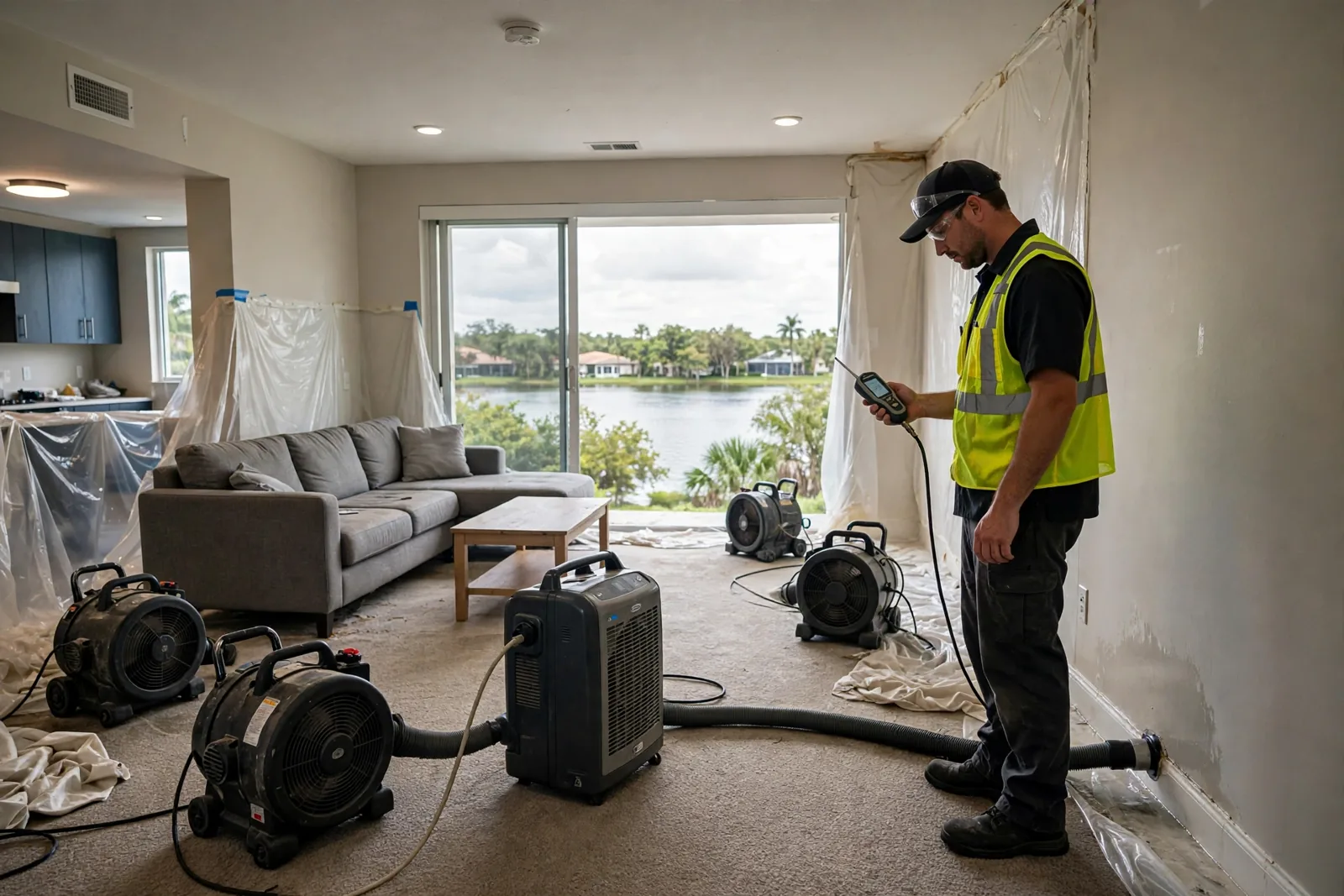
We are Water Damage Restoration of Fort Lauderdale: IICRC-informed technicians, licensed & insured, a service-area business with no walk-in office — we come to you. Same discipline on every job: find the source, map the moisture, dry to a measured target, document everything for your insurer.
Water Damage Restoration in Lauderdale Lakes at a Glance
- Based: Fort Lauderdale service area — Lauderdale Lakes is just west of Fort Lauderdale in central Broward — a short inland dispatch from our base
- Available: 24 hours a day, 7 days a week, including holidays
- Clock: Mold risk begins within 24–48 hours in South Florida humidity — same-day mitigation matters
- Local watch-out: A city built around lakes and canals, with a large stock of older condominiums and multi-family buildings — unit-to-unit water spread is the local signature
- Standards & paperwork: IICRC-informed work per IICRC S500; photo documentation + moisture logs for your claim from day one
What Water Damage Services Do We Provide in Lauderdale Lakes?
The full restoration service, not just the first hour of it:
- Mitigation, extraction & structural drying — stop the spread, remove standing water, dry to measured targets
- Flood damage cleanup & sewage cleanup — contaminated Category 3 water removed and the area sanitised
- Mold remediation & mold inspection — when damage sat too long, or before you buy or sell
- Leak detection & moisture mapping — find the true source and the full extent before anyone opens a wall
- Repair & reconstruction — rooms put back together after drying is verified
How Fast Can You Get to Lauderdale Lakes?
Lauderdale Lakes is a few miles west of Fort Lauderdale, so crews dispatch from our Fort Lauderdale service area directly into the city. We do not promise a fixed number of minutes — building access, gate procedures and which floor you are on affect any condo job more than road distance does. Call (214) 286-6943 at any hour, tell us the building and unit situation, and we will confirm coverage and a realistic dispatch time on the call.
What Causes Most Water Damage in Lauderdale Lakes?
The Lauderdale Lakes pattern is dominated by shared buildings and ageing systems:
- Unit-above leaks in condos — water heaters, AC units, supply lines and bathroom overflows in the unit above appearing as your ceiling stain
- Ageing condo plumbing — stacks, risers and unit lines from the 1970s–80s building era failing across whole buildings within a few years of each other
- AC condensate failures — the single most common condo ceiling-leak cause in South Florida; a blocked line can overflow for weeks inside a ceiling cavity
- Lake and canal-adjacent ground floors — buildings and homes near the city’s lakes and canals sit low; heavy rain and high water tables push moisture at ground-floor slabs
- Bathroom and kitchen leaks in older multi-family stock — original fixtures, wax rings, angle stops and supply hoses at end of life
Why Does Water Spread Further in Lauderdale Lakes Buildings?
In a single-family home, water mostly damages the home it started in. In Lauderdale Lakes’ condo and apartment buildings, water obeys gravity through other people’s property: a failed line on the fourth floor can wet ceilings and walls on the third and second, run inside a shared plumbing chase, and appear two units away from its source. Pinpointing the true source — rather than just drying the unit where the stain showed — is the skill that matters most here, because drying the wrong unit leaves the leak running.
The lakes and canals add the second local factor. Ground floors near the water sit on low, often saturated ground during the wet season, so slab moisture and slow drainage complicate drying: a ground-floor unit can test wet at the wall base from outside moisture while a leak is also active inside. Our moisture mapping in Lauderdale Lakes always separates those two questions — what came from the building’s plumbing, and what is the ground doing — because the fix, and the insurance route, are completely different.
Not sure how far the water has travelled? In Lauderdale Lakes the visible stain is rarely the whole job. Call (214) 286-6943 for a phone assessment first — we will tell you honestly whether you need a crew today or a plumber first.
How Much Does Water Damage Restoration Cost in Lauderdale Lakes?
It depends on the water category and the affected square footage — the same pricing this site publishes everywhere: Category 1 (clean water) mitigation runs about $3–$4.25/sq ft, Category 2 (gray water) about $4–$6.50/sq ft, and Category 3 (black water, including sewage and floodwater) about $7–$12/sq ft for mitigation alone. Full reconstruction typically runs $20–$37/sq ft. You get a written scope with real numbers before any work starts, so the figure you approve is the figure you are billed against.
Does Insurance Cover Water Damage in Lauderdale Lakes?
It depends on the cause, and in Florida that distinction matters. Sudden internal failures — burst pipes, a water heater letting go — are typically covered. Slow, gradual leaks are frequently excluded, and rising floodwater from outside generally requires separate flood insurance, often through the NFIP.
What Does the Restoration Process Look Like?
- Phone assessment — what happened, when, and where, so the right crew is dispatched.
- On-site inspection — source and full extent checked in person.
- Category & Class ID — contamination level and drying difficulty, per IICRC S500.
- Extraction — standing water and unsalvageable materials out first.
- Structural drying — equipment set to specific moisture targets, monitored daily.
- Cleaning & treatment — antimicrobial treatment and odour control where needed.
- Documentation — photos and moisture logs formatted for your adjuster.
- Final walkthrough — dryness confirmed by readings, not by touch.
What Do Jobs in Lauderdale Lakes Actually Look Like? Representative Scenarios
These are representative scenarios of how typical jobs of each type unfold in Lauderdale Lakes — not a specific past client’s file, and not testimonials.
Scenario 1 — Ceiling loss from the unit above, mid-rise condo. A stain spreads across a living-room ceiling; the source is a condensate overflow two floors up. We document from day one for three parties (owner, HOA, upstairs insurer), dry the cavity with minimal demolition, and the readings — not opinions — settle which unit the loss started in.
Scenario 2 — Ground-floor unit, lake-adjacent building, wet-season slab moisture plus a real leak. Mapping separates a genuine supply-line leak (fixed and dried as a plumbing loss) from general slab moisture at the wall base (managed with drying and monitoring, not demolition). Treating them as one problem would have meant tearing out walls for ground moisture.
Scenario 3 — Water heater failure in a stacked condo closet. A heater lets go and water runs down through the units below. Extraction and drying across multiple affected units, each documented separately so each owner’s claim stands on its own evidence.
Frequently Asked Questions
The leak is coming from the unit above me. What should I do?
Document first: photograph the damage with dates, notify your association and your insurer, and call us at (214) 286-6943. We identify and evidence the source unit with moisture readings — that evidence is what makes the other parties’ insurers engage.
Does the condo association pay, or do I?
It depends on where the failure sits (unit lines vs common elements) and on the association’s master policy versus your unit policy. That is exactly why we document source and extent from day one and can speak with adjusters directly — the evidence usually decides the argument.
Can you work around condo association rules and access hours?
Yes — multi-family work is a large part of what we do in Lauderdale Lakes. Tell us the building’s access and noise rules on the first call and we plan equipment and visits around them.
How long will drying take in a condo unit?
Extraction is same-day once we have access. Monitored drying commonly runs several days; ceiling cavities and shared chases can take longer because they dry slower than open rooms. Final sign-off is by moisture readings.
My ground-floor unit always feels damp in the wet season. Is that a leak?
Not always — low ground near lakes and canals can keep slabs and wall bases damp without any plumbing failure. The right first step is moisture mapping, which distinguishes slab/ground moisture from an active leak before anyone sells you a repair.
Water in your Lauderdale Lakes home or business? Call (214) 286-6943 now — 24/7, a written plan before we start, and documentation your adjuster can use.