
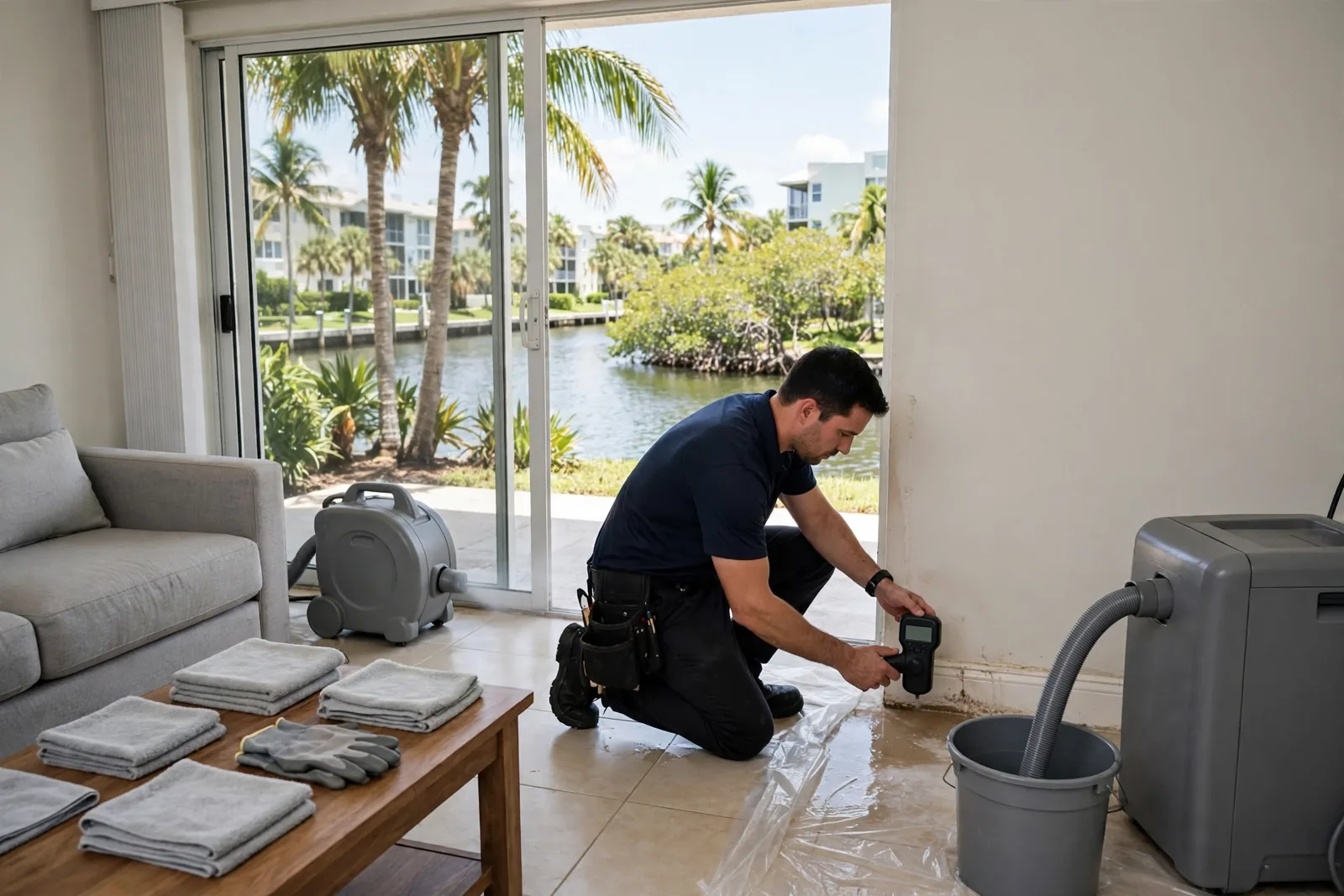
Water damage in Tamarac right now? Call (214) 286-6943 — 24/7 dispatch from our Fort Lauderdale service area, with a written plan before we start.
Water Damage Restoration in Tamarac, FL — Local Help, Fort Lauderdale Based
Tamarac, in northwest Broward, was built largely from the 1960s through the 1980s as a city of planned residential communities — many of them condominium and 55+ oriented, like the long-established Mainlands sections and the Woodlands — threaded through with canals. Its water damage follows that blueprint closely. When hundreds of units share a building era, they share a plumbing lifespan, and Tamarac’s stacks, water heaters, AC systems and unit supply lines are performing that arithmetic now, community by community.
For owners here, the practical stakes are specific: many residents are seasonal, many units sit closed for weeks, and a condensate overflow or a weeping supply line in a closed unit does not send anyone a warning — the neighbour below or the returning owner discovers it. Our Tamarac work leans into that reality: source detection across units, documentation built for associations and insurers, and prevention advice that respects how this city’s homes are actually lived in.
We are Water Damage Restoration of Fort Lauderdale: IICRC-informed technicians, licensed & insured, a service-area business with no walk-in office — we come to you. Same discipline on every job: find the source, map the moisture, dry to a measured target, document everything for your insurer.
Water Damage Restoration in Tamarac at a Glance
- Based: Fort Lauderdale service area — Tamarac is in northwest Broward, west of Fort Lauderdale — comfortably inside our service area
- Available: 24 hours a day, 7 days a week, including holidays
- Clock: Mold risk begins within 24–48 hours in South Florida humidity — same-day mitigation matters
- Local watch-out: One of Broward’s most condo-heavy, 55+ oriented cities: 1960s–80s communities where shared, same-age plumbing is the story
- Standards & paperwork: IICRC-informed work per IICRC S500; photo documentation + moisture logs for your claim from day one
What Water Damage Services Do We Provide in Tamarac?
The full restoration service, not just the first hour of it:
- Mitigation, extraction & structural drying — stop the spread, remove standing water, dry to measured targets
- Flood damage cleanup & sewage cleanup — contaminated Category 3 water removed and the area sanitised
- Mold remediation & mold inspection — when damage sat too long, or before you buy or sell
- Leak detection & moisture mapping — find the true source and the full extent before anyone opens a wall
- Repair & reconstruction — rooms put back together after drying is verified
How Fast Can You Get to Tamarac?
Tamarac is west of Fort Lauderdale in northwest Broward — a straightforward dispatch from our Fort Lauderdale service area. Community gate and building-access procedures are the usual variable, so tell us the community when you call. We do not publish guaranteed arrival times. Call (214) 286-6943 at any hour and we confirm coverage, access and a realistic dispatch estimate on the call.
What Causes Most Water Damage in Tamarac?
Tamarac’s recurring causes:
- Same-age condo plumbing — stacks, risers, heaters and unit lines from one building era failing in clusters across whole communities
- Closed-unit leaks — seasonal and travelling owners whose condensate lines, supply hoses or heaters fail in an empty unit and run until a neighbour or a return flight reveals them
- AC condensate overflows — the dominant condo ceiling-leak cause in South Florida, year after year, especially in units where the AC runs while nobody is home
- Canal-adjacent ground floors — Tamarac’s canal network keeps nearby ground low; wet-season saturation tests ground-floor slabs and thresholds
- Original-era bathrooms and kitchens — wax rings, angle stops, flexible supply hoses and fixtures at end of life across a large share of the housing stock
Why Does Tamarac’s Communities Age Together — Plumbing Included?
Tamarac was master-planned in sections, and each section is a cohort: built within a few years, plumbed with the same materials, maintained on similar cycles. That is efficient for a city and consequential for water damage, because pipe, hose and heater lifespans do not spread out politely — they cluster. A community that has had two stack failures this year should expect the question for every stack, which is why we tell Tamarac owners the truth we would want: when one original line in your unit fails, have the others looked at while the walls are open anyway.
The canals are the quiet second actor. They give Tamarac its look — water behind a large share of homes — and they hold the wet-season water table close to ground-floor level in the lower sections. After heavy rain spells, drainage slows across northwest Broward, yards pond, and ground-floor condos can take moisture at the slab edge even with perfect plumbing. Separating that ground story from a plumbing story, with meter readings an association can be shown, is standard practice for us here.
Not sure how far the water has travelled? In Tamarac the visible stain is rarely the whole job. Call (214) 286-6943 for a phone assessment first — we will tell you honestly whether you need a crew today or a plumber first.
How Much Does Water Damage Restoration Cost in Tamarac?
There is no honest flat price for water damage, because category and extent decide everything. The guide published on this site: mitigation about $3–$4.25/sq ft (Category 1), $4–$6.50/sq ft (Category 2), $7–$12/sq ft (Category 3 — sewage and floodwater), and reconstruction typically $20–$37/sq ft. A contained clean-water leak caught the same day sits at the low end; outside floodwater or a leak that ran for weeks does not.
Does Insurance Cover Water Damage in Tamarac?
It depends on the cause, and in Florida that distinction matters. Sudden internal failures — burst pipes, a water heater letting go — are typically covered. Slow, gradual leaks are frequently excluded, and rising floodwater from outside generally requires separate flood insurance, often through the NFIP.
What Does the Restoration Process Look Like?
- Phone assessment — what happened, when, and where, so the right crew is dispatched.
- On-site inspection — source and full extent checked in person.
- Category & Class ID — contamination level and drying difficulty, per IICRC S500.
- Extraction — standing water and unsalvageable materials out first.
- Structural drying — equipment set to specific moisture targets, monitored daily.
- Cleaning & treatment — antimicrobial treatment and odour control where needed.
- Documentation — photos and moisture logs formatted for your adjuster.
- Final walkthrough — dryness confirmed by readings, not by touch.
What Do Jobs in Tamarac Actually Look Like? Representative Scenarios
These are representative scenarios of how typical jobs of each type unfold in Tamarac — not a specific past client’s file, and not testimonials.
Scenario 1 — Returning seasonal owners, condensate disaster. A couple returns to a musty unit and a sagging ceiling patch: a condensate overflow ran in the closed unit for weeks. By then it is remediation plus drying — and a prevention setup before the next trip: condensate serviced, water shut off, a neighbour holding a key and our number.
Scenario 2 — Stack leak through two condo units. A drain stack failure wets the units it serves, one more visibly than the other. Both mapped, dried and documented as separate files; the source evidence supports the association’s role without either owner depending on the other’s claim.
Scenario 3 — Canal-side ground-floor condo, storm-spell moisture. Rear wall bases test wet after days of rain; mapping shows a ground band, no internal source. Monitoring, drying support and drainage notes for the association — not unit demolition.
Frequently Asked Questions
We are seasonal owners. How do we protect our Tamarac unit?
Three habits: shut the water off at the unit main when you leave, have the AC and condensate drain serviced before each season (the AC keeps running in your absence), and leave a key and our number — (214) 286-6943 — with someone local who will walk in after major storms.
A unit in our building had a pipe failure. Should I worry about mine?
If your unit shares the building era and original plumbing — which most Tamarac units do — it is worth a preventive look at heaters, hoses and visible lines. Failures cluster in same-age communities; that is a pattern, not a scare tactic.
Who pays when a shared stack fails — owner or association?
It turns on the association’s documents: common-element lines are usually the association’s side, unit lines the owner’s. Our job is the evidence — source located and documented from day one — because that is what the payment question gets decided with.
How quickly does an empty, air-conditioned unit grow mold after a leak?
Mold can begin within 24–48 hours of wetting in South Florida conditions. A closed unit does not pause that clock — which is why discovery time, not leak size, is usually what makes seasonal-unit jobs big.
Can you coordinate with our condo association?
Yes. Association notification, access rules and shared-element questions are routine in Tamarac. Tell us the community’s procedures on the first call and we work inside them.
Water in your Tamarac home or business? Call (214) 286-6943 now — 24/7, a written plan before we start, and documentation your adjuster can use.
Related services and guides
- Services
- Water Mitigation in Fort Lauderdale
- Flood Damage Cleanup in Fort Lauderdale
- Residential Water Damage Restoration in Fort Lauderdale
- Water Damage Restoration Cost in Fort Lauderdale
- Homeowners Insurance Water Damage in Florida
- Water Damage Restoration Service Area — Broward County
- Water Damage Restoration in Lauderhill, FL
- Water Damage Restoration in Margate, FL
- Water Damage Restoration in North Lauderdale, FL