
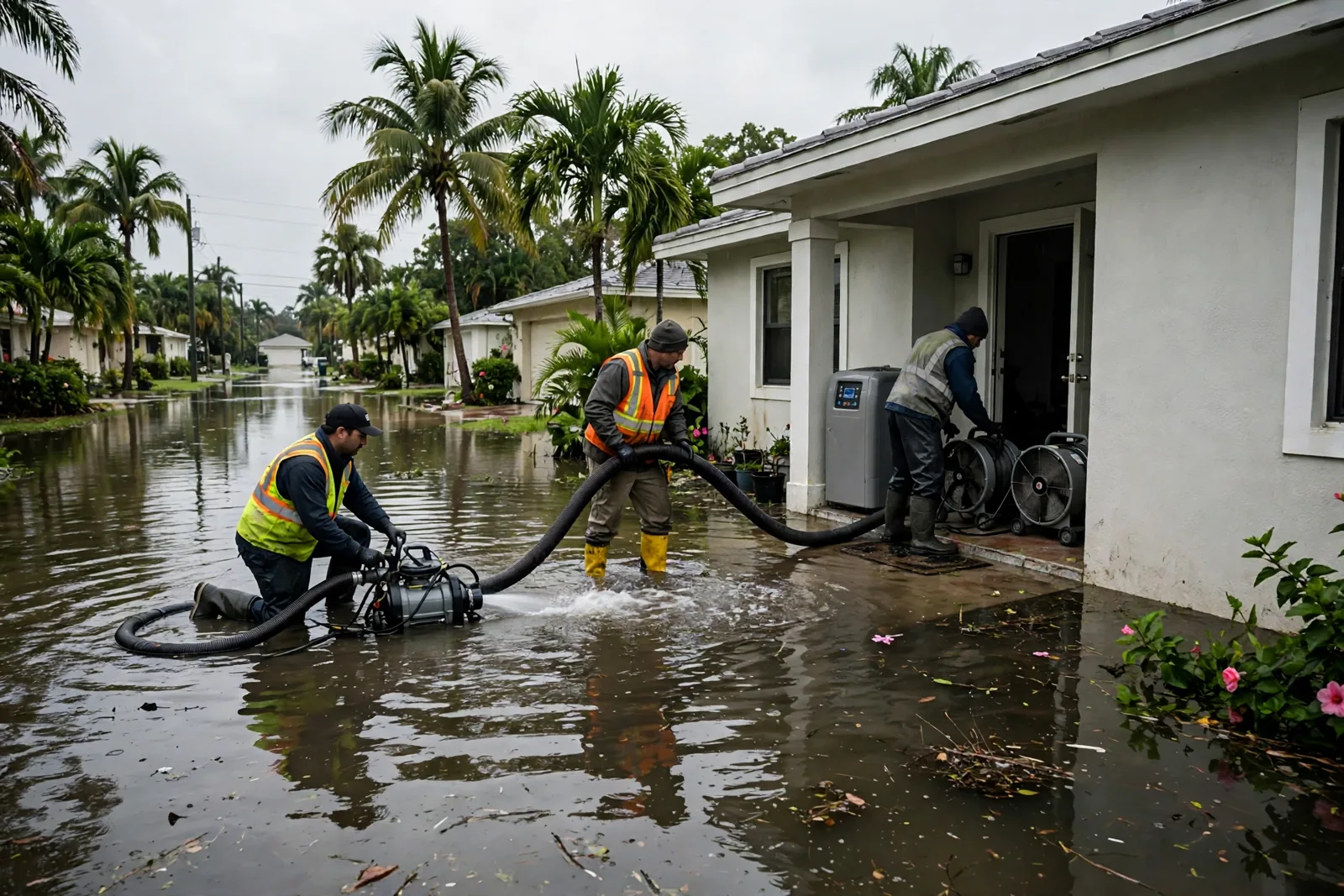
Floodwater has been inside an Edgewood, River Oaks or Melrose Park home — yours, right now? Call (214) 286-6943. 24/7 flood response from our Fort Lauderdale service area.
Flood-Prone Neighbourhoods in Fort Lauderdale — Edgewood, River Oaks & Melrose Park
If Fort Lauderdale has a front line for residential flooding, it runs through these three neighbourhoods. Edgewood, River Oaks and Melrose Park sit on some of the lowest ground in the city, in the same western and south-western districts that took some of the worst interior flooding when the storm of April 12–13, 2023 dropped more than two feet of rain on Fort Lauderdale in under 24 hours — the rainiest day in the city’s recorded history, with interior flooding in some homes here exceeding 18 inches. That storm was extreme, but for these neighbourhoods it was not a different kind of event. It was the normal pattern — low ground, slow drainage, ground-floor homes — with the volume turned all the way up.
This guide is for the people who live with that pattern: what actually happens to a house here when the rain wins, what proper flood cleanup looks like (and what it must never look like), what insurance honestly does with it, and how to be ready before hurricane season — June 1 to November 30 — rather than educated during it.
We are Water Damage Restoration of Fort Lauderdale: IICRC-informed, licensed & insured, a service-area business based in this city. No invented response times, no invented claims history — just the process below, applied the same way on your street as everywhere we work.
Flooding in Edgewood, River Oaks & Melrose Park at a Glance
- Why here: Some of the city’s lowest elevation, ground-floor housing stock, drainage that slows to a standstill in extreme rain
- Benchmark event: April 12–13, 2023 — 2+ feet of rain in under 24 hours; interior flooding over 18 inches in places here
- Water type: Street and storm flooding = Category 3 (contaminated) — porous materials are removed, not dried and kept
- Clock: Mold risk begins in 24–48 hours; the cleanup decisions that matter most happen on day one
- Insurance reality: Rising outside water generally needs separate flood insurance (often NFIP) — a standard homeowners policy usually excludes it
- First move: Photograph everything before anything is moved — water lines, every room, appliance serial plates
What Services Do Homes in These Neighbourhoods Actually Need?
The full flood sequence, in the order it matters:
- Flood damage cleanup — Category 3 extraction, removal, sanitising and drying
- Water mitigation & extraction — the emergency phase that stops damage spreading
- Structural drying — measured drying after contaminated materials are out
- Mold remediation — when entry was deep or the start was delayed
- Storm & hurricane water damage — the wider storm-loss service these floods arrive with
- Repair & reconstruction — putting floors, walls and rooms back after verified drying
Why Do Edgewood, River Oaks and Melrose Park Flood First?
Because the geography leaves them last in line for drainage:
- Elevation: Fort Lauderdale averages about 9 feet above sea level — and these districts sit at the lower end of the city’s range. In a flat city, a foot or two of elevation is the entire difference between a wet street and a wet living room.
- Ground-floor housing: Much of the stock here is single-storey homes at or near grade, including older homes and converted spaces whose floor level sits only inches above the yard. Thresholds are the flood line.
- Drainage limits: Local streets and swales feed a stormwater system that was not designed for two feet of rain in a day. When the whole region is saturated, water arriving in these neighbourhoods has effectively nowhere to go until levels fall.
- Saturation stacking: Wet-season rain for weeks beforehand leaves the ground full. The storm that floods a home here is often not the biggest one of the season — it is the one that lands on ground with no capacity left.
What Should You Do in the First 24 Hours After Flooding Here?
- Safety first: Treat all floodwater as contaminated. Keep clear of standing water if power may be live; boots and gloves for any contact; children and pets out of affected rooms.
- Photograph and video everything before moving or removing anything — wall water lines, every room, damaged contents in place. This is the backbone of your flood claim.
- Do not throw damaged items away before they are documented, however ruined they look.
- Stop further entry only if you safely can — never at the cost of wading through contaminated water.
- Call a flood cleanup team the same day — (214) 286-6943. Extraction, removal decisions and drying all belong inside the 24–48 hour mold window.
- Notify your flood insurer early and keep every receipt from day one.
How Does Flood Cleanup Work in a Ground-Floor Home, Step by Step?
- Phone assessment — depth, spread, and whether water is still rising; safety guidance first.
- On-site inspection — category confirmation and moisture mapping up walls and under floors.
- Extraction — standing floodwater out with professional equipment.
- Removal — flood-soaked porous materials (carpet, padding, affected drywall and insulation) removed, not dried.
- Cleaning & treatment — exposed structure cleaned, sanitised and treated.
- Structural drying — equipment run to specific moisture targets, monitored and logged.
- Documentation — photos and moisture logs formatted for a flood adjuster.
- Final walkthrough — dryness confirmed by readings.
Inches at the door or a foot across the floor — the first day’s decisions decide the claim and the cost. Call (214) 286-6943 for a written flood cleanup plan before we start.
How Much Does Flood Cleanup Cost in These Neighbourhoods?
Category 3 mitigation runs about $7–$12/sq ft for mitigation alone on this site’s published guide, with reconstruction typically $20–$37/sq ft after removal. Depth is the multiplier here: a 2-inch entry that stops at the thresholds is a fundamentally smaller job than the 18-inch entries parts of these neighbourhoods saw in April 2023. Written scope, real numbers, before full work starts.
Does Insurance Cover Flooding in Edgewood, River Oaks and Melrose Park?
Usually not under a standard homeowners policy — rising outside water is generally excluded and normally claimed under separate flood insurance, often through the NFIP. April 2023 made the point citywide: homes flooded from rainfall alone, including addresses nobody had labelled high-risk. If you own in these three neighbourhoods, treat flood cover as a core part of the household budget conversation, not an optional extra — and keep the documentation habit regardless: dated photos and moisture logs are what any adjuster, flood or otherwise, works from. We produce both and can speak directly with your adjuster.
What Do Flood Jobs Here Look Like? Representative Scenarios
These are representative scenarios of how typical jobs of each type unfold in these neighbourhoods — not a specific past client’s file, and not testimonials.
Scenario 1 — Extreme-rain entry, single-storey home. Several inches of stormwater cross a ground floor during a short-burst deluge, the April 2023 pattern. Carpet, padding and lower drywall come out; slab and framing are cleaned, treated and dried to readings; the claim is documented as the flood loss it is.
Scenario 2 — Repeat shallow entries, drainage-limited street. A home that takes an inch or two in the worst storms, more than once. The work is as much prevention as cleanup: threshold and door detailing assessed, a drying and documentation routine the owners can start in the first hour, and an honest map of what in the home should never again sit directly on the floor.
Scenario 3 — Delayed discovery, returning owners. A home sits closed through a storm spell and is found wet a week later. By then mold remediation is part of the job alongside flood cleanup — the standard local lesson: in these neighbourhoods, someone local should hold a key and our number, (214) 286-6943.
Frequently Asked Questions
Are these three neighbourhoods really Fort Lauderdale’s worst for flooding?
They are among the city’s lowest and were among the hardest hit in the April 2023 record storm, with some of the deepest interior flooding reported in the city. Other low pockets flood too — but if a Fort Lauderdale flood conversation starts anywhere, it starts here.
We flooded once. Does that mean it will happen again?
The geography that caused it has not changed, so the honest answer is: the risk remains, and heavy-rain years will test it again. Readiness — flood insurance, raised storage, a documented plan — is worth more here than optimism.
Can flood-soaked carpet and drywall be saved if we start fast?
Generally no. Floodwater is Category 3; porous materials it soaks are removed even with a fast start. Speed still matters enormously — it protects the structure behind those materials, your contents that can be sanitised, and the claim.
What should be stored off the floor in a ground-floor home here?
Documents, photographs, electronics, soft furnishings’ lower storage — anything porous, valuable or irreplaceable that currently lives in the first inches above the floor. In these neighbourhoods that habit is the cheapest flood insurance there is.
How fast can you reach Edgewood, River Oaks or Melrose Park?
These are home-city neighbourhoods for our Fort Lauderdale service area. We do not publish guaranteed times — during a citywide flood event, honesty matters more than slogans; call (214) 286-6943 and you will get the real dispatch picture on that call.
Living on Fort Lauderdale’s front line for flooding? Save the number now, not during the storm: (214) 286-6943 — 24/7, written plan before we start.