
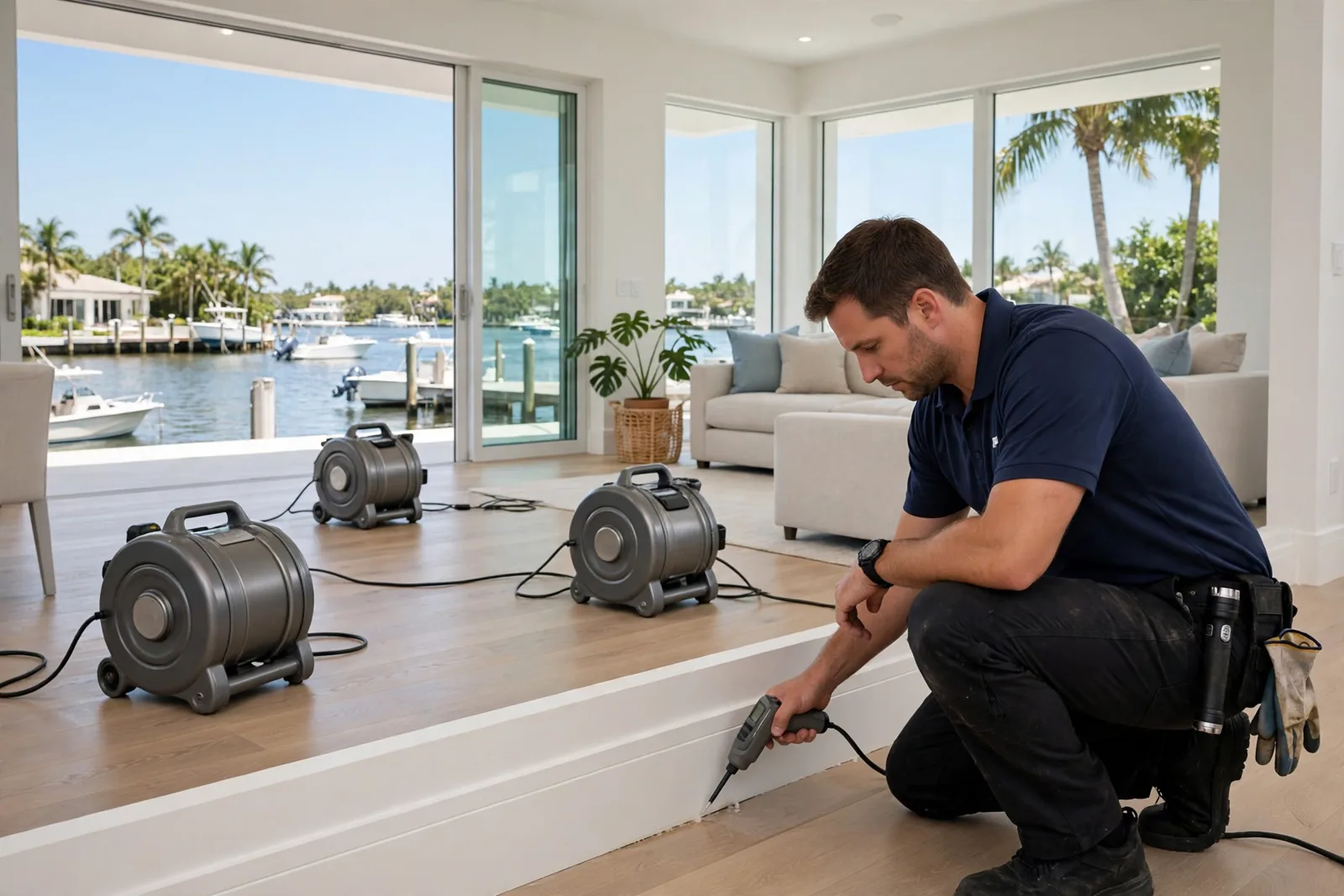
Water damage in Coral Ridge, Las Olas, Harbor Beach or a Galt Ocean Mile condo? Call (214) 286-6943 — 24/7, from single-family waterfront homes to high-rise stacks.
Water Damage in Coral Ridge, Las Olas, Harbor Beach & the Galt Ocean Mile — Waterfront Homes and Beach Towers
Fort Lauderdale’s east side holds two kinds of waterfront living, and this guide covers both. The first is the canal city: Coral Ridge in the north-east, built around canal fingers off the Intracoastal where mid-century ranch homes and their modern rebuilds sit with docks at the back door — and Las Olas, where the famous boulevard runs east from downtown to the beach and the Las Olas Isles finger canals line up some of the city’s most valuable homes. The second is the water’s edge itself: Harbor Beach, the gated barrier-island neighbourhood south of the Intracoastal’s inlet area, all deep-water lots and yachts — and the Galt Ocean Mile, the strip of high-rise condominium towers standing directly on the sand along A1A in the city’s north-east.
What unites them is exposure and value. These are homes where water can arrive as tide, surge, wind-driven rain or a neighbour’s failed line, and where the finishes at stake — wide-plank floors, custom kitchens, full-height glass — make sloppy restoration expensive in a way a standard job is not. What divides them is mechanics: a canal house fails from the ground and the dock side inward; a tower condo fails from the unit above downward. We scope, document and dry them as the different buildings they are, and we say the quiet part early: on the east side, the costliest sentence in water damage is “it was only a small leak,” said about a home with this much finish at stake.
The East Side at a Glance
- Two building worlds: Canal-front single-family homes (Coral Ridge, Las Olas Isles, Harbor Beach) and beachfront high-rise condos (Galt Ocean Mile)
- Outside risks: King tides, storm surge and wind-driven rain — water that needs no storm, or arrives with one, depending on the month
- Inside risks: Ageing canal-home plumbing under renovated finishes; tower stacks, risers and unit systems in the condos
- Stakes: High-value finishes — drying and salvage decisions made on readings, documented carefully for insurers
- Clock: 24–48 hours to mold growth in this humidity — waterfront air does not slow it down
- Documentation: Per-unit, per-room moisture logs — in towers and insured luxury homes alike, evidence quality decides arguments
What Services Do Waterfront Homes and Beach Condos Use Most?
- Condo & high-rise restoration — stacks, chases and unit-to-unit losses handled per unit
- Flood damage cleanup — tide and surge water is Category 3: remove, sanitise, dry
- Leak detection & moisture mapping — finding sources behind high-end finishes without exploratory demolition
- Water mitigation & structural drying — measured drying that gives premium flooring and cabinetry their best chance
- Storm & hurricane water damage — wind-driven rain intrusion through sliders, balconies and roof details
- Mold remediation — when a closed waterfront home or condo sat wet between visits
How Do Canal Homes and High-Rises Fail Differently?
| Question | Canal / waterfront home | Galt Ocean Mile high-rise condo |
|---|---|---|
| Usual outside water | Tide and surge at ground level, canal-side saturation | Wind-driven rain at height — sliders, balconies, window systems |
| Usual inside water | Own plumbing, often renewed above and original below | The unit above: heaters, AC, lines, bathrooms |
| Damage path | Horizontal — across ground-floor rooms and wall bases | Vertical — down stacks and chases, sometimes sideways a unit |
| Key evidence | Source gradient vs ground band, room by room | Per-unit mapping up the stack to the true source floor |
| Decision-makers | Owner + insurer | Owner + HOA + source unit’s insurer |
Why Does the Water Get In on the East Side?
- Tides before storms: King tides in the autumn push Intracoastal water up through drainage and over low seawall-side ground on sunny days — Las Olas Isles streets are among the places Fort Lauderdale residents associate with sunny-day flooding. Ground floors and garages near the canals feel ordinary tides’ bigger cousins first.
- Surge and wind together: In hurricanes and strong coastal storms, Harbor Beach and the Galt Ocean Mile take surge pressure at ground level and driven rain at every level simultaneously — two different intrusions with two different fixes, in one event.
- Canal saturation: Coral Ridge’s canal lots sit low beside managed water; in long wet spells the ground stays saturated against slabs and pool decks, and wall bases can test wet with no pipe involved.
- Salt air economics: Everything metal on the east side corrodes faster — fittings, tanks, AC components — so the internal failure clock runs faster than inland, including in carefully maintained homes.
What Does Restoration Look Like Here?
The company’s standard 8 steps — phone assessment, on-site inspection, Category & Class ID per IICRC S500, extraction, structural drying to monitored targets, cleaning and treatment, documentation for your adjuster, and a final walkthrough verified by readings — with east-side specifics. In canal homes, mapping always answers the ground-versus-plumbing question explicitly before drying is specified. In towers, we work to the building’s access rules, book freight elevators, and document each affected unit as its own file from the first visit, because a Galt Ocean Mile loss routinely involves three insurers before it involves a second contractor.
Waterfront finishes punish guesswork. If the stain is small, that is the best moment to map it — call (214) 286-6943 before a “small leak” prices itself like a renovation.
How Much Does Restoration Cost in These Neighbourhoods?
The site’s published guide applies everywhere: mitigation about $3–$4.25/sq ft (Category 1), $4–$6.50/sq ft (Category 2), $7–$12/sq ft (Category 3), reconstruction typically $20–$37/sq ft. What changes on the east side is the value density inside each square foot — custom flooring, cabinetry and glass cost more to protect, to work around and, when they cannot be saved, to replace — which is precisely why salvage-first drying, decided on readings, matters more here than anywhere else we work. Written scope with real numbers before work starts; no surprises built into the paperwork.
Does Insurance Work Differently for Waterfront and Tower Properties?
The rules are Florida’s usual ones — sudden internal failures typically covered, gradual damage disputed, rising tide/surge water generally a separate flood policy (often NFIP) — with two local wrinkles. Waterfront homes often carry layered policies and higher documentation expectations, so the quality of day-one evidence carries unusual weight. And in the Galt Ocean Mile towers, three policies can touch one loss: yours, the association’s master policy, and the source unit’s. We document to the standard all three can use, and we will tell you upfront — before anyone’s adjuster does — if part of a loss looks likely to be disputed.
What Do East-Side Jobs Look Like? Representative Scenarios
These are representative scenarios of how typical jobs of each type unfold here — not a specific past client’s file, and not testimonials.
Scenario 1 — Las Olas Isles home, king-tide ground-floor entry. Tide water crosses a garage and ground-floor threshold on a rainless day. Category 3 handling for the entry zone, materials assessed honestly for salt contamination, structure dried to readings, claim documented as the flood-route event it was — plus a threshold and storage conversation that prevents the sequel from reaching the same rooms.
Scenario 2 — Galt Ocean Mile tower, source three floors up. A ceiling stain in a beachfront condo traces, by meter readings up the chase, to a water heater failure three floors above, with the unit in between also affected. Three units, three files, one source story — and drying scheduled around the building’s elevator and access rules.
Scenario 3 — Coral Ridge canal home, renovated above, original below. A showpiece kitchen renovation sits over 1960s supply lines; a line weeps into a wall cavity until the baseboard swells. Surgical opening guided by the moisture map, the renovation’s finishes protected and largely preserved, and a plain recommendation about the remaining original lines, given while the evidence was on the table.
Frequently Asked Questions
Can high-end flooring and cabinetry be saved after water damage?
Frequently, yes — when water was clean and drying starts fast, measured drying saves finishes that demolition-first approaches would have written off. Category (contaminated) water or long durations change the verdict. Our job is to give you the reading-based answer, material by material, not a blanket promise either way.
Tide water came into our ground floor but it looks minor. Is it a real job?
Yes, treat it as one. Tide and surge water is Category 3 and salt-laden: what it soaked needs the remove-clean-dry sequence, and the claim route is flood insurance. “Minor” tide entries left to air-dry are how waterfront homes grow hidden mold in wall bases.
Our condo is on the Galt Ocean Mile and the leak is from above. What do we do first?
Notify building management (source access and possible shut-off), photograph your damage with dates, inform your insurer, and call us at (214) 286-6943. We map upward to evidence the source unit — that evidence is what engages the other policies.
Do you handle the HOA and building rules in the towers?
Yes — access hours, freight elevators, insurance certificates for building management and per-unit documentation are routine parts of tower work for us. Tell us the building on the first call and we plan inside its rules.
Is flood insurance worth it in Coral Ridge or Harbor Beach if we have never flooded?
That is a decision for you and your insurer, but the factual context is this: tide and surge exposure here is structural, not historical, and April 2023 showed rainfall alone flooding Fort Lauderdale homes outside the classic labels. Rising-water cover exists precisely for the event your history has not had yet.
Waterfront home or beach tower, the first day is the cheap day. Call (214) 286-6943 — 24/7, written plan before we start, evidence your insurer can use.