
Water damage in Victoria Park, Rio Vista, Tarpon River or Sailboat Bend? Call (214) 286-6943 — 24/7, with inspections that respect older and historic homes.
Water Damage in Victoria Park, Rio Vista, Tarpon River & Sailboat Bend — Older Homes, River Water, Hidden Leaks
These four neighbourhoods wrap around downtown Fort Lauderdale and the New River, and together they hold much of the city’s oldest and most characterful housing: Victoria Park’s mature, tree-lined streets of homes from the 1920s onward; Rio Vista’s canal-front streets south of the New River, where many homes back onto finger canals with docks; Tarpon River, the smaller, fast-changing neighbourhood just south of the river; and Sailboat Bend, on the river’s north fork west of downtown, one of the city’s oldest districts, with a designated historic area and homes that are genuine pieces of early Fort Lauderdale.
The water problems here are a distinct blend. From the outside: river and canal proximity, low spots that drain slowly, and storm rain pressing at older thresholds. From the inside — and this is the bigger share — time: original and ageing plumbing, cast-iron drains, layered renovations over old systems, and roof and window details that have weathered decades of South Florida summers. In these neighbourhoods the leak you find has usually been running longer than the stain suggests, inside materials that deserve a careful hand. Our inspections here are deliberately slower at the front end and more surgical throughout: map everything, open as little as the readings justify, and protect original features wherever drying — not demolition — is the honest answer.
These Four Neighbourhoods at a Glance
- Character: Historic and early-to-mid-century homes, mature canopy, river and canal frontage — Victoria Park, Rio Vista, Tarpon River, Sailboat Bend
- Dominant risk: Hidden internal leaks in ageing systems (cast iron, original supply lines), ahead of outright flooding
- Outside risk: Low river-adjacent ground, canal-side saturation, storm-driven rain through older details
- Special care: Original materials and features assessed for drying first — demolition is the last resort, justified by readings
- Clock: The same 24–48 hour mold window as everywhere in South Florida — old plaster and wood do not grant extensions
- Proof: Moisture mapping across whole wall systems, not just the stained one, plus photo documentation for insurers
What Services Do These Neighbourhoods Use Most?
- Leak detection & moisture mapping — the essential first step in older homes
- Water mitigation & structural drying — drying original materials to measured targets where readings allow
- Pipe leak & cast iron water damage — the era plumbing specialities
- Mold remediation — for the leaks discovered after months, which is most of the late ones
- Flood damage cleanup — for the river- and canal-side ground floors when outside water does arrive
- Repair & reconstruction — restoration that respects the character of the home
Why Do Older Homes Here Hide Leaks So Well?
Four local reasons stack up:
- Layered construction: Decades of renovations mean pipes, wiring and past repairs run behind newer surfaces. A leak can wet an original wall cavity while the renovated face of the wall shows nothing for weeks.
- Cast iron and era materials: Drain lines corrode from inside over many decades, weeping slowly into floors and wall bases — slow enough to avoid drama, fast enough to rot and feed mold.
- Mature trees and shifting ground: The canopy that defines Victoria Park comes with root systems and a century of soil movement around shallow, older pipe runs and slabs.
- River-side ground: Rio Vista’s canal fingers and the low ground along the New River forks keep foundations and ground floors in contact with high wet-season water tables, which can mimic a leak at the wall base and confuse diagnosis without meters.
What Does an Inspection Look Like in a Historic or Older Home?
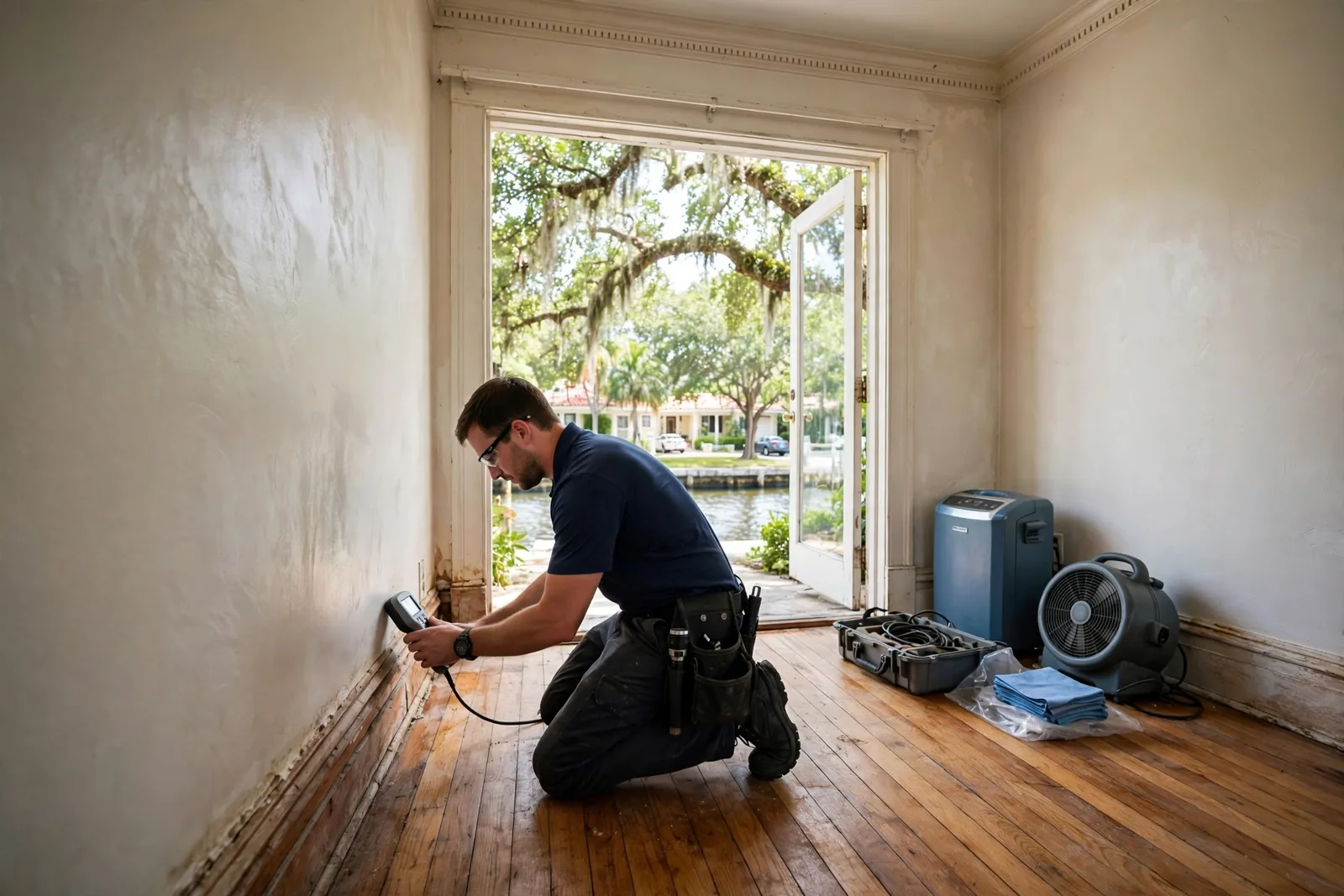
The same 8 steps we use everywhere — phone assessment, on-site inspection, Category & Class ID per IICRC S500, extraction, structural drying, cleaning and treatment, documentation, and a final walkthrough confirmed by readings — with two neighbourhood-specific adjustments. First, the inspection sweep is wider: in a 1930s–60s home we meter the whole wall system around a symptom and the rooms below and beside it, because the water’s map in an old house rarely matches the stain’s map. Second, removal decisions are evidence-threshold decisions: a material comes out when readings, category or duration say it cannot be dried safely — not as a default. Original wood flooring, plaster and trim get a genuine chance, and an honest verdict.
A stain, a smell, a soft patch of floor in an older home? Do not let anyone start by tearing out. Call (214) 286-6943 — mapping first, decisions second.
How Much Does Restoration Cost in These Neighbourhoods?
On the pricing published across this site: mitigation about $3–$4.25/sq ft (Category 1), $4–$6.50/sq ft (Category 2), $7–$12/sq ft (Category 3), and reconstruction typically $20–$37/sq ft. Older homes skew jobs in two directions at once: careful, surgical drying can cost more per day than standard work, while successfully saving original materials can remove large reconstruction items entirely. Late discovery is still the biggest multiplier — a cast-iron weep found at the smell stage is one job; found at the soft-floor stage, it is a bigger one. Written scope before work starts, either way.
Does Insurance Treat Older-Home Water Damage Differently?
The policy language is the same — sudden failures typically covered, gradual damage frequently disputed, rising outside water generally a flood-policy matter — but older homes land in the disputed zone more often, because their signature failure is the slow one. That makes documentation strategy different here: dating evidence matters. Dated photographs, a moisture map showing gradients (gradual losses look different from sudden ones, and honest mapping shows whichever truth is there), and prompt action once damage is discovered are the strongest position an owner can take. We will tell you plainly, on day one, which way your loss is likely to be read.
What Do Jobs in These Neighbourhoods Look Like? Representative Scenarios
These are representative scenarios of how typical jobs of each type unfold here — not a specific past client’s file, and not testimonials.
Scenario 1 — Victoria Park, cast-iron weep behind a renovated bathroom. The renovation was beautiful; the drain line behind it was original. A faint smell leads to mapping that finds a wet cavity and floor edge. Selective opening behind the bathroom only, contaminated material out, the rest of the renovation preserved — because the map, not a sledgehammer, chose the opening.
Scenario 2 — Rio Vista canal home, ground moisture plus a real leak. Rear wall bases test wet after a wet spell; readings separate into two stories — a low even ground band along the canal side, and a sharp gradient from a supply line at the kitchen. The line is repaired and dried as a plumbing loss; the ground band is monitored, not demolished.
Scenario 3 — Sailboat Bend historic home, roof-detail leak in storm season. Wind-driven rain enters at an old flashing detail and wets a ceiling and wall over two storms before the stain declares itself. Drying targeted to the affected assembly, original plaster assessed and saved on readings, and the flashing repair flagged as the true fix — drying alone would only have scheduled the sequel.
Frequently Asked Questions
Can original wood floors and plaster actually be saved after a leak?
Often, yes — when the water was clean, the duration was short and drying starts promptly, original materials respond well to measured drying. When water was contaminated or the leak ran for months, some materials cannot honestly be kept. Readings and category decide, and we show you both.
Why do you meter rooms that look completely dry?
Because in older, layered construction the stain is a late symptom, not a map. Water travels along cavities, joists and old pipe runs; the room that looks fine is regularly the room that is wet inside the wall. Skipping it is how “finished” jobs grow mold a month later.
Is a wet wall base near the river a leak or groundwater?
Either is possible here, and they look deceptively similar. A mapping visit separates them by pattern — a source gradient versus an even ground band — and the answer decides both the fix and the insurance route.
Do you work carefully in designated historic homes?
Yes — Sailboat Bend and the older stock across these neighbourhoods get the surgical approach described above: widest mapping, narrowest justified opening, drying-first wherever the evidence honestly allows it.
How fast can you get to these neighbourhoods?
They are central Fort Lauderdale, our home service area. Call (214) 286-6943 any hour — we confirm coverage and give a realistic dispatch time on the call rather than publishing guarantees.
Older homes reward careful work and punish rushed work. Call (214) 286-6943 — mapping first, honest verdicts, drying confirmed by readings.